
Overcoming the Karst: Inside the Engineering of the Record-Breaking Huajang Grand Canyon Bridge
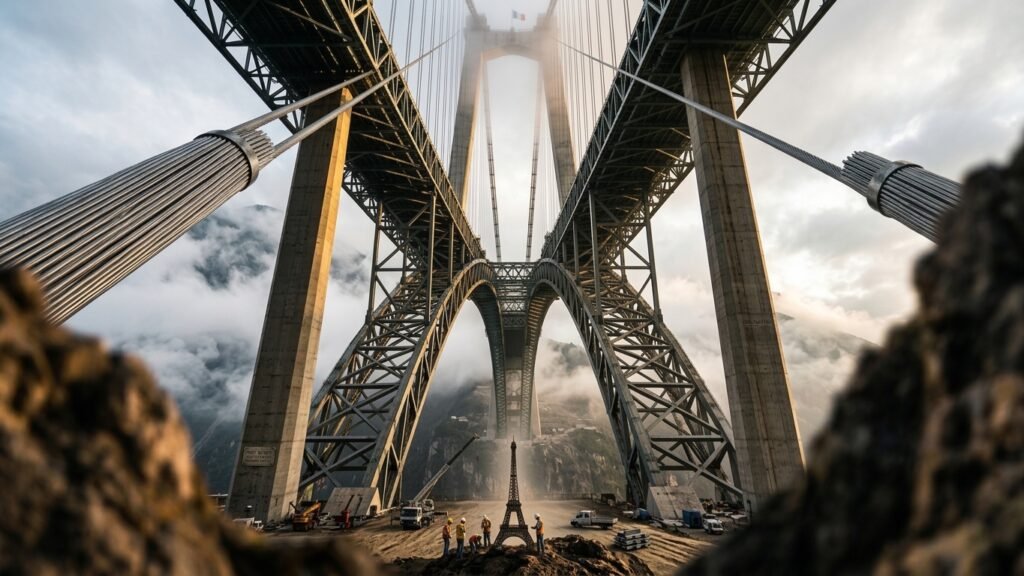
Spanning a canyon so deep it could swallow the Eiffel Tower whole, suspended over a river far below, the Huajang Grand Canyon Bridge in Guizhou, China, stands as one of the most ambitious engineering feats of the 21st century.
Located in one of North America’s and Asia’s most challenging topographies, this mega-project is not merely a bridge—it is a global milestone in modern civil engineering. Designed to conquer extreme karst geology, unpredictable mountain winds, and severe logistical constraints, the structure sets new standards for structural design, digital construction, and regional development.
Regional Significance: Unlocking Guizhou’s Economic Potential
Guizhou Province in southwest China is characterized by steep, jagged karst rock formations. While visually stunning, these vertical limestone landscapes have historically served as a barrier to economic growth, isolating communities and hindering regional commerce.
                  THE GEOGRAPHIC BARRIER
  [ Urban Centers / Ports ]  <=== (Impassable Karst Terrain) ===>  [ Inland Rural Communities ]

                  THE HUAJIANG BRIDGE SOLUTION
  [ Urban Centers / Ports ]  <===================================>  [ Inland Rural Communities ]
                                 Liuji-Anlong Expressway
Strategic Infrastructure Alignment
The Arterial Link: The Huajang Grand Canyon Bridge serves as a core segment of the 124-kilometer Liuji-Anlong Expressway.
Travel Time Reduction: The highway cuts travel time across the steep Huajang Canyon from hours of navigating hazardous mountain roads down to mere minutes.
Economic Integration: The corridor connects rural agricultural zones directly to major industrial, logistical, and urban distribution hubs, unlocking long-term economic mobility for the province.
Architectural & Structural Specs: A Record-Breaking Giant
Upon its opening, the Huajang Grand Canyon Bridge claims the title of the world’s highest bridge, surpassing existing structural icons such as the nearby Beipanjiang Bridge and France’s Millau Viaduct.
| Structural Attribute | Engineering Specification | Global Context / Comparison |
| Vertical Height (Deck to River) | ~625 meters (~2,050 feet) | Taller than One World Trade Center; double the height of the Eiffel Tower. |
| Main Span Length | 1,420 meters (~4,659 feet) | One of the longest suspension spans built in high-altitude mountain terrain. |
| Structural Design | Steel Truss Suspension | Optimized for extreme compression, wind resistance, and seismic damping. |
| Design Service Life | 100+ Years | Incorporates fatigue-resistant, weather-adaptive steel and specialized concrete. |
| Total Project Investment | ~1.56 Billion RMB (~$240 Million USD) | Cost-optimized via prefabrication, modular execution, and specialized equipment. |
Technical and Material Innovations
Building at an elevation of 625 meters above a canyon floor requires specialized materials engineered to resist atmospheric stress, thermal shifts, and seismic forces.
                    MATERIAL FABRICATION & ASSEMBLY
┌──────────────────────────┐    ┌──────────────────────────┐    ┌──────────────────────────┐
│  Off-Site Prefabrication │ ──>│ High-Precision Logistics │ ──>│  Robotic Field Assembly  │
│  - Ultra-High Steel      │    │  - Drone-assisted cable  │    │  - Automated welding     │
│  - Anti-Corrosive Concrete│   │    transport systems     │    │  - AI-guided placement   │
└──────────────────────────┘    └──────────────────────────┘    └──────────────────────────┘
Advanced Materials
Ultra-High-Performance Steel: The steel trusses utilize a fatigue-resistant, weather-adaptive alloy formulated to withstand continuous micro-stresses and temperature-induced expansion and contraction.
Corrosion-Resistant Concrete: The main pylons rely on custom-mixed concrete formulations that resist moisture absorption, chemical erosion, and thermal cracking in high-humidity mountain environments.
Deep Anchoring Systems: Structural bases are driven deep into the limestone cliff faces, stabilized using micro-piles and reinforced soil structures to prevent shifting during seismic events.
Engineering Challenges: Wind, Alignment, and Extreme Terrain
Constructing a mega-structure hanging hundreds of meters in the air presents severe physical and environmental complications.
       CANYON WIND DYNAMICS                 SEISMIC & BASE STABILITY
┌─────────────────────────────────┐  ┌─────────────────────────────────┐
│ High-velocity crosswinds generate│  │ Karst limestone contains secret │
│ vortex shedding. Steel trusses  │  │ caves and voids. Foundations use│
│ are aerodynamically perforated  │  │ micro-pile networks anchored    │
│ to self-stabilize under gusts.  │  │ deep into solid bedrock layers. │
└─────────────────────────────────┘  └─────────────────────────────────┘
1. High-Altitude Wind Dynamics
At 600+ meters above the canyon floor, crosswinds can reach extreme velocities. Engineers conducted extensive wind tunnel testing and digital fluid dynamics simulations, designing an aerodynamically open steel truss structure that allows wind to pass through harmlessly, preventing destructive resonance.
2. High-Precision Laser Alignment
Building suspension towers and cable stays from opposite sides of a vast canyon leaves zero room for error. Construction teams utilized real-time laser tracking, thermal compensation algorithms, and GPS positioning to lock structural segments into place with millimeter-level precision.
3. Site Accessibility
Because parts of the canyon are completely inaccessible by heavy machinery, temporary cable cranes, drone transport lines, and cliff-mounted staging platforms were deployed to transport materials and personnel safely.
Digital Construction: The Industry 4.0 Toolkit
The Huajang Grand Canyon Bridge highlights the role of automated and data-driven methods in modern civil engineering.
Digital Twin Technology: A real-time 3D digital model receives live data from sensors installed across the bridge deck and pylons, monitoring structural stress, wind loads, and temperature shifts.
Robotic Welding & Construction: Automated welding crawlers operate on suspended scaffolds, ensuring structural integrity while minimizing hazards for human workers.
LiDAR & Autonomous Inspection: Autonomous drones equipped with LiDAR scanners continuously map the physical build against BIM (Building Information Modeling) schematics to identify structural micro-variations immediately.
Environmental Preservation in Sensitive Karst Ecosystems
The Huajang Canyon is an ecologically sensitive zone with unique flora, fauna, and hydrological paths. The project incorporated explicit environmental controls during design and construction:
Minimized Ground Disturbance: By choosing a high-clearance suspension design anchored directly into stable cliff walls, engineers avoided carving massive access roads through the canyon floor.
Runoff Containment Systems: Concrete washouts and construction runoff are captured and neutralized to prevent chemical contamination of the Huajang River.
Acoustic and Environmental Buffering: Temporary noise barriers were erected around heavy machinery to protect local bird populations and wildlife from disruption.
Frequently Asked Questions
1. How high is the Huajang Grand Canyon Bridge?
The bridge deck hangs approximately 625 meters (~2,050 feet) above the Huajang River, making it the highest bridge in the world.
2. What highway does the Huajang Bridge belong to?
It forms a central segment of the Liuji-Anlong Expressway in Guizhou Province, designed to improve transport efficiency across southwest China.
3. How do engineers prevent the bridge from swaying dangerously in high winds?
The bridge utilizes an aerodynamically tested steel truss design that allows wind to flow through the structure rather than pushing against solid walls. Hydraulic dampers and high-tension cable stays further absorb kinetic energy and stabilize the deck.
4. How long did it take to build the Huajang Grand Canyon Bridge?
Construction officially commenced in 2022, with final structural testing, inspection, and commercial traffic opening scheduled for 2026.
Key References & Structural Studies
Guizhou Provincial Department of Transportation: Official engineering logs, design schematics, and regional expressway planning data.
International Association for Bridge and Structural Engineering (IABSE): Technical papers regarding high-altitude karst bridge foundations and aerodynamic wind-tunnel testing protocols.