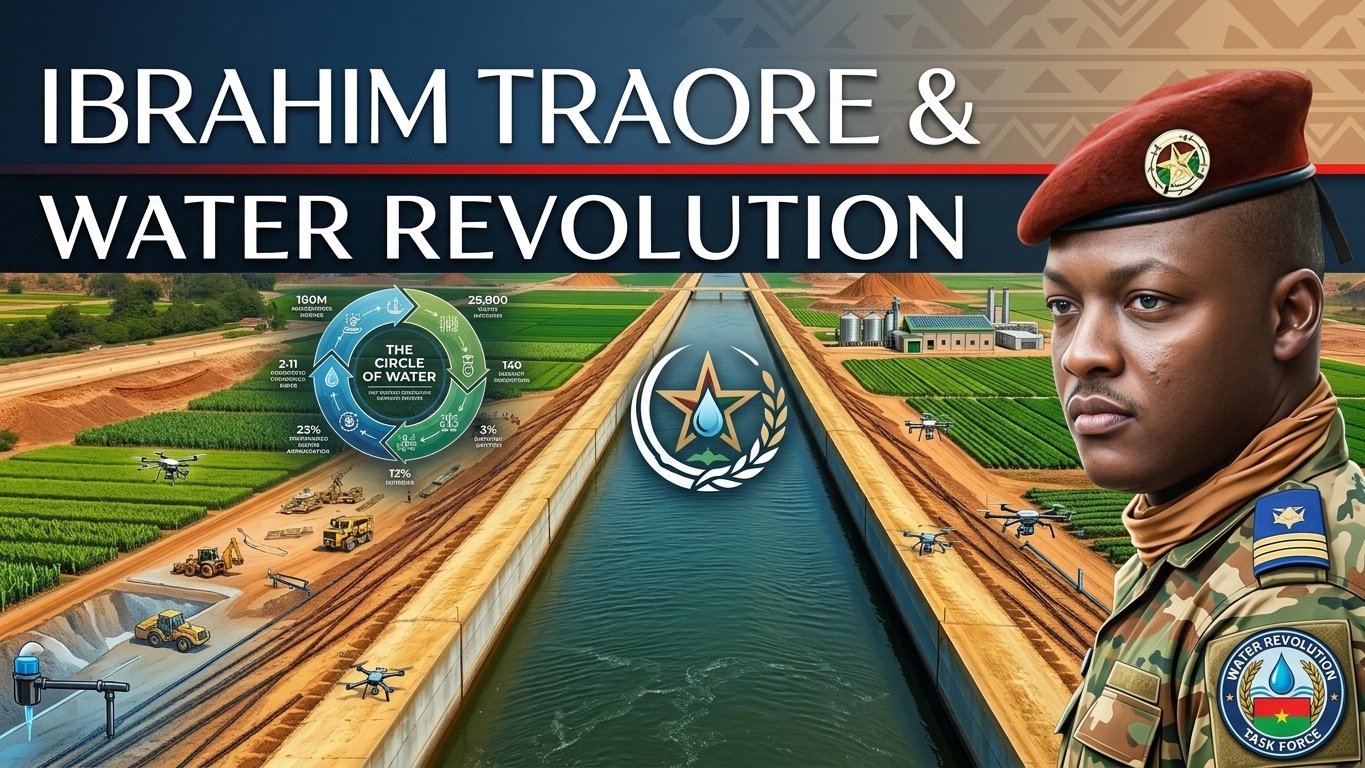
Tapping the Sahel: Inside Burkina Faso’s $145 Million Deep Aquifer & Water Sovereignty Strategy
The Sahel region of West Africa—a semi-arid zone stretching along the southern edge of the Sahara Desert—has long faced severe climate stress, erratic rainfall, and accelerating desertification. In landlocked Burkina Faso, where agriculture forms the backbone of the rural economy, water scarcity presents a direct threat to food security, public health, and long-term economic development.
Under the government of Captain Ibrahim Traoré, Burkina Faso has initiated an ambitious $145 million national water infrastructure project. By combining deep-well borehole drilling targeting ancient underground aquifers with dam rehabilitation and solar-powered irrigation, the initiative aims to establish national water sovereignty and agricultural self-sufficiency.
1. The Hydrogeological Strategy: Deep Boreholes and Ancient Aquifers
For decades, local communities relied primarily on shallow hand-dug wells (rarely exceeding 20 to 100 meters in depth) and seasonal rain reservoirs. These surface-level water sources are highly vulnerable to seasonal droughts and high evaporation rates.
+-----------------------------------------------------------------------+
|                    SAHEL SUBTERRANEAN HYDROLOGY                       |
+-----------------------------------------------------------------------+
|                                                                       |
|   [ Surface Level ]  ───> Seasonal Rainfall / Shallow Ponds           |
|  ===================================================================  |
|   [ 0m - 100m ]      ───> Shallow Aquifers (Prone to Drought)         |
|  -------------------------------------------------------------------  |
|   [ Impermeable Rock & Sedimentary Layers ]                           |
|  -------------------------------------------------------------------  |
|   [ 500m - 1,000m ]  ───> Ancient Deep Aquifers (Low Vulnerability)    |
|                           * Millions of m³ stored over millennia      |
|                           * Tapped using high-pressure drilling       |
|                                                                       |
+-----------------------------------------------------------------------+
Technical Blueprint
-
Drilling Depth Targets: Specialized drilling rigs penetrate 500 to 1,000 meters into deep sedimentary layers, bypassing depleted upper water tables.
-
Aquifer Mapping: Scientific validation relies in part on isotope hydrology assessments—pioneered in collaboration with international scientific bodies such as the IAEA—which confirmed large-volume, high-quality fossil water reserves across the Sahel.
-
Yield Potential: Deep aquifers remain shielded from surface climate variations, providing continuous water extraction capacity for human consumption and agricultural irrigation year-round.
2. Integrated Water Infrastructure & Component Breakdown
While deep drilling forms the primary extraction mechanism, the overall $145 million multi-year framework integrates surface water management, storage rehabilitation, and renewable energy pumping systems.
| Infrastructure Component | Scope and Target Specifications | Primary Functional Objective |
| Deep & Subterranean Wells | High-depth boreholes equipped with solar pumps | Long-term potable and irrigation water supply |
| Dam Rehabilitation | Repair & modernization of 35 strategic dams | Restoring surface reservoir capacity and flood management |
| Agricultural Irrigation | Restoration of ~788+ hectares of irrigated farmland | Enabling multi-season crop cycles (rice, sorghum, vegetables) |
| Land Restoration | Rehabilitation of ~5,000 hectares of degraded land | Mitigating soil erosion and combating desertification |
| Community Oversight | Establishment of ~80 local community water committees | Maintenance monitoring and decentralized water management |
3. Agricultural Impact and Economic Sovereignty
Transitioning from rain-fed agriculture to controlled irrigation fundamentally alters the economic output of rural communities.
[ Rain-Fed Agriculture ] ───> Vulnerable to Drought ───> Seasonal Yield Fluctuation
                                                                 │
                                                                 ▼
[ Deep Boreholes + Irrigation ] ───> Year-Round Farming ───> Yield Stability & Economic Growth
Economic Outcomes
-
Extended Growing Seasons: Farmers are able to cultivate crops throughout the dry season rather than relying solely on erratic seasonal rains.
-
Crop Diversification: Beyond staple grains like millet and sorghum, irrigation allows for high-value horticulture (tomatoes, market vegetables) and expanded cereal production.
-
Local Food Self-Sufficiency: Increasing domestic food production reduces national exposure to global supply chain disruptions and imported commodity price spikes.ldincu
4. Operational and Environmental Considerations
Executing large-scale hydro infrastructure projects in arid environments involves complex engineering and sustainability challenges:
-
Recharge Rates vs. Extraction: Deep fossil aquifers often feature low modern recharge rates. Sustainable extraction monitoring is critical to prevent premature depletion of underground reserves.
-
Technical Maintenance: Operating high-capacity pumps in high-temperature environments requires reliable solar power setups and locally trained maintenance technicians.
-
Soil Salinization Risk: Extended surface irrigation in arid regions must be paired with proper drainage systems to prevent salt build-up in arable soil over time.
Frequently Asked Questions
What is the difference between shallow wells and deep aquifer boreholes?
Shallow wells typically reach depths of 20 to 100 meters into upper water tables, which are heavily dependent on immediate seasonal rainfall and vulnerable to drought. Deep aquifer boreholes drill 500 to 1,000 meters down into subterranean fossil water layers that remain stable regardless of surface weather conditions.
How are these deep water pumps powered in remote rural regions?
The initiative utilizes solar-powered pumping systems. Given the high solar irradiance throughout the Sahel, photovoltaic arrays provide a continuous off-grid energy source, eliminating ongoing diesel fuel costs for rural pumping stations.
How does this project support long-term regional development in the Sahel?
By establishing reliable access to clean water, communities can expand year-round agricultural production, improve public health by reducing waterborne illnesses, and lower the time burden placed on rural populations for daily water collection.
References
-
International Atomic Energy Agency (IAEA): Sahel Groundwater Assessment & Isotope Hydrology Studies. https://www.iaea.org
-
Ministry of Agriculture, Animal Resources and Fisheries (Burkina Faso): National Water and Irrigation Infrastructure Reports.
-
West Africa Food System Resilience Program (PRSA-BF): Regional Agricultural & Dam Rehabilitation Frameworks.