Building a New Nation: The Top 10 Megaprojects Transforming South Sudan
1. Introduction to South Sudan’s Development Journey
A Young Nation Pulsing with Determination
South Sudan, the world’s youngest nation, stands out on the global stage for its incredible resilience and ambition. Despite facing historical challenges and economic growing pains, the country is actively redefining its landscape through a wave of transformative infrastructure initiatives. The government, working alongside prominent international and local construction partners, has embarked on a sweeping quest to modernize its urban centers, connect remote communities, and lay the foundation for long-term economic prosperity.
The Scope of Modernization and Investment
From renewable energy installations and petroleum facilities to expansive highways, modern aviation terminals, and educational innovation hubs, South Sudan’s ongoing and completed megaprojects reflect a comprehensive approach to development. These undertakings are not merely concrete and steel; they represent vital lifelines designed to ease trade, improve energy security, foster regional integration, and empower the next generation of innovators as the nation charts its course toward a prosperous future.
2. Number 10: The Juba Solar Power Plant
Harnessing Clean Energy Outside the Capital
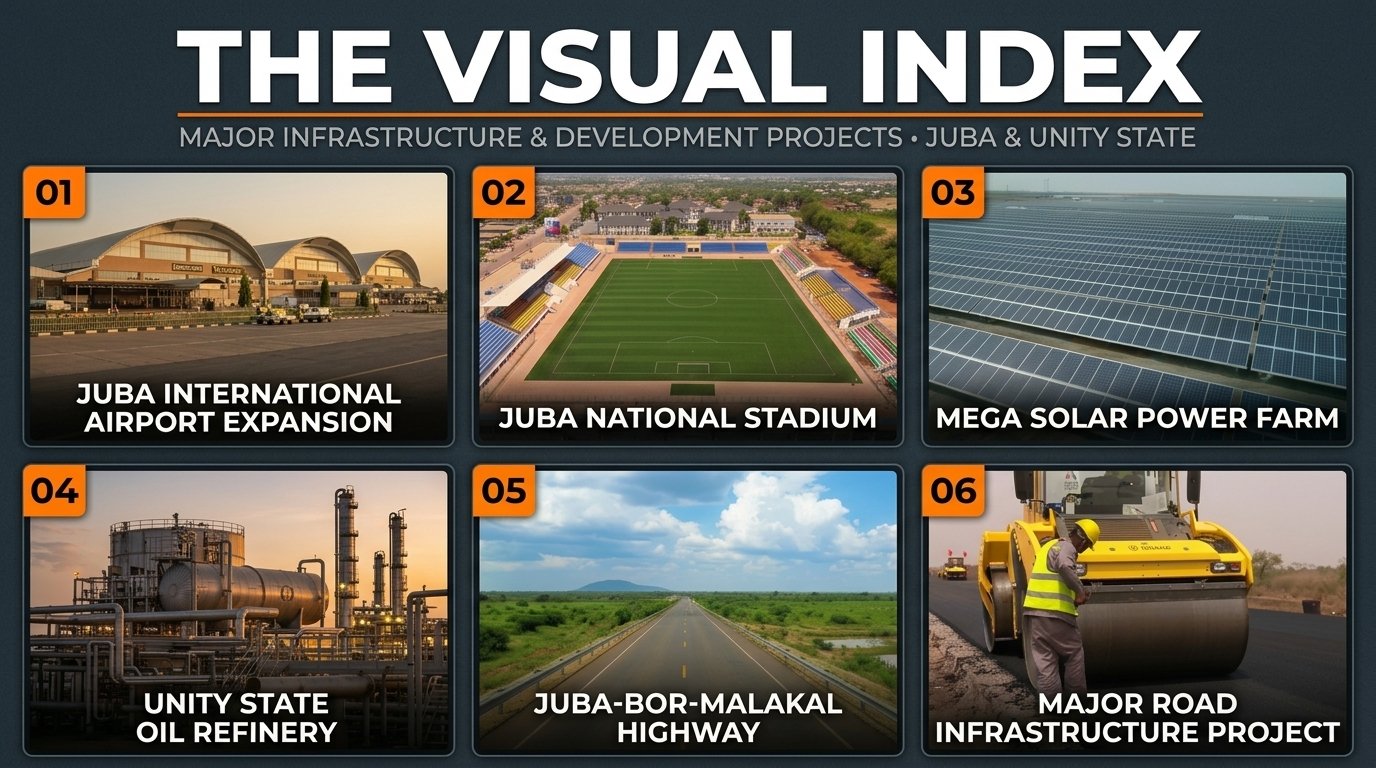
Located approximately 20 kilometers from the bustling capital city of Juba, the Juba Solar Power Plant stands as a major beacon of renewable energy and sustainable development in East-Central Africa. Spanning a vast 25-hectare expanse, this 20-megawatt solar facility was designed to diversify the country’s energy matrix and significantly reduce its carbon footprint.
Financial backing and International Collaboration
The project highlights strong international cooperation, featuring development work by Egypt’s Elsewedy Electric Company and a solar partner from the United Arab Emirates. Financed by the African Export-Import Bank at a cost of 45 million USD, the solar plant paves the way for energy independence. By tapping into abundant sunlight, it sets an inspiring example of clean energy adoption for other developing nations across the region.
3. Number 9: The Juba Power Plant
Strengthening Urban Electrical Grids
In 2017, South Sudan’s President Salva Kiir officially inaugurated the Juba Power Plant, marking a critical milestone in the nation’s efforts to stabilize urban infrastructure. Constructed by Ezra Company Limited and financed by the African Development Bank, this Monumental 100-megawatt facility was designed to overhaul and strengthen the power distribution network serving Juba.
Catalyzing Economic Activity
Reliable electricity is the lifeblood of modern commerce, and the Juba Power Plant has played a pivotal role in ensuring affordable, steady access to power for local residents and businesses alike. By eliminating the heavy reliance on costly, decentralized diesel generators, this facility has successfully catalyzed commercial activity, improved local manufacturing potential, and elevated the quality of life within the capital region.
4. Number 8: Nile Pet Building
The Commercial Arm of the Petroleum Ministry
As the operational, technical, and commercial arm of the Ministry of Mining and Petroleum, Nile Petroleum Corporation (Nilepet) oversees the backbone of South Sudan’s national economy. Under the leadership of Dr. Chol Deng, the corporation has actively driven the development of a brand-new administrative headquarters to centralize its operations and support future industrial growth.
International Engineering Expertise
To bring this corporate vision to life, the government partnered with China’s Zongda Overseas Corporation Limited to construct the Nile Pet Building. This modern edifice serves as a central nerve center for the nation’s petroleum sector, housing administrative functions that manage resources, coordinate technical projects, and streamline policies designed to maximize the economic benefits of South Sudan’s natural wealth.
5. Number 7: The Juba-Rumbek Road
Connecting the Capital to the Interior
Recognizing that physical connectivity is essential for national unity and trade, the government of South Sudan approved substantial funding allocations exceeding 25 million USD to accelerate the ongoing construction of the Juba-Rumbek Highway. Originally initiated through a partnership struck in 2019 with the Beijing-affiliated construction giant Shandong High-Speed, this massive undertaking links the capital city directly to the heart of the nation.
Facilitating Regional Trade and Mobility
The highway cuts across challenging terrain, serving as an economic corridor that slashes transport times and lowers the cost of goods moving between urban centers and regional hubs. By bridging geographic divides, the Juba-Rumbek road allows agricultural products, manufactured goods, and citizens to move seamlessly, fostering equitable growth and ensuring development reaches deep into the country’s interior.
6. Number 6: The Unity State Oil Refinery
Overcoming Adversity and Restoring Production
Conflict historically hindered the steady production of oil in South Sudan’s resource-rich Unity State, disrupting local livelihoods and national revenue streams. However, following the cessation of hostilities in 2019, the government embarked on an aggressive campaign of reconstruction and industrial resurgence, prioritizing the revival of petroleum operations in the region.
A Symbol of National Resilience
The Unity State Oil Refinery stands as a physical testament to the nation’s resilience and unwavering determination to harness its natural endowments for economic self-sufficiency. Restoring operations at the refinery has reactivated local employment, injected vital capital into the state economy, and strengthened South Sudan’s internal fuel processing capabilities, reducing dependency on costly imported petroleum products.
7. Number 5: Juba National Stadium
Elevating Sports and Cultural Celebrations
To foster community engagement, youth development, and national pride, the government approved the construction of a modern sports facility in the capital. Erected in the northern bore area of Juba County at a total cost of 25 million USD, the Juba National Stadium was constructed by the Metallurgical Corporation of China.
Accommodating Thousands of Spectators
Boasting a massive capacity to comfortably accommodate up to 35,000 spectators, the stadium is fully equipped to host grand international sporting fixtures, regional football tournaments, and vibrant cultural celebrations. It serves as a dynamic gathering space where citizens can unite, celebrate athletic achievement, and showcase South Sudanese culture to visiting international delegations.
8. Number 4: Juba International Airport Expansion
Upgrading Aviation Infrastructure
As South Sudan opens its doors wider to the international community, modernizing its primary aviation gateway has become an absolute necessity. In 2022, the government unveiled an ambitious master plan to expand the Juba International Airport Terminal, ensuring it can seamlessly handle an increasing volume of both domestic and international passenger and cargo flights.
Advanced Air Traffic Management Systems
The comprehensive expansion project encompasses more than just terminal buildings; it features the construction of the Juba Air Traffic Management system, specialized operational facilities, and a brand-new, state-of-the-art air traffic control tower. These upgrades usher in a new era of safety, efficiency, and global connectivity, ensuring the nation’s skies are managed according to the highest international aviation standards.
9. Number 3: Juba-Bor-Malakal Highway
Spanning Central and Eastern Regions
Stretching over 151 kilometers as a dual-carriage corridor, the Juba-Bor-Malakal Highway connects the capital city of Juba to Bor, the capital of Jonglei State. Undertaken by the African Resource Corporation—a prominent local construction firm based in South Sudan—this infrastructure marvel stands as one of the longest and most challenging road projects in East-Central Africa.
Catalyzing Growth Along the Nile Corridor
The highway facilitates the uninterrupted movement of people, livestock, and commercial merchandise across flood-prone and rugged terrain. By establishing a reliable, year-round transport link along this vital corridor, the project significantly reduces spoilage of agricultural goods, lowers logistics costs, and catalyzes localized economic growth throughout communities historically isolated by poor transport infrastructure.
10. Number 2: Rumbek Bridge
Spanning the Rumbek River
The Rumbek Bridge Project represents a critical civil engineering triumph designed to span the formidable Rumbek River, overcoming seasonal flooding barriers that previously severed regional transport routes for months at a time. Upon completion, this robust bridge creates an unbroken transit line that links isolated rural communities directly to major urban markets.
Fostering Inclusive National Growth
Beyond simple vehicle crossings, the Rumbek Bridge acts as an instrument of social and economic integration. By guaranteeing reliable year-round access, the project ensures that emergency medical services, educational supplies, and commercial trade can reach remote populations without interruption, fostering inclusive growth and ensuring that the tangible benefits of national development touch even the most isolated corners of the country.
11. Number 1: University of Juba Innovation Hub (UNIPOD)
Nurturing Future Generations of Innovators
In 2022, the University of Juba, in direct collaboration with the United Nations Development Programme (UNDP), launched an inspiring initiative to construct the University of Juba Innovation Hub (UNIPOD). Built at a cost of 1.9 million USD, UNIPOD serves as a premier institutional beacon of technology, knowledge creation, and entrepreneurial incubation.
Equipping Youth with Modern Technological Skills
Designed to nurture the brilliant young minds that will shape South Sudan’s technological future, UNIPOD provides students and local entrepreneurs with access to modern digital tools, fabrication laboratories, and mentorship programs. By fostering local problem-solving and startup culture, the hub ensures that the nation’s youth are equipped to build home-grown solutions for South Sudan’s unique socioeconomic challenges.
Frequently Asked Questions (FAQs)
1. What is the primary objective of the Juba Solar Power Plant?
The 20-megawatt solar power plant aims to harness clean energy, reduce the nation’s carbon footprint, and provide a sustainable stride toward energy independence for South Sudan.
2. How much did the Juba National Stadium cost to construct?
The Juba National Stadium was built at a total cost of 25 million USD and features a seating capacity of 35,000 spectators.
3. Which company constructed the Nile Pet Building?
The Nile Pet Building, serving as the headquarters for the Nile Petroleum Corporation, was constructed by China’s Zongda Overseas Corporation Limited.
4. What role does the University of Juba Innovation Hub (UNIPOD) play?
Established in collaboration with the UNDP, UNIPOD acts as a knowledge and technology incubator designed to nurture young minds and support local entrepreneurship and innovation.
5. How long is the Juba-Bor-Malakal Highway?
The Juba-Bor-Malakal Highway spans 151 kilometers as a dual-carriage road connecting Juba to Bor in Jonglei State.
6. What was the significance of the Juba Power Plant inauguration in 2017?
Financed by the African Development Bank and built by Ezra Company Limited, the 100-megawatt plant was built to strengthen Juba’s power distribution network and catalyze economic activity.
7. Why is the Rumbek Bridge Project considered crucial for South Sudan?
The bridge spans the Rumbek River to eliminate seasonal isolation, connecting remote rural communities with urban centers and facilitating the efficient movement of goods and services.
Authoritative References
-
African Development Bank Group – South Sudan: Juba Power Distribution System Project Overview
-
United Nations Development Programme (UNDP) – Supporting Innovation and Youth Entrepreneurship in South Sudan
-
African Export-Import Bank (Afreximbank) – Financing Renewable Energy and Sustainable Infrastructure in East Africa