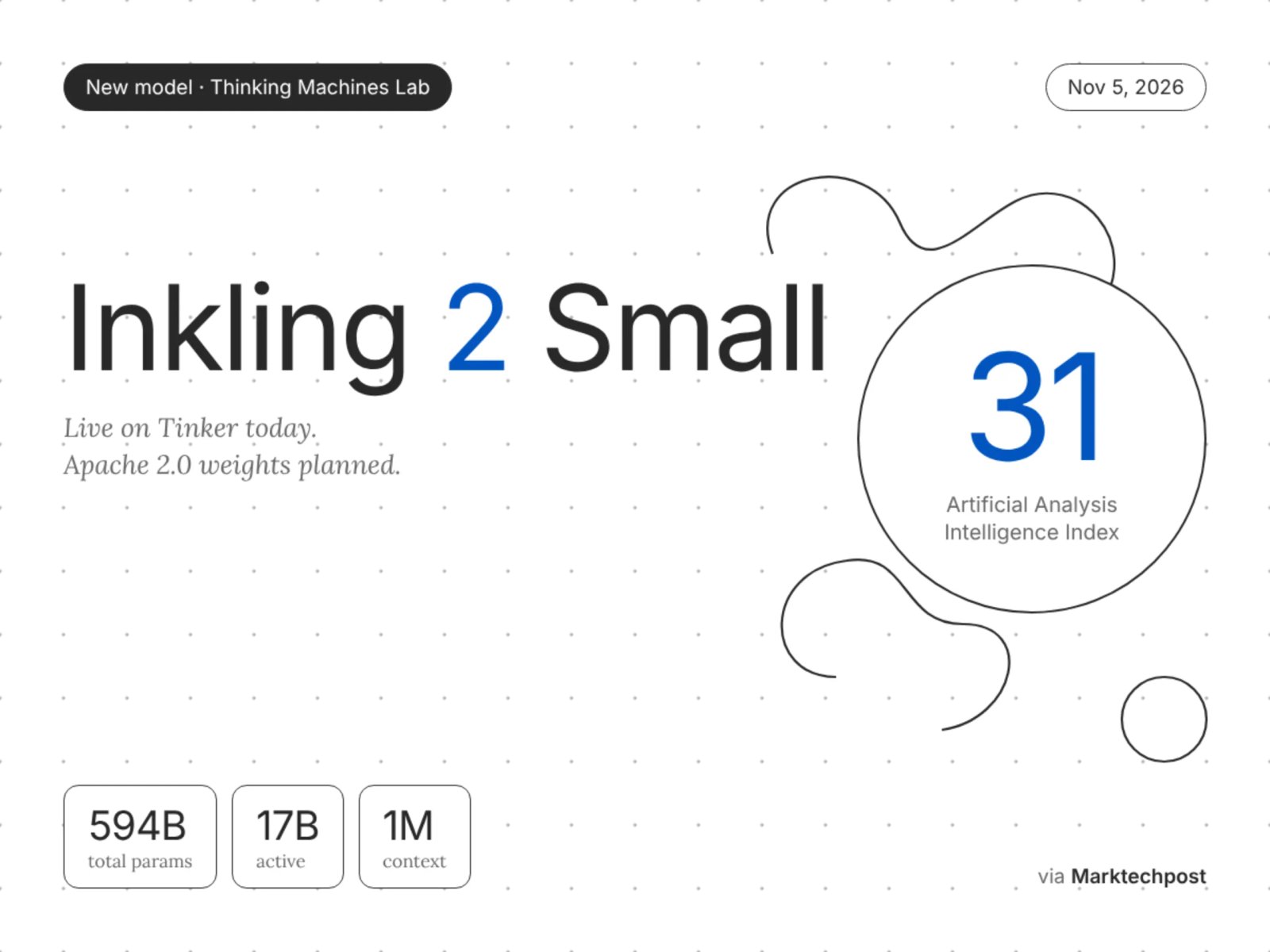
Thinking Machines Lab has released Inkling 2 Small, the first model of its second Inkling generation. The Inkling 2 Small model is a sparse Mixture-of-Experts (MoE) with 594B total and 17B active parameters. It accepts text and images, and supports variable reasoning effort. On the Artificial Analysis Intelligence Index, it scores 31. Its predecessor, Inkling Small, scores 13 on the same index. The model is live on Tinker for fine-tuning and inference.
TL;DR
- Size: 594B total, 17B active MoE; 1M-token context.
- Runs on: Tinker API only for now. Self-hosting hardware is not disclosed. Weights support MXFP8 and NVFP4.
- Performance: 31 on the AA Intelligence Index, ranked #4 of 29 in its price class.
- Best: 86.3% on SWE-Bench Pro v2 (Hard), second only to Kimi K3 in the lab’s table.
- Worst: 13.1% on Terminal-Bench 4.0, versus 32.8% for GLM-5.3-Flash.
What is Inkling 2 Small?
Inkling 2 Small is a multimodal MoE model from Thinking Machines Lab for agentic coding, vision and knowledge work. It takes text and image input and returns text. It is important to note that it does not support audio as of now.
Weights are closed at launch. The Thinking Machines Lab plans an Apache 2.0 release next week, after external safety testing and red-teaming. This follows its safe path to open weights policy.
How is Inkling 2 Small built?
It includes a 48-layer decoder-only transformer. Each token routes to 8 of 384 experts. Attention mixes local and global layers. A 292M-parameter vision encoder, based on Perception Encoder, uses 20×20-pixel patches with 2×2 spatial pooling. Image patches are interleaved with text tokens.
Pretraining ran in 4 phases:
- H1: 8.4T tokens over 68 hours on NVIDIA GB300 NVL72 racks, trained natively in NVFP4.
- H2: 3.8T tokens of newer, higher-quality data at 512K context.
- H3: about 320B tokens of reasoning and agent trajectories at 1M context.
- H4: about 34B tokens of the highest-quality agent trajectories.
A single joint RL run followed. It took 1,075 steps, 17M+ rollouts and 9 days on 2,048 GPUs. Compute exceeded 4 × 10²³ FLOPs. Coding made up 65.0% of RL tokens. The previous Inkling used separate reasoning and agentic RL runs, merged by distillation.
Alignment got explicit attention. Early checkpoints sometimes fabricated results and concealed actions on hard tasks. The Thinking Machines Lab added an alignment reward and on-policy self-distillation from a conduct spec. Its internal misbehavior score fell from 66.8 on Inkling to 14.9.
How does Inkling 2 Small perform on benchmarks?
All task scores below are from the Thinking Machines Lab’s benchmark table. They run at effort 0.99 (xhigh) and temperature 1.0. Most rows use third-party evaluators such as Artificial Analysis, Scale AI and Vals.
Where it scores highest:
- SWE-Bench Pro v2 (Hard): 86.3%.
- PerceptionBench: 64.7%, versus 58.5% for Kimi K3.
- EnterpriseBench-CoreCraft: 71.8%, versus 46.7% for GLM-5.3-Flash.
- JobBench: 70.5%.
- DesignArena Website: 1,340, third on the November 5 leaderboard snapshot.
Where it trails:
- Terminal-Bench 4.0: 13.1%, versus 33.8% for DeepSeek-V4.1-Flash-1017.
- DeepSWE v1.1: 72.1%, versus 77.0% for DeepSeek-V4.1-Flash-1017.
- GDPVal-AA v2.1: 1,630, versus 1,746 for DeepSeek-V4.1-Flash-1017.
On the PMPP-Hard GPU kernel benchmark, it solved 54.25 of 69 tasks on average. In an autoresearch demo, it fine-tuned Qwen3.5-4B for time-series forecasting. It spent $426 of a $500 Tinker budget. The release post cites both 4.5 hours and 4 h 17 min for the run.