Introduction
Bullet trains have revolutionized travel with their incredible speed and efficiency, connecting cities and countries like never before. As technology has advanced, various nations have developed their own High-Speed Rail (HSR) systems to compete for the title of the world’s fastest train.
From Japan’s pioneering Shinkansen to Europe’s cutting-edge models and China’s maglev marvels, these trains have set brand-new standards for speed, engineering, and passenger comfort. Today, we explore the top 15 bullet trains in the world.
The Top 15 Fastest High-Speed Trains
15. Thalys (Eurostar)
Country/Region: France, Belgium, Netherlands, Germany
Top Speed: 186 mph (300 km/h)
Estimated Project Cost: $1.5 Billion
Operating since 1997, Thalys is a landmark French-Belgian high-speed service. Known as one of Europe’s pioneer green high-speed trains, it serves over 7 million passengers annually, connecting key hubs like Paris, Brussels, Amsterdam, and Cologne. (Note: In October 2023, Thalys officially rebranded under the Eurostar name).
14. THSR 700T
Country: Taiwan
Top Speed: 196 mph (315 km/h)
Estimated Project Cost: $18 Billion
Introduced in 2007, the THSR 700T was built through a collaboration of major Japanese manufacturers based on Shinkansen technology. Featuring 12 carriages and a seating capacity of 989 passengers, it prioritizes interior comfort and high passenger volume while maintaining rapid island-wide connectivity.
13. TGV Euroduplex
Country: France
Top Speed: 198 mph / 320 km/h (Design capability up to 350 km/h)
Estimated Project Cost: $6 Billion
Developed by Alstom and launched in 2011, the double-decker TGV Euroduplex carries 40% more passengers than standard single-deck trains of the same length. Aside from its extensive routes across France, Spain, Switzerland, and Germany, it also forms the basis of Morocco’s Al Boraq line—bringing Africa its very first high-speed rail line.
12. Eurostar e320
Country/Region: UK, France, Belgium
Top Speed: 200 mph (320 km/h)
Estimated Project Cost: $1 Billion
Entering service in November 2015, the 400-meter-long Eurostar e320 carries up to 900 passengers through the Channel Tunnel. Operating between London, Paris, Brussels, and Amsterdam, it features state-of-the-art regenerative braking systems and tailored passenger amenities.
11. Deutsche Bahn ICE (Intercity Express)
Country: Germany
Top Speed: 205 mph (330 km/h)
Estimated Project Cost: $2 Billion
Germany’s flagship high-speed service launched in 1991 (with early testing in the mid-1980s). Known for its iconic sleek white design with red striping—which earned it a Red Dot Design Award—the ICE connects major German metro areas with neighboring countries, serving over 100 million passengers every year.
10. KTX-I & KTX-Sancheon
Country: South Korea
Top Speed: 205 mph (330 km/h)
Estimated Project Cost: $11 Billion
Operated by Korail since 2004, South Korea’s High-Speed Rail network features the TGV-derived KTX-I and the domestically developed, upgraded KTX-Sancheon (introduced in 2010). During speed runs, experimental test sets of the Korean HSR platform have reached speeds in excess of 260 mph.
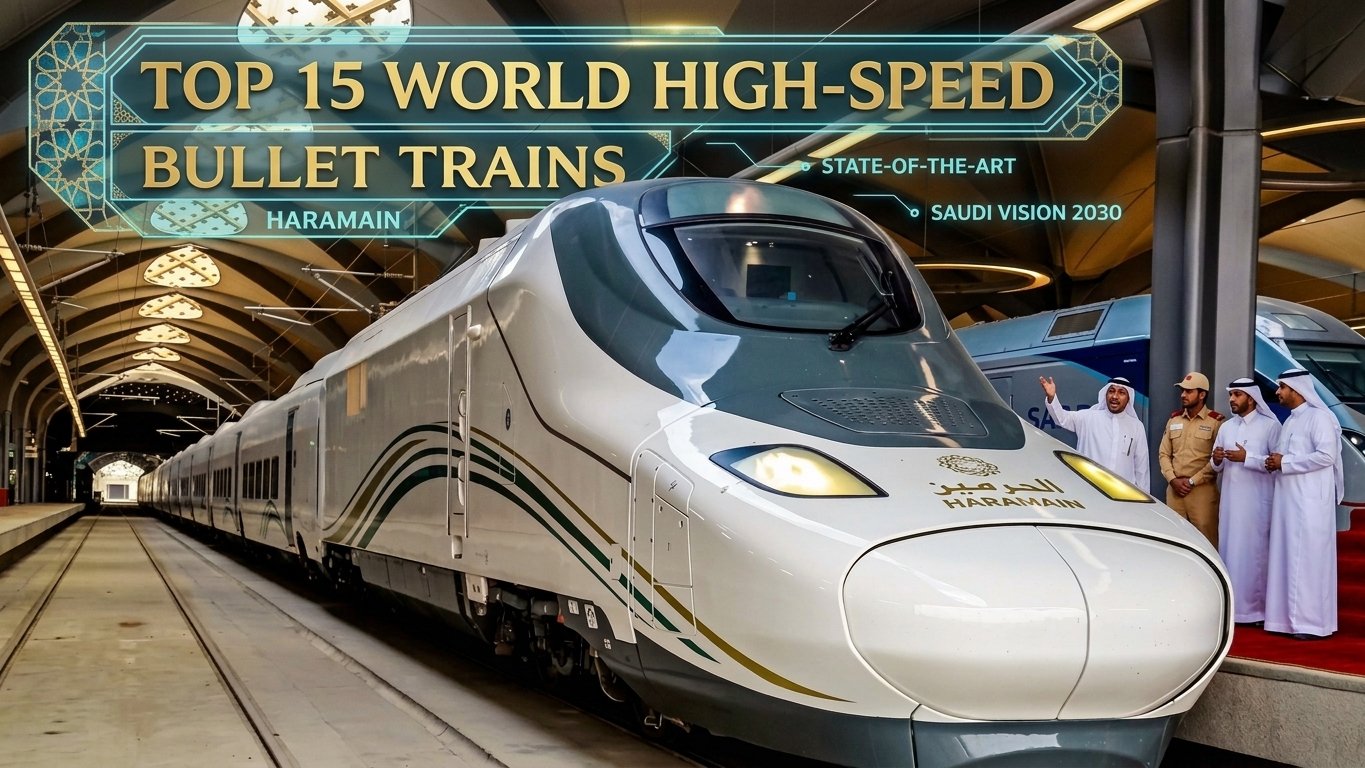
9. Haramain High-Speed Railway
Country: Saudi Arabia
Top Speed: 217 mph (350 km/h)
Estimated Project Cost: $9.4 Billion
Connecting the holy cities of Mecca and Medina via Jeddah, this 280-mile high-speed line opened in 2018. Designed to withstand extreme desert temperatures and blowing sand, it carries tens of millions of pilgrims and passengers safely across the region each year.
8. Frecciarossa 1000 (ETR 400)
Country: Italy
Top Speed: 220 mph (350 km/h)
Estimated Project Cost: $2.5 Billion
Operated by Trenitalia since 2015, the Frecciarossa 1000 (“Red Arrow”) is renowned for its luxury, aerodynamic shaping, and eco-friendly build—constructed with nearly 100% recyclable materials. It offers four distinct travel classes, executive meeting rooms, and active noise-canceling cabin insulation.
7. Italo AGV 575
Country: Italy
Top Speed: 224 mph / 360 km/h (Commercial cap at 186 mph)
Estimated Project Cost: $5 Billion
Run by Europe’s first private open-access high-speed operator (NTV), the Alstom-built AGV 575 utilizes distributed traction across its motor bogies. This design reduces train weight, eliminates power cars, cuts energy consumption by up to 30%, and delivers an exceptionally smooth ride.
6. Shinkansen E5, E6 & H5 Series
Country: Japan
Top Speed: 224 mph / 360 km/h (Commercial operation at 199 mph / 320 km/h)
Estimated Project Cost: $5 Billion
Serving Japan’s Tohoku and Hokkaido lines, these iconic bullet trains feature 15-meter long aerodynamic nose cones designed specifically to eliminate “tunnel boom” noise at high speeds. The green E5/H5 and vibrant red E6 frequently run coupled together before splitting off to different destinations.
5. Talgo 350 (AVE Class 102)
Country: Spain
Top Speed: 227 mph (365 km/h)
Estimated Project Cost: $7 Billion
Nicknamed Pato (“Duck”) due to its unique aerodynamic nose design, Spain’s Talgo 350 entered service on the Renfe network in 2005. It features ultra-lightweight articulated cars and pressurized cabin technology designed to prevent pressure changes in passengers’ ears when entering tunnels.
4. Harmony CR380A
Country: China
Top Speed: 235 mph / 380 km/h (Tested up to 302 mph / 486 km/h)
Estimated Project Cost: $10 Billion
Entering service in 2010 on the flagship Beijing–Shanghai route, the CR380A was engineered for vibration-free travel and low interior noise. It stands as a major landmark in China’s indigenous high-speed rail engineering capabilities.
3. Hexie Hao CR380 Series
Country: China
Top Speed: 236 mph (380 km/h)
Estimated Project Cost: $7 Billion
The broader CR380 “Hexie” (Harmony) family—including the A, B, C, and D variants—represents China’s massive rollout of high-speed trunk lines over the past decade. Built through localized adaptation and advanced technology integration, these sets form the backbone of China’s HSR passenger line network.
2. Fuxing Hao CR400AF / CR400BF
Country: China
Top Speed: 249 mph / 400 km/h (Commercial operation at 217 mph / 350 km/h)
Estimated Project Cost: $7.3 Billion
Introduced in 2017, the Fuxing Hao (“Rejuvenation”) series—nicknamed the “Blue Dolphin” (AF) and “Golden Phoenix” (BF)—features completely localized intellectual property. Designed with ultra-sleek, drag-reducing profiles, integrated Wi-Fi, wireless charging, and smart monitoring systems, it is currently the world’s fastest conventional wheel-on-rail commercial train.
1. Shanghai Maglev
Country: China
Top Speed: 267 mph (430 km/h)
Estimated Project Cost: $1.3 Billion
Topping the list is the Shanghai Maglev, the world’s fastest commercial high-speed public transport system. Using electromagnetic levitation technology to float above the track without touching it, it covers the 19-mile (30 km) distance between Shanghai Pudong International Airport and the city center in just 7 minutes and 20 seconds.
Summary Overview
| Rank | Train Model | Country / Region | Operational Top Speed |
|---|---|---|---|
| 1 | Shanghai Maglev | China | 267 mph (430 km/h) |
| 2 | Fuxing Hao CR400AF/BF | China | 217 mph (350 km/h) |
| 3 | Hexie Hao CR380 Series | China | 186–217 mph (300–350 km/h) |
| 4 | Harmony CR380A | China | 186–217 mph (300–350 km/h) |
| 5 | Talgo 350 | Spain | 193 mph (310 km/h) |
| 6 | Shinkansen E5 / E6 / H5 | Japan | 199 mph (320 km/h) |
| 7 | Italo AGV 575 | Italy | 186 mph (300 km/h) |
| 8 | Frecciarossa 1000 | Italy | 186–199 mph (300–320 km/h) |
| 9 | Haramain Railway | Saudi Arabia | 186 mph (300 km/h) |
| 10 | KTX-I / KTX-Sancheon | South Korea | 190 mph (305 km/h) |
| 11 | DB ICE 3 / ICE 4 | Germany | 186–199 mph (300–320 km/h) |
| 12 | Eurostar e320 | UK / EU | 200 mph (320 km/h) |
| 13 | TGV Euroduplex | France | 198 mph (320 km/h) |
| 14 | THSR 700T | Taiwan | 186 mph (300 km/h) |
| 15 | Thalys (Eurostar) | France / Benelux | 186 mph (300 km/h) |