




Engineering Icons: The 5 Most Impressive Bridges in the World
Suspension bridges represent some of the most striking feats of structural engineering in human history. Defined by their sweeping cables, towering pylons, and record-breaking spans, these mega-structures do far more than facilitate transit across treacherous straits and deep valleys—they reshape local economies, define regional skylines, and stand as monumental proofs of architectural ingenuity.
1. Golden Gate Bridge (California, USA)
Spanning the Golden Gate Strait to connect San Francisco with Marin County, the Golden Gate Bridge remains one of the most recognizable and photographed bridges on Earth.
+-------------------------------------------------------------------------+
|                         GOLDEN GATE BRIDGE AT A GLANCE                  |
+--------------------------+----------------------------------------------+
| Location                 | San Francisco & Marin County, California     |
| Main Span                | 4,200 feet                                   |
| Total Tower Height       | 746 feet                                     |
| Construction Period      | 1933 – 1937                                  |
| Primary Chief Engineer   | Joseph Strauss                               |
+--------------------------+----------------------------------------------+
Origins & Early Vision
The idea of bridging the treacherous Golden Gate Strait was discussed throughout the late 19th century, but serious planning did not materialize until 1916 following a prominent feature in the San Francisco Bulletin by James Wilkins. Chief engineer Joseph Strauss initially proposed a hybrid cantilever-suspension design. Recognizing its aesthetic and structural limitations, Strauss revised the plan into a pure suspension bridge.
Construction Challenges
When construction officially commenced in early 1933, crews faced fierce natural obstacles:
Strong Tides & Deep Waters: Workers had to establish concrete foundations in open ocean conditions.
Persistent Fog: Dense coastal fog frequently reduced visibility to zero, complicating crane and high-steel maneuvers.
Financial Constraints: Built during the Great Depression, the project notably finished on schedule in early 1937 and within its $35 million budget.
Upon completion, it held the title of both the longest and tallest suspension bridge in the world, establishing a benchmark for modern suspension engineering.
2. Akashi Kaikyo Bridge (Hyogo Prefecture, Japan)
Also known as the Pearl Bridge, the Akashi Kaikyo Bridge links the bustling city of Kobe on the Japanese mainland to Awaji Island. Crossing the turbulent Akashi Strait, it represents a high-water mark for disaster-resilient infrastructure.
| Spec / Parameter | Measurement | Structural Function |
| Main Span | 6,532 feet | Formed the world’s longest central suspension span upon opening |
| Tower Height | 1,017 feet | Designed with tuned mass dampers to flex safely under seismic stress |
| Main Cable Diameter | 13 inches | Constructed from 290 individual steel wire strands per cable |
| Completion Year | 1998 | Completed after more than 40 years of planning and construction |
Engineering for Extreme Environments
The concept for the crossing was introduced in 1955, but actual construction required decades of advanced engineering prep. The Akashi Strait is notorious for severe typhoons, heavy maritime traffic, and frequent seismic activity. To ensure long-term stability:
Dynamic Wind Resistance: The main towers were engineered to absorb and dissipate high-wind loads without structural failure.
Earthquake Survivability: During its construction in 1995, the Great Hanshin Earthquake struck the area, moving the towers and expanding the main span by over 3 feet—yet the structural integrity held, proving the resilience of the design.
3. Brooklyn Bridge (New York, USA)
Connecting Manhattan and Brooklyn across the East River, the Brooklyn Bridge is an iconic 19th-century marvel. Combining suspension and cable-stayed design elements, it served as a vital arterial link that helped catalyze the consolidation of modern New York City.
+-------------------------------------------------------------------------+
|                        BROOKLYN BRIDGE SPECIFICATIONS                   |
+--------------------------+----------------------------------------------+
| Main Span                | 1,595 feet                                   |
| Design Type              | Hybrid Cable-Stayed / Suspension             |
| Chief Designers          | John Augustus Roebling & Washington Roebling |
| Opening Date             | May 24, 1883                                 |
+--------------------------+----------------------------------------------+
A Tragic & Triumphant History
Designed by German-American engineer John Augustus Roebling, the project was plagued by severe adversity from its inception in 1869:
Loss of the Lead Designer: Shortly after site preparation began, John Roebling suffered a foot injury that led to fatal tetanus.
Caisson Disease: His son, Washington Roebling, took over as chief engineer but contracted “the bends” (decompression sickness) while supervising underwater timber caissons. Bedridden and partially paralyzed, Washington relied on his wife, Emily Warren Roebling, to carry daily technical instructions to site engineers.
Despite these setbacks, the bridge opened on May 24, 1883, as the longest suspension bridge of its era, becoming an enduring symbol of industrial perseverance.
4. Humber Bridge (Yorkshire / Lincolnshire, UK)
Spanning the Humber Estuary between the East Riding of Yorkshire and North Lincolnshire, the Humber Bridge stands as a landmark achievement in British civil engineering.
+-------------------------------------------------------------------------+
|                           HUMBER BRIDGE OVERVIEW                        |
+--------------------------+----------------------------------------------+
| Main Span                | 4,626 feet                                   |
| Tower Height             | 510 feet above water level                   |
| Consulting Engineers     | Freeman Fox & Partners                       |
| Primary Contractor       | Cleveland Bridge & Engineering Company       |
| Official Opening         | 1981                                         |

Taming the Estuary
When it opened in 1981, the Humber Bridge claimed the title of the world’s longest single-span suspension bridge—a record it held for 17 years. Designing a structure over the Humber Estuary presented unique hydrographic obstacles:
Shifting Shoals: The estuary bed features shifting sandbanks and unpredictable mud deposits.
High Tidal Ranges: Powerful coastal tides required deep-caisson foundation techniques to anchor the 510-foot concrete towers.
Aerodynamic Decking: Engineers utilized an aerodynamic box-girder deck design to prevent wind-induced oscillations across the wide, exposed estuary.
5. Millau Viaduct (Aveyron, France)
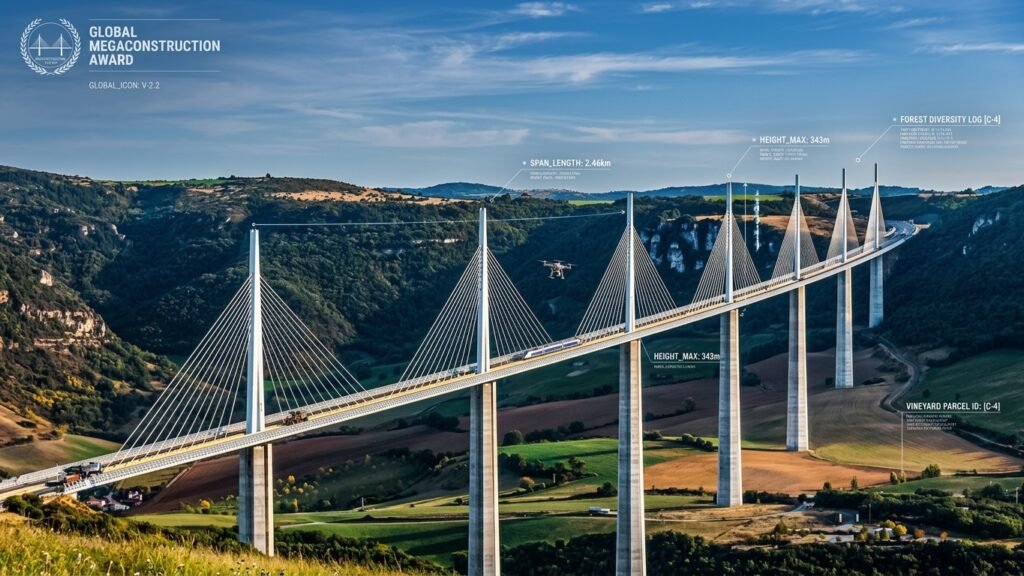
While technically classified as a multi-span cable-stayed bridge rather than a pure suspension bridge, the Millau Viaduct in southern France commands respect as one of the most visually stunning elevated crossings ever constructed.
| Feature | Details |
| Structural Height | Maximum pylon height of 1,125 feet (tallest bridge in the world) |
| Design Team | Structural Engineer Michel Virlogeux & Architect Norman Foster |
| Structural Layout | 7 concrete pylons holding an aerodynamic steel roadway deck |
| Completion Time | Just over 3 years (Opened December 2004) |
Minimalist Design, Maximum Scale
Conceived in the late 1980s to relieve severe holiday traffic congestion along the Tarn River Valley near Millau, the design team focused on creating a structure that would harmoniously integrate into the surrounding landscape.
                  TYPICAL CABLE-STAYED PROFILE (MILLAU VIADUCT)

                                    /|\
                                   / | \
                                  /  |  \
                                 /   |   \
                                /    |    \
     __________________________/_____|_____\__________________________
    [=================================================================]  Roadway Deck
                                     |
                                     |  Concrete Pylon
                                     |  (up to 800+ ft tall)
By utilizing high-strength steel, prefabricated deck segments, and hydraulic launching systems, crews pushed the bridge deck across seven massive pylons with extreme precision. The highest pylon reaches 1,125 feet, making the Millau Viaduct taller than the Eiffel Tower and an internationally celebrated icon of modern structural architecture.
Frequently Asked Questions
What is the primary difference between a suspension bridge and a cable-stayed bridge?
In a standard suspension bridge, the main load-bearing cables run continuously between main anchorages located at either end of the bridge, with vertical vertical suspender cables holding up the deck. In a cable-stayed bridge (like the Millau Viaduct), the cables run directly from the central supporting towers (pylons) to the roadway deck in a fan or harp pattern, eliminating the need for large end anchorages.
Which bridge held the record for the longest main span for the longest time?
The Golden Gate Bridge held the world record for the longest main suspension span (4,200 feet) for 27 years, from its opening in 1937 until the Verrazzano-Narrows Bridge opened in New York in 1964.
Why do suspension bridge towers need to flex in high winds?
Allowing bridge towers to flex slightly prevents excessive stress buildup within the steel and concrete structures. By absorbing dynamic loads caused by crosswinds, seismic shifts, and heavy traffic, flexible towers reduce material fatigue and maintain overall structural balance.
What is caisson disease, and how did it affect early bridge construction?
Caisson disease (commonly known as “the bends”) is caused by rapid decompression when workers surface too quickly from high-pressure underwater work chambers (caissons). During the late 19th century—most notably during the construction of the Brooklyn Bridge—the physiology of decompression was poorly understood, leading to severe joint pain, paralysis, and death among compressed-air workers.
How do modern bridges handle extreme weather conditions like typhoons?
Engineers conduct extensive wind-tunnel testing on scale models to optimize aerodynamics. Solutions include:
Using hollow, stream-lined box girders for the roadway deck to reduce wind drag.
Installing tuned mass dampers (heavy counter-weights) inside the towers to counter oscillation.
Engineering open-grate sections or aerodynamic fairings to let air pass through or over the structure smoothly.