




Heritage in the Highlands: The Identity, History, and Resilience of the Awa People
Deep in the mountainous terrain of southwest China—spanning Yunnan, Guizhou, and Sichuan provinces—lies the ancestral home of the Awa (also known as the Black Yi), a distinct subgroup within the Yi (Nusu) ethnic nationality.
While categorized under one of China’s 56 official ethnic groups, the Awa possess a unique cultural, visual, and spiritual heritage that sets them apart within the region’s broader historical tapestry.
Origins and Historical Theories
The origins of the Awa feature a mix of indigenous heritage and historical debate regarding ancient human migration.
                             [ Awa Origins Framework ]
                                         │
                   ┌─────────────────────┴─────────────────────┐
                   ▼                                           ▼
       [ High-Altitude Indigenous ]                [ Trade Route Migration ]
    Descendants of ancient Southwestern         Ancestral intermixing along Indian
    tribes inhabiting highland borders.         Ocean routes from South Asia/Africa.
Indigenous Deep-Rootedness: Many historians view the Awa as direct descendants of ancient highland tribes who inhabited the Southwestern mountain ranges long before imperial dynasties extended administrative control into the region.
Migration and Intermixing: Alternative historical hypotheses suggest their distinct physical traits—including darker skin complexions and wavy hair patterns—may stem from early intermixing with traveling groups along ancient Indian Ocean and overland trade networks thousands of years ago.
Imperial Resistance: Historically documented in regional chronicles as fiercely independent mountain dwellers, the Awa maintained local autonomy by utilizing the rugged topography of the highlands to resist complete assimilation into expanding imperial administrative structures.
Nomenclature: “The Black Tribe of China”
The designation “Black Tribe” (or Black Yi) carries multi-layered historical, visual, and social meanings:
+--------------------------+-----------------------------------------------------------------+
| Dimensional Origin       | Cultural & Historical Significance                              |
+--------------------------+-----------------------------------------------------------------+
| Physical Appearance      | Used historically by outsiders to denote darker skin tones.     |
| Textile Tradition        | Refers to the traditional practice of dyeing garments black.     |
| Social Hierarchy         | Historically linked to social class designations within the Yi. |
+--------------------------+-----------------------------------------------------------------+
Historically, the label was applied externally to mark differences between highland groups and neighboring populations. Within the traditional social stratification of the Yi, “Black” often designated noble lineages or independent social classes. Additionally, the widespread practice of using natural plant-based dyes to produce deep black garments made Awa communities visually distinct across the region.

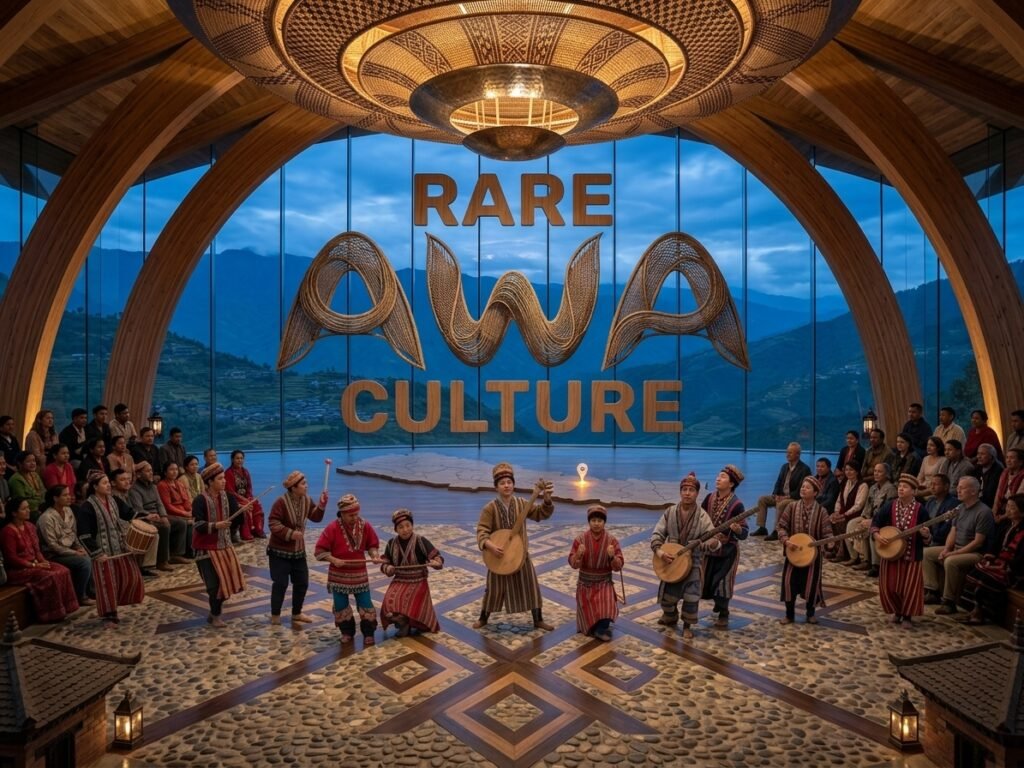
Cultural Foundations and Spiritual Life
Awa culture is deeply linked to the environment, characterized by animistic beliefs, specialized roles, and rich artistic traditions.
                                [ Awa Cultural Ecosystem ]
                                            │
         ┌──────────────────────────────────┼──────────────────────────────────┐
         ▼                                  ▼                                  ▼
[ Spiritual Leadership ]         [ Material Expressiveness ]        [ Oral Transmission ]
  Bimo Shaman-Priests              Bold Geometric Embroidery          Creation Myths & Ballads
  Rituals & Oral Records           Silver Ornaments & Sashes          Drum & Flute Circles
Animism and the Bimo
Spiritual life centers on animism—the belief that mountains, rivers, forests, and animals possess sacred spirits. The central spiritual figure is the Bimo, a shaman-priest who acts as healer, ritual performer, and custodian of oral histories and written chants.
Traditional Attire and Artistry
Traditional clothing features vivid geometric patterns embroidered onto dark bases. Red, yellow, and green thread motifs symbolize natural elements, ancestral spirits, and protective forces. Women adorn their headdresses with intricate silver ornaments, while men wear traditional sashes and tunic garments passed down through generations.
Communal Performance
Music and dance function as primary vehicles for historical preservation. During community gatherings and festivals, villagers perform circle dances accompanied by drums and bamboo flutes, singing ballads that transmit creation myths, historical battles, and ancestral lineage.
Contemporary Challenges and Cultural Revitalization
Like many indigenous minority groups, the Awa navigate the intersection of modern socio-economic shifts and cultural preservation.
Modern Dynamics:
[ Systemic Challenges ] ───> Urban Migration • Language Shift to Mandarin • Regional Isolation
            │
            ▼
[ Adaptive Revitalization ] ───> Youth-Led Digital Media • Ethno-Tourism • Modern Musical Fusion
Socio-Economic Shifts: Migration to urban centers for employment and the prominence of Mandarin in schooling have created generational gaps in native language fluency and traditional oral transmission.
Economic Integration: Historical geographic isolation led to developmental lags; recent infrastructure initiatives have focused on improving accessibility and living standards in remote highland villages.
Cultural Adaptation: Contemporary Awa youth, artists, and designers are using digital platforms, social media, and modern musical genres to preserve their heritage. Ethno-tourism and regional cultural festivals have further elevated the visibility of Awa textile craft, ritual music, and traditional celebrations.
Frequently Asked Questions
Who are the Awa people?
The Awa (often referred to historically as a subgroup of the Black Yi) are an ethnic population residing primarily in the highland regions of Yunnan, Guizhou, and Sichuan provinces in southwest China.
Why were the Awa historically called the “Black Tribe”?
The name originates from a combination of factors: external observations of their darker skin tones compared to neighboring populations, their traditional practice of dyeing garments black with natural pigments, and historical social designations within the broader Yi ethnic hierarchy.
What is the role of the Bimo in Awa culture?
The Bimo is a traditional shaman-priest who serves as the spiritual leader, healer, and keeper of sacred texts and oral history within the community.
What spiritual beliefs do the Awa practice?
The Awa practice animism, holding that natural elements—including mountains, rivers, forests, and animals—are inhabited by spirits that require respect and ceremonial recognition.