




The Mechanical Titans: How China’s Heavy Engineering Fleet Is Redefining Civil Infrastructure
In the history of civil engineering, physical transformation has long been defined by the tools available to human builders. From the bronze chisels of ancient stone carvers to the steam-driven shovels that excavated the Panama Canal, every major leap in global infrastructure has required a corresponding revolution in heavy machinery.
Today, China is executing an infrastructure push on a scale unprecedented in human history. Transforming mountain ranges, constructing sea-crossing bridge networks, and expanding deep subterranean metro grids requires far more than physical labor. It demands an entirely new class of specialized, ultra-heavy machinery—custom-engineered mechanical titans designed to conquer extreme topographies, bypass geological hazards, and execute monumental construction tasks with surgical precision.
This comprehensive guide explores the engineering specs, operational mechanics, and real-world impacts of China’s most formidable construction fleet across five critical domains: subterranean tunneling, heavy lifting, marine reclamation, foundation engineering, and sustainable transport.

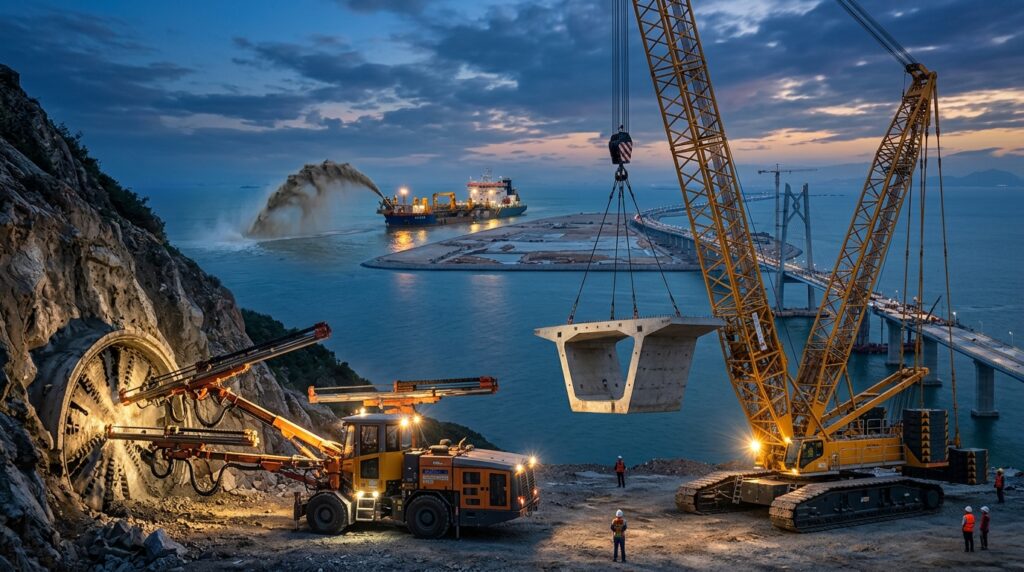
1. Subterranean Conquest: Advanced Tunneling and Drilling Technology
Deep underground excavation presents some of the most treacherous working conditions in civil engineering. Managing subterranean water pressure, tectonic fault lines, unstable rock formations, and toxic gas pockets requires equipment that combines raw mechanical force with automated intelligence.
The Four-Arm Face Drilling Rig (Four-Boom Tunnel Titan)
When carving transportation tunnels through granite mountain ranges—such as those found in Southwestern China’s Sichuan and Yunnan provinces—traditional manual drilling and blasting methods are slow, labor-intensive, and inherently dangerous. To accelerate hard-rock excavation, heavy machinery manufacturers like Siton and Biesse developed the four-arm (four-boom) hydraulic face drilling rig.
Multi-Boom Synchronization: Rather than relying on a single drill head, this machine deploys four independently articulated robotic booms mounted on a heavy-duty tracked or wheeled chassis. Working in total synchronization, the four booms drill precision blast holes into rock faces simultaneously.
Blast-Hole Precision: The rig utilizes high-frequency hydraulic rock drills that bore dozens of uniform holes across a tunnel face in a fraction of the time required by conventional rigs. Once filled with explosives, these engineered patterns produce clean, controlled detonations that break through rock layers without compromising the structural integrity of surrounding formations.
Automated Precision and Safety: Controlled by an onboard computer running real-time geological mapping software, the rig can execute pre-programmed drilling patterns autonomously. By removing human operators from the unsupported working face, worker risk is reduced to near zero.
Vertical Shaft Variants: For deep mining operations and hydroelectric surge shafts, specialized variants of the four-boom rig operate vertically. Clamping directly onto shaft walls like a mechanical spider, the machine drills downward into deep earth layers from above.
The CRCC C1459 Mega Slurry Tunnel Boring Machine (TBM)
For soft ground, water-bearing strata, and underwater passages, shield tunneling machines are indispensable. Built by the China Railway Engineering Equipment Group (CREG), the CRCC C1459 is a mega-diameter slurry Tunnel Boring Machine (TBM) engineered for extreme marine and urban excavations.
15.7-Meter Diameter Cutterhead: With a cutting diameter rivaling the height of a five-story building, the C1459 is designed to excavate wide-gauge tunnels capable of accommodating multi-lane highways and high-speed rail lines within a single bore.
Slurry Shield Technology: During operation, the rotating cutterhead churns through soil while high-pressure bentonite slurry is injected into the cutter chamber. This slurry stabilizes the tunnel face against massive groundwater and soil pressure, preventing surface collapse in delicate urban environments or under riverbeds.
Robotic Blade Maintenance: One of the greatest operational hazards in TBM excavation is replacing worn cutter discs, which historically required workers to enter pressurized, dangerous cutterhead chambers. The C1459 addresses this with integrated sensor arrays that monitor cutter wear in real time and an internal robotic arm capable of automatically replacing damaged blades without human exposure.
Global Deployment: Demonstrating the international reach of Chinese tunneling equipment, CREG TBMs of this class have been deployed worldwide, including high-profile projects like Sydney’s Western Harbour Tunnel in Australia.
2. World-Record Hoisting Power: Lifting Megastructures
Modular construction—assembling massive, pre-fabricated steel and concrete components on-site—requires cranes with lifting capacities measured in thousands of metric tons.
The XGC88000: World’s Largest Self-Propelled Crawler Crane
Developed by XCMG (Xuzhou Construction Machinery Group), the XGC88000 was built specifically to address the assembly challenges of modern mega-projects, including nuclear power plants, coal chemical refineries, and super-tall bridges.
4,500-Metric-Ton Lifting Capacity: The crane boasts a rated lifting moment of 88,000 ton-meters, allowing it to lift the equivalent of roughly 30 Boeing 747 aircraft combined.
5,400-Ton Operating Weight & 2,900-Ton Counterweight: To balance these extreme loads, the machine weighs over 5,000 tons and relies on a massive trailing counterweight assembly.
Dual-Vehicle Modular Configuration: To handle extreme structural forces without tipping, the XGC88000 splits its operational load across two distinct crawler units: the primary lifting vehicle housing the main boom and winch systems, and a secondary, trailing counterweight carriage supporting 2,900 tons of ballast.
Nuclear-Grade Heavy Assembly: The crane’s massive lifting moment allows it to lift entire 2,000-ton nuclear reactor containment domes and heavy chemical processing caps into place in a single, continuous motion, drastically shortening construction schedules and improving weld integrity.
The Zoomlion R20000-720: The Pinnacle of High-Altitude Tower Cranes
While crawler cranes excel at ground-based heavy lifting, super-tall skyscrapers and cable-stayed bridge towers demand extreme high-altitude capacity. The Zoomlion R20000-720 holds the title of the world’s largest tower crane.
720-Ton Lifting Capacity: Jointly developed by Zoomlion and China Communications Construction Company (CCCC), the R20000-720 features a rated lifting moment of 20,000 ton-meters and a maximum capacity of 720 metric tons.
400-Meter Operational Height: Designed to erect steel pylons for mega-bridges—such as the Ma’anshan Yangtze River Highway-Railway Bridge—it can hoist 720 tons to heights reaching 400 meters.
Mobile Counterweight Technology: To maintain balance under dynamic wind loads and shifting weights at extreme heights, the crane utilizes a real-time mobile counterweight system that shifts ballast along the jib dynamically based on torque feedback, boosting lifting performance by over 60%.
The Honghai Gantry Crane: Shipbuilding Heavyweight
For coastal shipyards and offshore oil rig construction, gantry cranes provide stable overhead lifting across vast assembly bays. The Honghai Gantry Crane, located in Shandong Province, represents the absolute peak of overhead industrial lifting strength.
22,000-Ton Lift Capacity: Standing 460 feet (140 meters) tall, this rail-mounted gantry structure can hoist a staggering 22,000 metric tons—nearly double the structural weight of the Eiffel Tower.
Offshore Block Construction: By lifting fully assembled ship hulls, offshore platform modules, and deep-sea drilling assemblies as single units, the crane eliminates the need for piecemeal offshore welding, drastically reducing construction failure rates.
3. Marine Engineering & Maritime Expansion
Building artificial landmasses, deepening shipping channels, and securing coastal ports require equipment capable of interacting directly with seabed geography.
MV Tian Kun Hao (“The Island Maker”)
Launched by Tianjin Dredging Co. (a subsidiary of CCCC), the Tian Kun Hao is Asia’s most powerful self-propelled cutter-suction dredger.
Severe Marine Capability: Measuring 140 meters long with a beam of 28 meters, the vessel features a 6,600-kilowatt power rating on its cutterhead alone. This steel cutter bit can grind through hard underwater bedrock, coral reefs, and dense seabed sediment down to depths of 35 meters below sea level.
High-Volume Dredging and Pumping: The vessel can dredge up to 6,000 cubic meters of material per hour—a volume equivalent to excavating three standard Olympic-sized swimming pools every 60 minutes.
15-Kilometer Discharge Range: Once excavated, the rock-sand slurry is drawn into high-pressure pumps and propelled through floating transport pipelines up to 15 kilometers away without requiring intermediate booster pumps. This continuous pumping capability allows engineers to construct deep-water port terminals and artificial land expansions directly from seabed materials.
The “Clay Emperor” Amphibious Dredger
While the Tian Kun Hao dominates deep-water operations, shallow coastal marshes, inland rivers, and muddy deltas require extreme flexibility. Built by Shandong Haohai Dredging Equipment, the amphibious dredger nicknamed the “Clay Emperor” is designed for multi-environment functionality.
Multi-Terrain Track-and-Pontoon Drive: Equipped with watertight pontoon tracks, the Clay Emperor can drive on dry land, navigate thick mudflats, and float independently in open water.
Five-in-One Modular Workhead: Operating on an articulated hydraulic excavator boom, the machine rapidly switches between five distinct attachments:
Cutter Suction Head: For dredging sediment channels.
Backhoe Bucket: For heavy shore excavation.
Hydraulic Hammer: For breaking concrete pilings or submerged rock.
Pile Driver: For setting perimeter retaining walls.
Weed Cutting Rake: For clearing choked aquatic waterways.
4. Deep Foundation & Urban Engineering
Before skyscrapers, elevated expressways, or high-speed rail viaducts can be built, structural loads must be anchored deep into underlying bedrock. In dense urban centers, foundation equipment must operate quietly, efficiently, and with minimal ground disturbance.
The SR235W10 Rotary Drilling Rig
For deep foundation bored piles, the SR235W10 rotary drilling rig represents a benchmark in geotechnical engineering.
220+ Foot Drilling Depth: Utilizing heavy telescopic Kelly bars fitted with specialized tungsten carbide drill bits, the rig can bore foundation shafts exceeding 220 feet (68 meters) in depth through soil, clay, and solid rock layers.
Precision Geotechnical Monitoring: An onboard cabin computer continuously analyzes drill torque, vertical penetration rates, and soil resistance, automatically adjusting rotational speed to prevent hole collapse before concrete casing can be poured.
Hydraulic Static Pile Drivers
Traditional pile driving relies on heavy diesel impact hammers that smash concrete pilings into the earth—a process that creates deafening noise pollution and dangerous ground vibrations capable of damaging adjacent building foundations.
Silent Hydraulic Pressing: Hydraulic static pile drivers eliminate impact hammers entirely. The machine uses its own massive deadweight (often hundreds of tons) as a counterweight, clamping onto pre-cast concrete or steel pilings and pressing them directly into soil layers using continuous, smooth hydraulic force.
Zero-Vibration Urban Execution: Because the piling is pressed smoothly rather than struck, vibration levels are zero, allowing foundation work to occur directly adjacent to historic structures, hospitals, and active utility lines without causing structural settling or noise disruption.
5. Heavy Transport & Sustainable Infrastructure
Building infrastructure is only part of the challenge; maintaining road networks and moving raw materials from open-pit mines require an equally sophisticated fleet of transport and recycling equipment.
The XCMG XDE 440 Mining Dump Truck
For heavy industrial extraction, moving hundreds of thousands of tons of ore and rock requires ultra-class haulers. The XCMG XDE 440 is built specifically for high-capacity open-pit mining environments.
400-Ton Payload Capacity: Weighing 260 tons empty, the XDE 440 can haul a massive 400 metric tons of material in a single trip, bringing its total operating weight to 660 tons.
Diesel-Electric Drive Architecture: To move this immense weight up steep quarry inclines, the truck utilizes a high-efficiency diesel-electric system. A high-horsepower diesel engine acts as an onboard power generator, supplying electricity to high-torque electric motors mounted directly inside the rear wheel hubs. This eliminates mechanical transmission wear and provides maximum torque at low speeds.
Sustainable Overhauls: The XCMG Road Cold Recycler
Constructing thousands of miles of expressways is resource-intensive, but maintaining and repaving them traditionally generates millions of tons of discarded asphalt waste. The XCMG Road Cold Recycler provides a closed-loop, sustainable solution for modern highway overhaul.
Single-Pass Asphalt Reclamation: As the heavy machine moves down a deteriorating highway, its high-torque milling drum grinds up the top layers of old, cracked asphalt in real time.
Onboard Material Transformation: The crushed material is funneled directly into an onboard mixing chamber where liquid binders—such as lime, cement slurries, or emulsified asphalt—are precisely injected into the crushed aggregate based on real-time soil chemistry sensors.
Immediate Base Laying: The newly recycled, stabilized asphalt mixture is continuously laid back onto the roadbed behind the machine, ready for immediate compaction by rollers. By reusing 100% of existing road materials on-site, the machine eliminates the carbon emissions, trucking costs, and material waste associated with transporting old asphalt away and hauling new aggregate in.
Summary of Key Capabilities
Tunneling (Four-Boom Drilling Rig): Automated multi-point hard rock blasting that removes human operators from unsupported working faces.
Shield TBM (CRCC C1459): Features a 15.7-meter diameter cutterhead for underwater and urban shield excavation with robotic blade replacement.
Ground Heavy Lift (XGC88000): Holds a 4,500-ton max lift capacity backed by a 2,900-ton trailing counterweight unit.
High Tower Lift (Zoomlion R20000-720): Achieves a 720-ton lift capacity up to 400 meters in height using dynamic mobile counterweights.
Gantry Heavy Lift (Honghai Gantry Crane): Rail-mounted overhead structure boasting a 22,000-ton capacity for shipyard hull assembly.
Deep Dredging (Tian Kun Hao): Cuts through seabed bedrock to pump 6,000 m³/hr of slurry across distances up to 15 kilometers.
Shallow Marine (Clay Emperor): Amphibious pontoon dredger featuring a 5-in-1 modular workhead.
Deep Foundations (SR235W10): Bores foundation shafts deeper than 220 feet (68 meters) with real-time torque monitoring.
Silent Piling (Hydraulic Static Pile Driver): Presses heavy concrete pilings directly into soil without vibration or impact noise.
Mining Logistics (XDE 440): Hauls a 400-ton payload powered by a high-torque diesel-electric drive system.
Pavement Recycling (Cold Recycler): Reclaims, treats, and re-lays 100% of existing asphalt on-site in a single continuous pass.
Frequently Asked Questions (FAQs)
1. How does the XGC88000 move when carrying 4,500 tons?
The crane distributes its immense operating weight across heavy-duty crawler track assemblies. It operates in tandem with a secondary, trailing hydraulic crawler unit that holds a 2,900-ton counterweight, ensuring that ground pressure remains evenly distributed and preventing structural rollover during heavy swings.
2. Why are slurry TBMs like the C1459 preferred for underwater tunneling?
When digging under rivers or ocean channels, groundwater pressure can cause immediate tunnel face collapse. Slurry TBMs pump a pressurized liquid bentonite mixture directly into the cutter chamber, creating a continuous hydrostatic wall that holds the surrounding soil and water back while the cutting head works.
3. What makes cutter-suction dredgers like the Tian Kun Hao so effective at island building?
Unlike simple suction dredgers that can only vacuum soft sand, cutter-suction dredgers use a steel cutting head to crush solid underwater rock layers. High-powered internal pumps then draw the rock-sand slurry through internal pipes and project it up to 15 kilometers away, allowing direct deposition onto reclamation zones.
4. How do static pile drivers press concrete pillars into the ground without hammering?
Static drivers use smooth hydraulic force rather than impact force. The machine clamps around a concrete pillar and uses its own massive weight (boosted by onboard counterweights) to push the pillar straight down into the soil, achieving foundation anchoring with zero noise and zero vibration.
5. What is the environmental benefit of cold asphalt recycling?
Traditional road repaving requires scraping off old asphalt, trucking it to landfills, quarrying new stone, heating new bitumen, and trucking fresh hot asphalt back to the site. Cold recyclers crush, re-mix, and lay the existing road material directly on-site in a single pass, saving thousands of gallons of diesel and preventing material land-filling.