




Inside Europe’s Mega Tunnel: How the Fehmarnbelt Project is Reshaping Continental Transport
The geography of Europe is about to undergo a radical physical transformation. For decades, traveling between Central Europe and Scandinavia meant relying on time-consuming ferry networks, weather-dependent schedules, and bottlenecks across maritime borders. Enter the Fehmarnbelt Tunnel—an engineering marvel designed to bridge the gap between northern Germany and Lolland, Denmark.
As the world’s longest combined road and rail immersed tunnel, this multi-billion-euro undertaking is rewriting the rules of mega-infrastructure. But building an underwater passage stretching roughly 18 kilometers across the Baltic Sea comes with a staggering array of structural, financial, and environmental hurdles.
Bridging the Gap: The Vision Behind the Fehmarnbelt Fixed Link
The primary goal of the Fehmarnbelt link is to eliminate one of the most stubborn transit bottlenecks in Northern Europe. Currently, the ferry trip from Rødby to Puttgarden takes roughly 45 minutes—excluding waiting, loading, and boarding times.
Once the tunnel is fully operational, that journey will shrink to:
-
10 minutes by car (at cruising speeds of up to 110 km/h)
-
7 minutes by train (with high-speed rail lines reaching up to 200 km/h)
This dramatic reduction transforms travel times between major hubs like Hamburg and Copenhagen, cutting cross-border transit down to roughly two and a half hours. By replacing the Scandlines ferry route with a seamless subterranean connection, the project integrates Scandinavian and European rail networks more tightly than ever before.
The Engineering Feat: Why Choose the Immersion Method?
When planning underwater crossings, engineers generally choose between deep-water tunnel boring and shallow-water immersion. Because of the specific depth profile of the Fehmarnbelt, designers opted for the immersion method.
+-------------------------------------------------------------+
|               Fehmarnbelt Tunnel Cross-Section               |
+-------------------+-------------------+---------------------+
| 2 Lanes (Road)    | 2 Lanes (Road)    | Service Passage (3m)|
+-------------------+-------------------+---------------------+
| Rail Track (East) | Rail Track (West) | Technical Subfloor  |
+-------------------+-------------------+---------------------+
The Construction Process
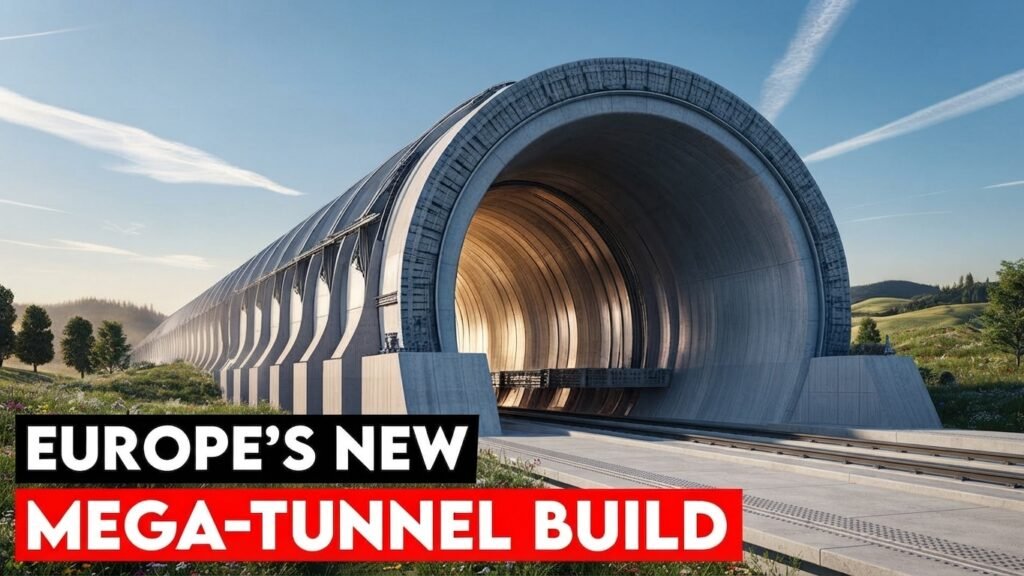
The immersion approach relies on dredging a massive trench across the seafloor, placing prefabricated concrete elements into it, and sealing them with backfill.
-
The Trench: Measuring 40 to 50 meters wide and 12 to 15 meters deep, the trench required specialized dredging barges to excavate millions of cubic meters of soil.
-
The Elements: The tunnel is built from 79 standard precast concrete sections (plus specialized technical units), each stretching 217 meters long and weighing an astonishing 73,500 tonnes.
-
Internal Layout: Inside, the structure features four main passageways—two dedicated to a four-lane highway, two for electrified rail tracks, and a continuous 3-meter-wide service passageway.
The service passageway functions as the tunnel’s “backstage.” It features a subfloor basement that houses all vital technical equipment, power distribution, and ventilation systems to keep traffic flowing safely.
Financial Architecture: Budgets, State Loans, and EU Backing
A mega-project of this scale requires immense fiscal coordination between nations. Originally budgeted at roughly 5 billion euros when approved by the Danish Parliament in 2009, cumulative cost adjustments, safety upgrades, and railway enhancements have pushed the total bill higher.
-
Funding Model: The primary financial engine relies on state-guaranteed loans taken out by Denmark, which will be systematically repaid through road and train toll revenues.
-
National Contributions: Denmark shoulders the vast majority of the construction and direct funding, while Germany handles the crucial land-based infrastructure and rail connections on its side.
-
European Union Support: Recognizing its strategic importance, the European Union classified the link as a priority transport infrastructure project under the Scandinavian-Mediterranean corridor, injecting substantial subsidies.

Hurdles, Controversies, and Environmental Safeguards
Despite its undeniable economic promise, the Fehmarnbelt project has faced continuous friction since its conceptualization before German reunification.
Political and Economic Debates
Critics have long questioned whether Cold War-era visions of connecting Copenhagen and Berlin remain optimal. Some groups historically advocated for alternative surface solutions—such as the Goser-Rostock bridge—arguing it would better serve eastern Germany. Furthermore, independent auditors have scrutinized cost escalations driven by modifications to railway speeds and local noise mitigation requirements.
Environmental Mitigation
Placing an 18-kilometer structure on the floor of the Baltic Sea inevitably raises red flags regarding marine ecosystems, water quality, and coastal habitats. To minimize disruption, developers utilized advanced precision-dredging technologies and strict environmental monitoring frameworks to protect local wildlife, fish stocks, and delicate seabed biomes throughout construction.
Frequently Asked Questions (FAQs)
1. How long is the Fehmarnbelt Tunnel?
The immersed tunnel stretches for approximately 18 kilometers, making it the longest combined road and rail immersed tunnel in the world.
2. How much will it cost to travel through the tunnel?
While final toll structures will be calibrated to help service the state-guaranteed loans, pricing is expected to remain competitive with historical ferry crossing fees.
3. Will the tunnel accommodate both cars and trains?
Yes. The structure features separate tubes housing a four-lane motorway and two electrified high-speed railway tracks.
4. How fast can travelers go inside the tunnel?
Cars can travel at speeds up to 110 km/h, while passenger trains can reach cruising speeds of up to 200 km/h.
5. How long does the ferry trip take compared to the tunnel?
The current ferry crossing takes about 45 minutes (excluding wait times), whereas the tunnel reduces transit time to 10 minutes by car and 7 minutes by train.
6. Who is building and managing the project?
The project is led by specialized engineering firms and consortiums—including Ramboll, Arup, and Vinci—under the oversight of developer Femern A/S.
7. What are the main environmental concerns?
Main concerns center on temporary seabed disruption, marine life displacement, and noise pollution during construction, which are managed via rigorous environmental impact assessments and specialized low-impact building techniques.