




As a sprawling urban center home to over 22 million residents, Lagos, Nigeria, is rapidly redefining what it means to be a modern African megacity. Long recognized as the cultural, economic, and financial engine of West Africa, Lagos is currently undergoing a massive structural evolution.
To keep pace with rapid urbanization, severe traffic challenges, and surging industrial demands, state authorities and private investors have committed tens of billions of dollars toward ambitious engineering feats. These initiatives span maritime logistics, heavy refining, aviation, urban rail mass transit, and coastal reclamation.
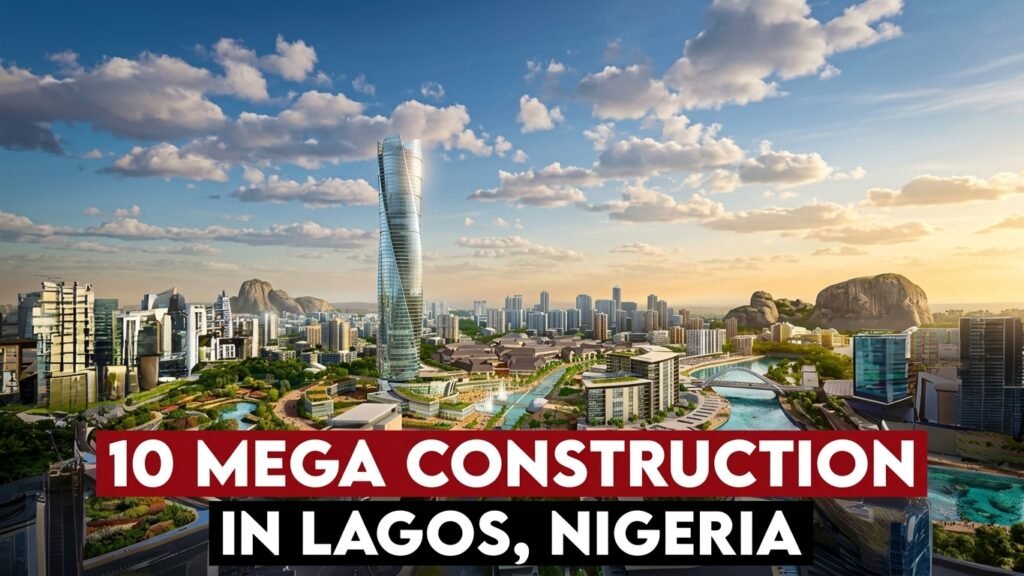
Below is an in-depth, structured breakdown of the top 10 mega projects actively reshaping the skyline, infrastructure, and commercial future of Lagos.
1. Eco Atlantic City: The “Dubai of Africa”
Eco Atlantic City is a master-planned, state-of-the-art urban development built directly on land reclaimed from the Atlantic Ocean, adjacent to Victoria Island. Spanning approximately 10 square kilometers, the project was envisioned not only as an ultra-modern business and residential zone but also as an environmental shield for the city.
Key Objectives and Impact
-
Coastal Defense: The perimeter of the city is protected by the “Great Wall of Lagos,” an armored sea barrier engineered to prevent catastrophic coastal erosion and storm surges that have historically threatened Victoria Island.
-
Financial District: Designed to serve as the future financial center of West Africa, complete with independent power supply, advanced fiber-optic networks, and private water treatment facilities.
-
Real Estate & Investment: Attracting substantial foreign direct investment (FDI), the city features high-rise commercial towers, luxury residential apartments, and dedicated marina districts.
| Feature | Specification |
| Land Area | ~10 Square Kilometers (Reclaimed) |
| Primary Goal | Erosion Control, Financial Hub, Luxury Housing |
| Location | Adjacent to Victoria Island, Lagos |
2. Lekki Deep Sea Port: A Gateway for West African Trade
Officially commissioned as one of West Africa’s deepest multi-purpose ports, the Lekki Deep Sea Port represents a $1.5 billion investment designed to transform Nigeria’s maritime logistics sector.
Technical and Operational Features
-
Draft Depth: At a depth of 16.5 meters, the port easily accommodates modern, ultra-large container vessels (ULCVs) that were previously unable to dock at older, shallower ports like Apapa and Tincan Island.
-
Smart Automation: Operates with advanced ship-to-shore cranes and computerized yard management systems to maximize cargo throughput and eliminate severe vessel turnaround delays.
-
Capacity: Capable of handling over 2.7 million TEUs (Twenty-Foot Equivalent Units) annually, making it a critical transshipment hub for the broader Gulf of Guinea region.
3. The Fourth Mainland Bridge: Easing Congestion Along the Eastern Corridor
Traffic congestion has long been a defining challenge for Lagosians, particularly along the routes connecting the mainland to the island. The proposed Fourth Mainland Bridge is a 38-kilometer infrastructure project designed to provide a vital alternative arterial route across the Lagos Lagoon.
Strategic Importance
-
Route Trajectory: The bridge connects Lagos Island through Abraham Adesanya (Ajah), running across the lagoon to Ikorodu and terminating near the Lagos-Ibadan Expressway.
-
Design Features: Built as an eight-lane carriageway, it includes dedicated Bus Rapid Transit (BRT) lanes, multiple interchanges, and strategically located toll plazas to regulate traffic flow.
-
Economic Relief: By diverting non-essential traffic away from the heavily congested Third Mainland Bridge, the project is structured to dramatically decrease transit times, lower commercial haulage costs, and unlock economic growth in Eastern Lagos.
4. Dangote Refinery: Revolutionizing Africa’s Energy Sector
Located within the Lekki Free Trade Zone, the $19 billion Dangote Refinery is a game-changing industrial asset. Recognized as the world’s largest single-train crude oil refinery, the facility was designed to shift Nigeria from a refined-fuel importer into a self-sufficient exporter.
[Crude Oil Input: 650,000 bpd]
       │
       ▼
[Advanced Processing & Catalytic Cracking]
       │
       ├────► Premium Motor Spirit (Petrol)
       ├────► Automotive Gas Oil (Diesel)
       ├────► Aviation Jet Fuel (Jet A-1)
       └────► Polypropylene & Petrochemicals
Macroeconomic Impact
-
Processing Capacity: Operates at a maximum capacity of 650,000 barrels per day (bpd).
-
Foreign Exchange Preservation: Significantly reduces the foreign exchange drain caused by importing refined petroleum products from international markets.
-
Regional Supply: Positioned to export refined products across West Africa and international markets, generating valuable foreign currency reserves for the nation.
5. Lekki Free Trade Zone (LFTZ): The Industrial Hub
Flanking the Lekki Deep Sea Port and the Dangote refinery complex, the Lekki Free Trade Zone is a master-planned economic enclave engineered to drive rapid industrialization and foreign investment.
Core Strategic Advantages
-
Tax and Regulatory Incentives: Offers operating companies complete tax holidays, duty-free importation of capital equipment, and streamlined administrative processing.
-
Integrated Sectors: Segregated into specialized zones catering to heavy manufacturing, chemical processing, logistics, technology hubs, and commercial real estate.
-
Employment Creation: Designed to create tens of thousands of direct and indirect skilled industrial jobs for the local workforce.
6. Lagos Blue Line Rail: Transforming Public Transit
The Lagos Blue Line Rail is an electric mass transit rail project managed by the Lagos Metropolitan Area Transport Authority (LAMATA). It runs east-west across the city to connect densely populated mainland communities with the commercial core on Lagos Island.
Phase 1 (Operational):  [Mile 2] ═══════ [Orile] ═══════ [National Theatre] ═══════ [Marina]
Phase 2 (Under Construction): [Okokomaiko] ─────── [Alaba] ─────── [Mile 2]
Key Operational Milestones
-
Phase 1 Execution: Spanning 13 kilometers from Mile 2 to Marina, Phase 1 is fully operational and powered by a dedicated high-voltage electricity grid.
-
Phase 2 Expansion: Extension works are underway to push the corridor further west to Okokomaiko, bringing the total length of the line to 27 kilometers.
-
Transit Capabilities: Designed to carry over 250,000 passengers daily upon full completion, cutting travel times from hours in highway traffic down to minutes.
7. Lekki-Epe International Airport: Expanding Air Capacity
To relieve severe pressure on the aging Murtala Muhammed International Airport (MMIA) in Ikeja, the Lagos State Government conceptualized the Lekki-Epe International Airport project.
Structural Overview
-
Capacity Goals: Planned as a modern multi-runway aviation facility capable of handling wide-body commercial aircraft such as the Airbus A380.
-
Geographic Alignment: Positions aviation infrastructure right next to the rapidly expanding industrial corridors of Lekki, Epe, and the Free Trade Zones.
-
Economic Value: Expected to serve as a major cargo transit hub, streamlining supply chains for regional manufacturing plants and international commercial enterprises.

8. Dangote Fertilizer Plant: Safeguarding Food Security
Sharing space within the vast industrial footprint of the Lekki corridor, the $2.5 billion Dangote Fertilizer Plant stands as one of the world’s largest complex urea and ammonia fertilizer manufacturing operations.
Agricultural and Economic Benefits
-
Production Volume: Engineered with a production capacity of 3 million metric tons of urea per annum.
-
Soil Productivity: Formulated specifically to optimize crop yields across diverse soil types found in West Africa.
-
Export Market: Fulfills 100% of local domestic demand in Nigeria while exporting surplus volume to international markets across South America, North America, and Europe.
9. Lagos Red Line Rail: The High-Capacity North-South Corridor
Complementing the east-west Blue Line, the Lagos Red Line Rail is a 37-kilometer mass transit corridor designed to move massive volumes of commuters along the city’s dense north-south highway axis.
Key Transit Nodes:
[Agbado] ──► [Ikeja] ──► [Oshodi] ──► [Yaba] ──► [Oyingbo / Marina]
Network Integration
-
Strategic Coverage: Traverses high-density commercial and residential areas, including major transport interchanges at Ikeja, Oshodi, and Yaba.
-
Shared Infrastructure: Shares designated corridor space with the Nigerian Railway Corporation (NRC) regional lines while utilizing dedicated elevated overpasses to avoid urban traffic cross-intersections.
-
Passenger Capacity: Projected to carry up to 500,000 commuters daily, vastly simplifying movement across the mainland urban sprawl.
10. Lekki-Epe Expressway Expansion: Enhancing Regional Arteries
The upgrade and expansion of the Lekki-Epe Expressway into a six-lane, high-capacity dual carriageway is a critical road infrastructure initiative supporting the rapid urban buildout of the Lekki Peninsula.
Project Deliverables
-
Traffic Flow: Widens the bottlenecked road corridor to accommodate heavy industrial transport traveling to and from the deep-sea port and refinery complex.
-
Corridor Modernization: Features reinforced rigid concrete paving, improved drainage channels to combat seasonal flooding, and modern LED street lighting infrastructure.
-
Real Estate Catalyst: Unlocks residential and commercial property development across suburban nodes such as Abijo, Eleko, and Epe town.
Frequently Asked Questions
Why are so many mega projects concentrated around the Lekki axis?
The Lekki Peninsula offers vast expanses of undeveloped land relative to the dense urban core of mainland Lagos. By clustering key infrastructure—such as the Lekki Deep Sea Port, the Dangote Refinery, the Free Trade Zone, and an airport—Lagos is building an integrated industrial and logistics city-within-a-city.
How do the Blue Line and Red Line rail systems differ?
The Blue Line runs primarily east-west (connecting mainland districts like Mile 2 and Okokomaiko to Lagos Island), utilizing a fully electrified, dedicated elevated rail system. The Red Line runs north-south (from Agbado down to Oyingbo/Marina), utilizing diesel-electric rolling stock along a shared, highly secured rail corridor.
How is Eco Atlantic City financed?
Eco Atlantic City is built entirely through a private-public partnership (PPP). The development is funded, executed, and managed by South Energyx Nigeria Limited (a subsidiary of the Chagoury Group) in partnership with the Lagos State Government.
What environmental measures are built into these mega projects?
Major projects integrate environmental protection systems. For example, Eco Atlantic City uses the engineered “Great Wall of Lagos” to mitigate coastal erosion, while new transport projects (like the electric Blue Line rail and dedicated BRT lanes) aim to cut greenhouse gas emissions by reducing road congestion.
How will these infrastructure projects impact small businesses?
Enhanced transportation networks lower the cost of moving goods, reduce transit times, and make key commercial hubs more accessible. Furthermore, increased power generation capacity and improved port efficiency eliminate costly logistics delays for local merchants.
Strategic Source Recommendations
For further technical reading on urban infrastructure development in emerging megacities, refer to the following authoritative resources:
-
The World Bank (Urban Development & Transport Sector): Comprehensive research papers on transit-oriented development and public-private partnership models in Sub-Saharan Africa.
-
Lagos Metropolitan Area Transport Authority (LAMATA Reports): Official strategic master plans detailing rail, bus, and inland waterway intermodal transport networks across Lagos State.
-
African Development Bank (AfDB Infrastructure Investment Studies): In-depth analysis covering large-scale industrial enclaves, deep-water port developments, and regional energy self-sufficiency across West Africa.