




Shaping the Future: 6 Mega Construction Projects Transforming Ethiopia
Ethiopia is experiencing a period of historic development, marked by monumental infrastructure and real estate endeavors. Embracing modern technology, sustainable design, and regional integration, the nation is aggressively modernizing its landscape. From world-class aviation hubs to massive hydroelectric dams, these six ongoing and completed mega projects showcase Ethiopia’s ambition to become an economic titan in East Africa.
1. The New Addis Ababa International Airport
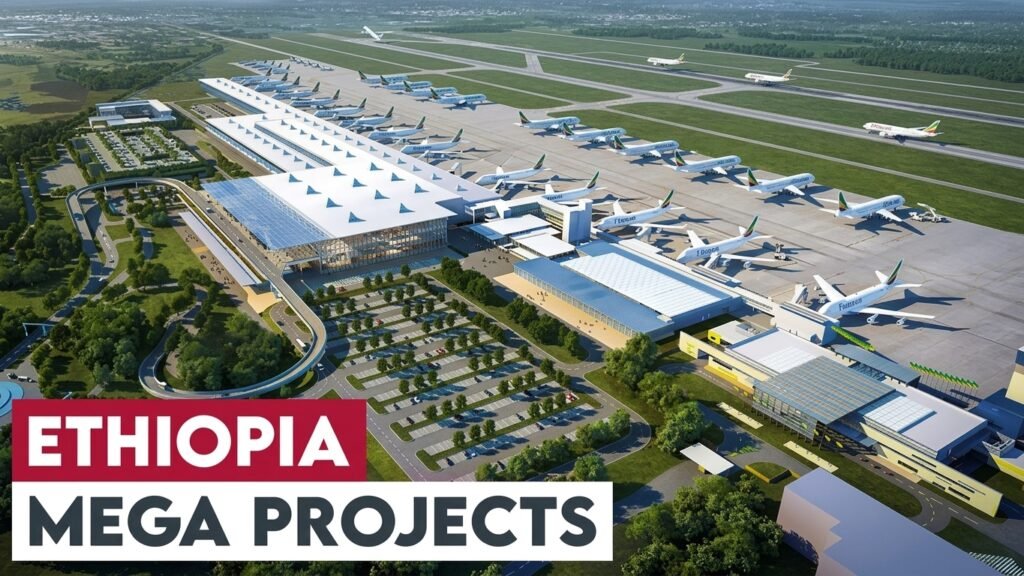
With a projected investment of $4 billion, the upcoming mega-airport located roughly 25 kilometers outside the capital is set to become the largest airport on the African continent. Led by Ethiopian Airlines, the facility is designed to handle over 100 million passengers annually, relieving severe congestion at Bole International Airport and radically elevating African aviation.
Beyond standard transit facilities, the development anchors a multi-faceted “Airport City” featuring:
Commercial Centers: International business parks and duty-free retail hubs.
Hospitality Infrastructure: Luxury accommodations tailored for global transit travelers.
Eco-Friendly Design: Cutting-edge technology focused on operational efficiency and environmental sustainability.
2. The Mesob Tower
Standing as a symbol of cultural pride and architectural innovation in the heart of Addis Ababa, the 70-story Mesob Tower is an architectural nod to the traditional Ethiopian mesob (woven basket used for serving food).
Carrying a $681 million budget, the skyscraper introduces luxury residential suites, a premium shopping mall, and a five-star hotel to the city skyline. It incorporates state-of-the-art energy-efficiency technology, setting a benchmark for future eco-friendly high-rises in urban East Africa while attracting tourism and foreign investment.
3. The Grand Ethiopian Renaissance Dam (GERD)
Situated on the Blue Nile River, the Grand Ethiopian Renaissance Dam (GERD) stands as Ethiopia’s flagship hydroelectric achievement. With an installed capacity of 5,150 megawatts, the project effectively doubles the nation’s electricity generation capacity.
| Key Metric | Details |
| Primary Objective | Clean energy generation, grid expansion, and power export |
| Regional Impact | Flood control, agricultural irrigation management |
| Capacity | 5,150 MW |
| Strategic Significance | Establishes Ethiopia as a dominant power exporter in Africa |
Despite complex regional geopolitics concerning downstream water management, the GERD serves as a cornerstone of national energy independence and economic self-reliance.

4. The LaGare Mixed-Use Development
The historic site of Addis Ababa’s old railway station is undergoing a $1.5 billion urban renewal project known as LaGare. Designed to blend modern commercial needs with historical preservation, this multi-purpose development spans high-end residential towers, hospitality spaces, and pedestrian-friendly retail zones.
LaGare sets international standards for urban living and sustainability, serving as a primary magnet for both local and foreign real estate investment as urban density in the capital grows.
5. The Addis Ababa–Djibouti Railway
As East Africa’s first modern, electrified cross-border railway, the $4 billion Addis Ababa–Djibouti Railway fundamentally changes how landlocked Ethiopia trades with the rest of the world.
Jointly owned by Ethiopia and Djibouti, the line drastically cuts freight transit times between Addis Ababa and the Port of Djibouti from three days down to 12 hours. This drastic reduction in logistical friction improves export efficiency, strengthens bilateral relations, and accelerates Ethiopia’s push to become a primary manufacturing hub.
6. Africa CDC Headquarters & LAPSSET Corridor
Ethiopia’s strategic development extends deeply into international cooperation and regional logistics through two other major endeavors:
Africa CDC Headquarters
Financed via an $80 million grant from China, this state-of-the-art facility in Addis Ababa acts as the continent’s central command post for public health. It centralizes Africa-wide disease surveillance, emergency response logistics, and medical capacity-building.
The LAPSSET Corridor Project
Part of a massive $34 billion regional infrastructure program, the Lamu Port-South Sudan-Ethiopia Transport (LAPSSET) corridor establishes vital multimodal links—including roads, pipelines, and railways—connecting Ethiopia directly to Kenya’s Lamu Port. This diversifies Ethiopia’s access to maritime trade routes, reducing single-port dependency and unlocking economic activity across East Africa.
Economic Outlook
These mega projects represent far more than steel and concrete; they serve as structural pillars for sustained growth across commerce, real estate, energy, and transport. As Ethiopia continues to execute these large-scale endeavors, its transforming infrastructure lays a firm foundation for long-term prosperity and regional leadership.