




The $40 Billion Race to Build America’s First High-Speed Railway
For over a century, the United States possessed one of the world’s most advanced rail networks, serving as the economic engine that connected industrial hubs, coastlines, and expanding frontiers. However, the mid-20th century marked a seismic shift. The rise of the interstate highway system and commercial jet travel diverted federal investments and engineering talent toward asphalt and aerospace, leaving intercity passenger rail largely stalled.
Today, while nations across Europe and Asia operate expansive bullet train networks reaching speeds of 200 mph (320 km/h) or higher, the United States remains the only major global economy without a fully dedicated high-speed rail corridor. A new chapter is unfolding. Driven by private enterprise, strategic public funding, and innovative right-of-way planning, a high-speed rail transformation is taking shape across North America.

1. The Historical Context: How American Rail Fell Behind
To understand America’s modern high-speed rail push, it is necessary to examine the decline of intercity passenger rail during the post-WWII era.
Post-War Infrastructure Shifts: During the 1950s and 1960s, massive federal subsidies funded the Interstate Highway System and airport infrastructure. Car travel quadrupled, and commercial air travel surged over fifteen-fold, draining passenger volume from private rail operators.
Brain Drain in Transportation Engineering: As passenger rail profitability collapsed, civil and mechanical engineering talent migrated toward aerospace, automotive, and defense industries, drying up rail-specific R&D inside the U.S.
The High-Speed Gap: The International Union of Railways (UIC) defines high-speed rail as newly built lines supporting speeds of at least 155 mph (250 km/h). While Amtrak’s Acela express reaches 150 mph along localized stretches of the Northeast Corridor, shared tracks, aging overhead catenary systems, and sharp curvature limit its overall average speeds, leaving the U.S. without a true UIC-compliant high-speed line.
2. Public vs. Private Models: The Two High-Speed Approaches
America’s high-speed rail race is defined by two fundamentally different structural models: state-led public megaprojects and privately financed infrastructure ventures.
The Public Model: California High-Speed Rail (CAHSR)
Initiated by California voters via Proposition 1A, the California High-Speed Rail project aims to connect San Francisco and Los Angeles via the Central Valley at operating speeds up to 220 mph.
Scale and Scope: Spanning 500 miles for Phase 1, the project requires extensive mountain tunneling through the Pacheco Pass and Tehachapi Mountains, major grade separations, and complex land acquisitions across thousands of private parcels.
Current Construction Status: Active heavy construction is concentrated along an initial 119-mile segment in the Central Valley (Merced to Bakersfield), where dozens of major grade separations, viaducts, and river crossings have been completed.
Challenges: CAHSR faces significant cost escalations, political delays, environmental litigation, and land eminent domain disputes, highlighting the friction inherent in large-scale public land condemnation across densely populated corridors.
The Private Model: Brightline and Brightline West
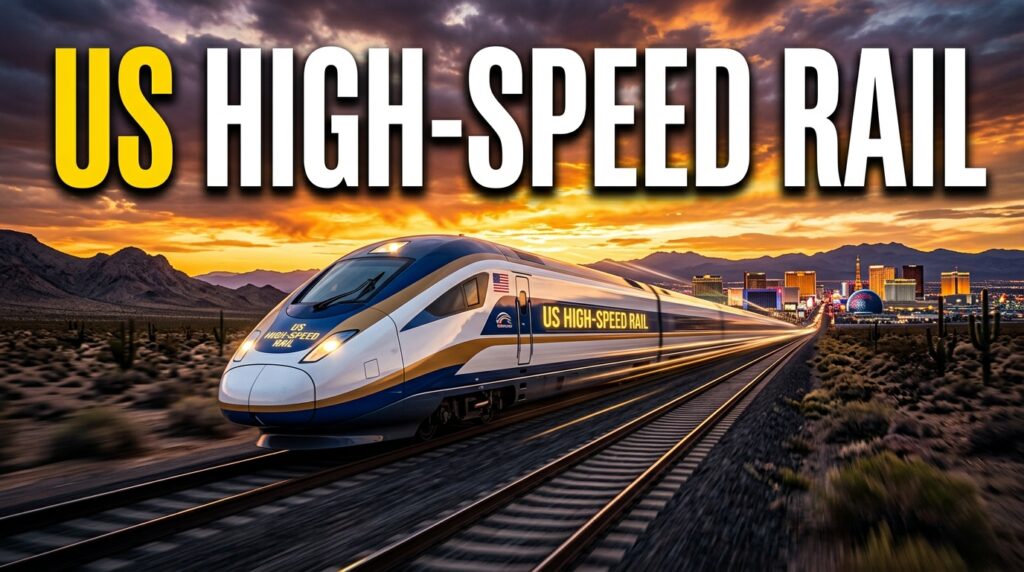
Florida-based Fortress Investment Group introduced a private, real-estate-integrated rail model via Brightline, opening a 125-mph intercity passenger line connecting Miami, Fort Lauderdale, West Palm Beach, and Orlando. Building on that foundation, Brightline West represents a multi-billion-dollar project to construct America’s first true high-speed electric rail line linking Southern California to Las Vegas.
The I-15 Right-of-Way Advantage: Instead of acquiring thousands of private agricultural or urban properties, Brightline West secured agreements to build the vast majority of its 218-mile track alignment directly within the median strip of Interstate 15.
Simplified Engineering: Operating primarily inside an established highway corridor drastically reduces land acquisition litigation, simplifies environmental impact clearances, and speeds up site preparation.
Key Route Specs: Running from Las Vegas, Nevada, to Rancho Cucamonga, California (connecting directly to the Los Angeles Metrolink commuter network), trains will operate at speeds up to 186 mph (300 km/h), completing the trip in approximately 2 hours and 10 minutes.
3. Engineering and Civil Challenges on the West Coast
Despite utilizing highway medians, building a high-speed line across the American Southwest requires solving formidable civil engineering problems:
Navigating Cajon Pass: The line must traverse the steep, seismically active Cajon Pass in Southern California, where heavy highway traffic, fault lines, and sharp elevation drops require custom viaduct engineering and heavy grading.
Extreme Thermal Cycling: The Mojave Desert experiences extreme temperature shifts between summer highs and winter freezes, requiring continuously welded rail (CWR) equipped with specialized tensioners to prevent track buckling under extreme heat.
Electrification Infrastructure: Fully electric high-speed trainsets demand high-voltage overhead catenary systems fed by dedicated traction power substations spaced across remote desert stretches, alongside wildlife protection fencing to protect desert tortoise habitats.
Summary of Key American High-Speed Rail Projects
Brightline West: 218 miles connecting Las Vegas, NV to Rancho Cucamonga, CA; features 186 mph electric trainsets operating primarily in the I-15 median.
California High-Speed Rail (CAHSR): 500 miles connecting San Francisco to Los Angeles/Anaheim at 220 mph; initial 119-mile segment under active construction in the Central Valley.
Brightline Florida: 235 miles connecting Miami to Orlando; operating up to 125 mph as a private diesel-electric intercity passenger service.
Texas Central Railway: Proposed 240-mile private high-speed line connecting Dallas and Houston using Japanese N700S Shinkansen technology at 205+ mph.
Amtrak Acela (Northeast Corridor): 457 miles connecting Boston, New York, and Washington D.C.; reaches localized top speeds of 150 mph on shared infrastructure.
Frequently Asked Questions (FAQs)
1. Is Brightline West considered a true high-speed rail system?
Yes. Brightline West is engineered as a fully electric high-speed rail line with top operating speeds of 186 mph (300 km/h) on dedicated tracks, meeting international UIC high-speed standards.
2. Why is Brightline West building in the Interstate 15 median?
Utilizing an existing state highway median avoids the multi-billion-dollar costs and decade-long legal delays associated with buying thousands of private properties through eminent domain, dramatically shortening project construction timelines.
3. How will travelers connect from Rancho Cucamonga to downtown Los Angeles?
The Rancho Cucamonga station is designed as a multi-modal transit hub connecting directly to the Metrolink San Bernardino Line, allowing passengers to transfer seamlessly onto regional commuter rail to reach LA Union Station.
4. What is the current status of the California High-Speed Rail project?
Construction is actively progressing across a 119-mile segment in the Central Valley between Merced and Bakersfield, with over 60 major grade separations, bridges, and viaduct structures completed.