




Engineering Might: Germany’s Top 10 Colossal Infrastructure & Industrial Megaprojects
Germany has long been globally recognized as an engineering powerhouse. From iconic cultural venues and high-tech manufacturing plants to massive energy transition schemes and trans-European transport corridors, the country’s infrastructure projects push the limits of modern civil engineering and architecture.
However, building at this scale often brings significant complexities, ranging from environmental scrutiny and legal challenges to soaring budgets and construction delays. This article breaks down the top 10 most expensive megaprojects in Germany, examining their technical scope, financial investments, and regional impacts.

1. Top 10 High-Cost German Megaprojects
1. The Intel Magdeburg Gigafactory (Magdeburg, Saxony-Anhalt)
Estimated Investment: ~$33 Billion (€30+ Billion)
Overview: Positioned as the cornerstone of Europe’s semiconductor independence strategy, Intel planned a massive silicon wafer manufacturing complex in Magdeburg. Intended to produce cutting-edge sub-2nm chips for third-party clients, the project saw major timeline shifts and ultimate restructuring due to global market shifts and corporate spending re-evaluations.
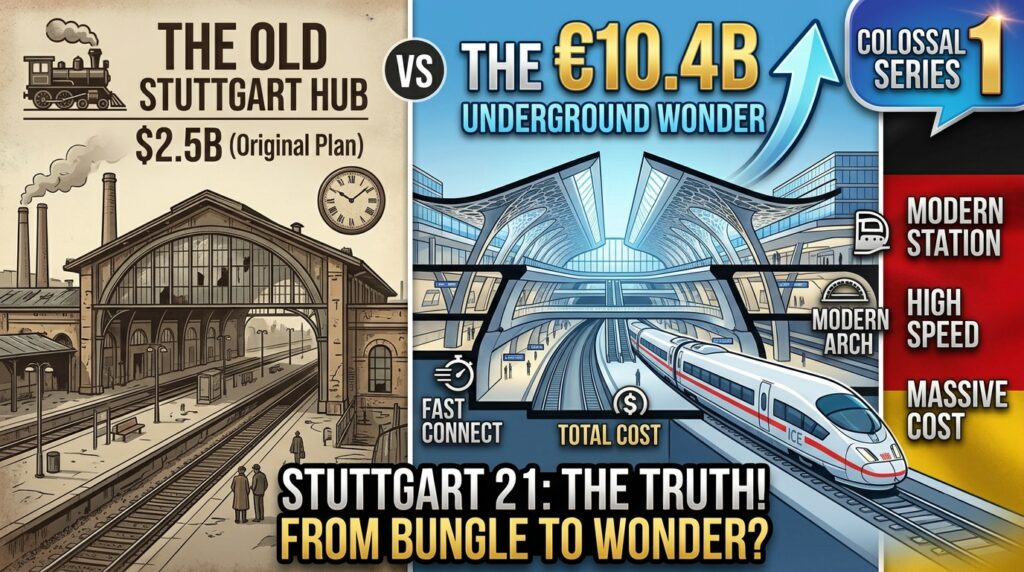
2. Stuttgart 21 Railway Realignment (Stuttgart, Baden-Württemberg)
Estimated Investment: ~$10.4 Billion
Overview: One of Europe’s most radical railway modernizations, Stuttgart 21 rotates the city’s main terminal station by 90 degrees and moves it underground to transform it into a continuous transit hub. Highlighting the project is the station hall’s striking roof structure, supported by 28 massive, chalice-shaped concrete pillars (Lichtaugen) that allow daylight to illuminate the subterranean platforms below.
3. The Fehmarnbelt Fixed Link & German Fehmarn Connection (Fehmarn, Schleswig-Holstein)
Estimated Investment: ~$7.8 Billion (German & Joint Rail/Road Access)
Overview: Connecting Germany’s Fehmarn Island to the Danish island of Lolland across the Fehmarn Belt, this project replaces ferry routes with the world’s longest immersed tunnel (18 km). The project features a two-tube railway and a four-lane motorway that will cut travel times between Hamburg and Copenhagen down to under three hours.
4. Berlin Brandenburg Airport BER (Willy Brandt) (Schönefeld, Brandenburg)
Estimated Investment: ~$7.5 Billion
Overview: Built to unify Berlin’s post-Cold War air traffic (replacing Tegel, Schönefeld, and Tempelhof), BER became famous for its long construction saga, marked by smoke extraction failures and regulatory delays. Originally budgeted at $2 billion with a 2011 opening, the mega-airport ultimately opened nearly a decade late after extensive systems overhauls.
5. Tesla Giga Berlin-Brandenburg (Grünheide, Brandenburg)
Estimated Investment: ~$5.5 Billion
Overview: Tesla’s first European manufacturing hub was constructed in record time despite bureaucratic hurdles. Employing over 10,000 workers, the facility integrates EV assembly with a high-capacity battery cell production plant, serving as a critical hub for Europe’s electric vehicle transition.
6. Frankfurt Airport Terminal 3 (Frankfurt am Main, Hesse)
Estimated Investment: ~$4.3 Billion
Overview: Designed to handle an additional 19 million passengers annually, Terminal 3 expands Europe’s premier aviation hub. Constructed on the southern side of the airport grounds, the terminal integrates an extended autonomous SkyLine people-mover train to seamlessly connect transit passengers to Terminals 1 and 2.
7. Hohe See & Albatross Offshore Wind Parks (North Sea)
Estimated Investment: ~$2.4 Billion
Overview: Located nearly 100 kilometers offshore in the North Sea, these dual wind farms incorporate 112 giant turbines generating roughly 610 megawatts of clean energy—enough to power a city the size of Munich while significantly advancing Germany’s Energiewende goals.
8. FOUR Frankfurt Skyscraper District (Frankfurt am Main, Hesse)
Estimated Investment: ~$2.1 Billion
Overview: Redefining the financial capital’s skyline, FOUR Frankfurt is an urban density project consisting of four high-rise towers up to 233 meters tall built on a shared multi-story podium base. The complex mixes office spaces, apartments, hotels, and retail to create an integrated multi-use district.
9. Datteln 4 Coal-Fired Power Plant (Datteln, North Rhine-Westphalia)
Estimated Investment: ~$1.6 Billion
Overview: Constructed to supply traction current directly to Deutsche Bahn’s railway grid alongside regional residential power, Datteln 4 faced a long legal battle over municipal planning permits and environmental challenges before finally entering service as one of Europe’s most modern hard-coal power plants.
10. The Elbphilharmonie Concert Hall (Hamburg)
Estimated Investment: ~$900 Million (€866 Million)
Overview: Sitting atop a historic brick warehouse in Hamburg’s HafenCity, the “Elphi” features a dramatic wave-shaped glass facade housing a state-of-the-art 2,100-seat concert hall engineered by Nagata Acoustics. Despite rising from an initial $82 million estimate, it has become an iconic cultural symbol of modern Germany.
Frequently Asked Questions (FAQs)
1. What is the current status of the Intel Magdeburg Gigafactory?
While initially announced as an $85+ billion European chip strategy cornerstone, Intel paused construction and delayed the project’s timeline to re-evaluate capital spending and foundry demand.
2. Why did the Stuttgart 21 rail project cause so much public controversy?
Stuttgart 21 faced intense public opposition due to massive cost increases, environmental concerns regarding mineral spring protection under the city, the demolition of parts of the historic station building, and years of urban traffic disruption.
3. How does an immersed tunnel like the Fehmarnbelt Fixed Link work?
Instead of using a tunnel-boring machine under the seabed, large pre-cast concrete tunnel sections are fabricated on land, towed out into the ocean, submerged into a pre-dredged trench on the sea floor, and sealed together underwater.
4. When is Frankfurt Airport Terminal 3 scheduled to fully open to passengers?
While construction of structural piers like Pier G was completed earlier, the entire Terminal 3 complex is scheduled to open for full passenger operations by 2026.