




Transforming Urban Transit: How the $64 Billion Sydney Metro Project Is Reshaping Australia’s Largest City
Sydney, a bustling metropolis on Australia’s East Coast, is undergoing a remarkable urban transformation. Driven by a rapidly expanding population, the city is in the middle of constructing one of the most extensive suburban rail infrastructure endeavors on Earth.
With an overarching budget exceeding $64 billion, the landmark Sydney Metro project is set to fundamentally redesign the region’s urban landscape. By 2030, this high-tech transport initiative will deliver 113 kilometers of brand-new metro rail alongside 46 state-of-the-art stations.
By bridging historic geographical divides and upgrading legacy public transit lines into an automated transit network, Sydney is setting a global benchmark for modern megacity connectivity.
The Geographic Challenge: Conquering Sydney Harbour
Sydney’s world-famous harbors have long defined its iconic aesthetic, but for urban planners, they present a major geographic hurdle. The natural body of water creates a strict divide between the city’s Northern and Southern shores, creating persistent traffic bottlenecks for commuters.
Throughout its history, Sydney has met these environmental barriers head-on through ambitious engineering feats:
-
The Sydney Harbour Bridge (1932): The original landmark structure that physically linked the Northern and Southern shores with its massive steel arch.
-
The Sydney Harbour Tunnel (1992): A subsea dual carriageway built to relieve growing vehicular traffic directly beneath the harbor’s floor.
-
The Sydney Metro (Present): The next generation crossing—moving away from heavy road traffic and traditional rail toward a fully automated, high-frequency underground network.
Breakdown of the Four Sydney Metro Delivery Phases
To execute a project of this unprecedented scope, project planners structured the network extension across four distinct phases.
| Metro Phase | Key Corridor / Destinations | Track Distance | Key Infrastructure Highlights | Status / Target |
| Phase 1: Metro Northwest | Chatswood to Rouse Hill | 36 km | 15 km of twin tunnels, 13 converted/new stations | Operational (2019) |
| Phase 2: Metro West | Parramatta to Sydney CBD | 24 km | Under-harbour/ground rapid link connecting Sydney’s second CBD | Target: ~2030–2032 |
| Phase 3: Western Sydney Airport | St Marys to Aerotropolis | 23 km | Direct connection to the new international airport hub | Target: 2026/2027 |
| Phase 4: City & Southwest | Chatswood to Bankstown | ~30 km | Subsea harbour tunneling, 11 line conversions | Phased Openings |
Phase 1: Sydney Metro Northwest (Completed)
Becoming fully operational in May 2019, Phase 1 served as the critical proof-of-concept for driverless rail in Australia. Spanning 36 kilometers of track from Chatswood out to Rouse Hill, it brought 15 kilometers of twin-bore tunnels and 13 operational stations to Sydney’s rapidly developing outer north-west suburbs.
The successful delivery of the Northwest line laid the foundational systems, depot management facilities, and signaling protocols necessary to validate expanding the driverless footprint across the remainder of the city.
Phase 2: Sydney Metro West
Representing an estimated $25 billion investment, Phase 2 focuses entirely on the critical east-west economic spine of Greater Sydney.
Parramatta (Second CBD) ---> Olympic Park ---> The Bays Precinct ---> Sydney CBD
Parramatta is quickly evolving into Sydney’s commercial and cultural second downtown. By laying 24 kilometers of underground metro track directly connecting Parramatta to the primary Sydney CBD, Phase 2 will cut standard commute times in half while doubling overall rail capacity along this high-density corridor.
Phase 3: Western Sydney Airport Link
Set to open in alignment with the brand-new Western Sydney International (Nancy-Bird Walton) Airport, Phase 3 represents an $11 billion infrastructure build.
With the new international terminal projected to process over 10 million annual passengers, integrating dedicated mass transit early is vital. This 23-kilometer rail spur links existing outer suburban lines at St Marys directly to the airport terminal and the surrounding Aerotropolis, driving immense commercial development across Western Sydney.
Phase 4: City & Southwest – The Project’s Engineering Masterpiece
The most complex operational undertaking of the network belongs to Phase 4: Sydney Metro City & Southwest. This leg converts 11 legacy stations along the old Bankstown line to handle automated rolling stock while driving a new 15.5-kilometer twin tunnel alignment straight through the central business district and beneath Sydney Harbour itself.
Engineering Marvel: The Victoria Cross Station Cavern
Located deep beneath North Sydney, engineers excavated Australia’s largest underground railway cavern at Victoria Cross Station.
       SURFACE LEVEL / NORTH SYDNEY STREETS
===================================================
  |                                             |
  |  Depth: ~40 Metres Underground              |
  |                                             |
  v                                             v
+-------------------------------------------------+
|          VICTORIA CROSS STATION CAVERN          |
|                                                 |
|  * Length: 265 Metres                           |
|  * Width:  25 Metres                            |
|  * Height: 20 Metres                            |
+-------------------------------------------------+
Carved out of solid bedrock, this mammoth subterranean space houses multi-level mezzanine floors, massive high-speed escalator banks, and polished platform zones designed to seamlessly transfer thousands of commuters per hour out of the deep earth up to surface level.
Under the Harbour: The Fleet of Subterranean Tunnel Boring Machines
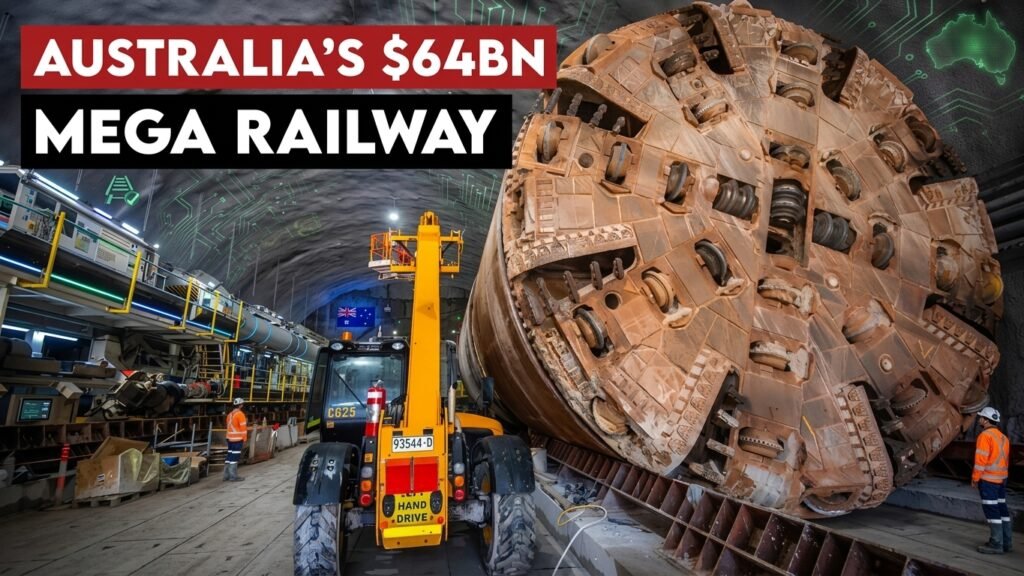
Navigating Sydney’s complex geotech landscape required a specialized fleet of massive Tunnel Boring Machines (TBMs).
Across the entire program, 16 individual TBMs have been deployed beneath the city:
-
Weight: Over 1,100 tonnes each
-
Length: Up to 120 meters long
-
Operational Depth: 35 to 58 meters below street level
-
Average Pace: ~120 meters per week through rock six times harder than standard concrete
Navigating the Seabed: Slurry TBM Technology
To cut through the variable silt, clay, and dense Hawkesbury sandstone forming the floor of Sydney Harbour, engineers deployed a specialized Slurry TBM. By pumping liquid fluid directly to the cutter head face, the machine safely balanced external hydrostatic water pressure, allowing crew members to bore 40 meters below the harbor surface without risk of collapse or water ingress.
By the time the system expansion reaches completion, these TBMs will have excavated well over 56 kilometers of combined subterranean tunnels—a distance greater than the English Channel crossing between Dover and Calais.

Preparing Sydney for Mid-Century Growth
Demographic projections indicate that Sydney’s population could expand by up to 60% by the middle of the 21st century. While highway projects expand road capacity, heavy reliance on private vehicles remains unsustainable.
The introduction of driverless turn-up-and-go rapid transit directly addresses long-term urban livability:
-
Traffic Decongestion: Removes thousands of commuter vehicles from congested harbour bridges and bottlenecks daily.
-
Air Quality Improvements: Zero direct emissions from fully electric, high-capacity driverless train fleets.
-
The “30-Minute City”: Enhances economic mobility by placing major employment, healthcare, and educational hubs within a 30-minute transit window for suburban residents.
Frequently Asked Questions (FAQs)
What makes the Sydney Metro different from traditional Sydney Trains?
The Sydney Metro operates as a fully automated, driverless rapid transit system on a dedicated, single-deck fleet. Unlike Sydney’s traditional double-decker suburban trains, the Metro runs on a high-frequency “turn-up-and-go” model where passengers do not need a timetable.
How deep are the Sydney Metro tunnels under Sydney Harbour?
The twin tunnels run approximately 40 meters below the surface of Sydney Harbour, carving deep through the dense Sydney sandstone bed to ensure structural integrity and prevent water infiltration.
When will the entire Sydney Metro expansion be complete?
While Phase 1 (Northwest) opened in 2019, subsequent phases are rolling out in stages. The Western Sydney Airport line targets a 2026/2027 opening, with the full multi-line network—including Metro West—scheduled to be fully integrated by 2030–2032.
How many TBMs were used to construct the tunnels?
A total of 16 specialized Tunnel Boring Machines (TBMs) were commissioned across the various phases of the Sydney Metro network expansion, including dedicated Slurry TBMs for subsea excavation.
What is the total budget for the Sydney Metro project?
The cumulative investment across all four phases—including Northwest, City & Southwest, West, and Western Sydney Airport—is estimated at approximately $64 billion, making it one of the largest infrastructure undertakings in Australian history.
Strategic Value & External Resources
To explore the engineering standards, urban planning frameworks, and environmental assessments shaping Sydney’s mega projects, consult these authoritative references:
-
Infrastructure Australia: Independent research and strategic auditing on major Australian transport infrastructure programs.
-
Transport for NSW: Official government management agency overseeing state transport networks and integration strategies.
-
Sydney Metro Official Project Portal: Detailed real-time construction updates, planning documents, and station layout breakdowns.