Unconquered: The History, Culture, and Wonders of Ethiopia
Few nations on Earth possess a legacy as deep and unbroken as Ethiopia. Nestled in the Horn of Africa, this extraordinary country stands out as a beacon of African independence—one of the only nations on the continent to never be colonized by a foreign power. That independence allowed its ancient writing systems, architectural styles, and distinct religious traditions to evolve continuously over millennia.
From its origins as the cradle of early human ancestors and trade empires to its modern identity as a diplomatic capital, Ethiopia is a land defined by dramatic contrasts, enduring faith, and breathtaking geography.
1. The Ancient Eras: Empires, Dynasties, and Legend
Ethiopia’s history spans thousands of years, interwoven with trade, religion, and royal lineages that trace back to antiquity.
       [Aksumite Empire]
   (Centuries BCE – 10th Century CE)
             │
             ▼
      [Zagwe Dynasty]
  (10th Century – 1270 CE)
             │
             ▼
    [Solomonic Dynasty]
  (1270 CE – 20th Century)
-
The Aksumite Empire: At its peak, the Kingdom of Aksum was one of the world’s four great powers alongside Rome, Persia, and China. Controlling trade routes between Africa, the Middle East, and Asia, Aksum converted to Christianity in the 4th century CE under King Ezana. Rulers traced their lineage to the biblical union of King Solomon and the Queen of Sheba.
-
The Zagwe Dynasty: Following the decline of Aksum around the turn of the millennium, the Zagwe Dynasty rose to power. Their most lasting legacy is the city of Lalibela, where monumental churches were carved directly down into subterranean rock.
-
The Solomonic Dynasty: Restored in 1270 CE, the Solomonic lineage governed the Ethiopian Empire (historically known as Abyssinia) for centuries, preserving a unique feudal and cultural system up through the mid-20th century.
2. Unconquered: How Ethiopia Defeated Colonization
During the late 19th-century “Scramble for Africa,” European powers partitioned virtually the entire continent. Ethiopia stood as a major exception, fiercely preserving its sovereignty through strategic leadership, geographical defenses, and national unity.
The Battle of Adwa (1896)
When the Kingdom of Italy attempted to expand its territorial claims into Ethiopia under the contested Treaty of Wuchale, Emperor Menelik II unified the country’s diverse regional leaders. On March 1, 1896, Ethiopian forces met the invading Italian army at the Battle of Adwa. The decisive Ethiopian victory forced Italy to sign the Treaty of Addis Ababa, unconditionally recognizing Ethiopia’s full independence.
Resistance During WWII
Though Fascist Italy briefly occupied parts of the nation from 1936 to 1941 following a brutal invasion, Ethiopian guerrilla fighters (Arbegnoch) maintained constant resistance. By 1941, Allied forces and local fighters expelled the occupiers, restoring Emperor Haile Selassie I to the throne.
3. Extreme Landscapes: A Geography of Contrasts
Ethiopia’s topography varies from alpine mountain peaks to one of the lowest, hottest places on Earth.
  Highlands / Rift Valley / Lowlands Profile

   4,500m ── Simien Mountains (Ras Dashen)
          │   ▲
          │  / \   Highland Plateaus (High agricultural yield)
   2,000m ──/───\────────────────────────
          │      \  Great Rift Valley (Lakes & geothermal activity)
     0m ──│───────\──────────────────────
   -125m  └───┐    \  Danakil Depression (Sulfur springs & salt flats)
              └────┴─────────────────────
-
The Simien & Bale Mountains: These high-altitude Afroalpine regions feature dramatic escarpments and harbor rare endemic wildlife, including the critically endangered Ethiopian wolf and the Gelada baboon.
-
The Great Rift Valley: Splitting the country from northeast to southwest, this geological trench is home to a chain of vibrant Rift Valley lakes, including Lake Zway and Lake Abijatta, which host massive bird populations like pelicans and flamingos.
-
The Danakil Depression: Located in the Afar region along the border with Eritrea and Djibouti, this hyper-arid basin sits over 100 meters below sea level. Characterized by active volcanoes, yellow-green hydrothermal sulfur fields, and vast salt flats, it is one of the most extreme environments on the planet.
-
The Blue Nile & Lake Tana: Originating at Lake Tana in the northern highlands, the Blue Nile (Abay) supplies the majority of the water that flows into the main Nile River, serving as a critical vital link for northeastern Africa.
4. Peoples, Languages, and Cultural Diversity
With a population of over 120 million people, Ethiopia is home to around 80 distinct ethnic groups, each contributing to a rich mosaic of language, music, and social customs.
Major Ethnic Groups & Cultural Hubs
-
The Oromo: The largest ethnic group in Ethiopia, historically known for their traditional Gadaa system—an ancient, egalitarian social and political governance structure.
-
The Amhara: Concentrated in the central and northern highlands, the Amhara have historically exercised significant influence over national governance, literature, and the spread of Ethiopian Orthodox Christianity.
-
The Tigrayans: Inhabiting the far northern highlands, they maintain deep historic ties to the ancient Aksumite civilization and early Christian monuments.
-
The Afar: Nomadic pastoralists who have adapted to survive in the scorching climate of the Danakil desert through complex clan structures and salt trade networks.
Script and Language
Unlike most African nations that adopted European alphabets during the colonial era, Ethiopia relies on Ge’ez (or the Ethiopic script)—an ancient abugida writing system that remains in active daily use for writing Amharic, Tigrinya, and liturgical texts.
5. Living Heritage of the Omo Valley
In the far south of the country lies the Lower Omo Valley, a UNESCO World Heritage site celebrated for its cultural diversity and ancestral traditions.
+───────────────────+───────────────────────────────────────────────────+
| Community         | Notable Cultural Feature / Tradition              |
+───────────────────+───────────────────────────────────────────────────+
| Hamer             | Bull Jumping ceremony (a male rite of passage)    |
| Mursi             | Crafting and wearing decorative clay lip plates   |
| Karo              | Intricate white-chalk body and face painting      |
| Bana              | Walking on high stilts for herding and ceremonies |
+───────────────────+───────────────────────────────────────────────────+
6. Lalibela: The Rock-Hewn “New Jerusalem”
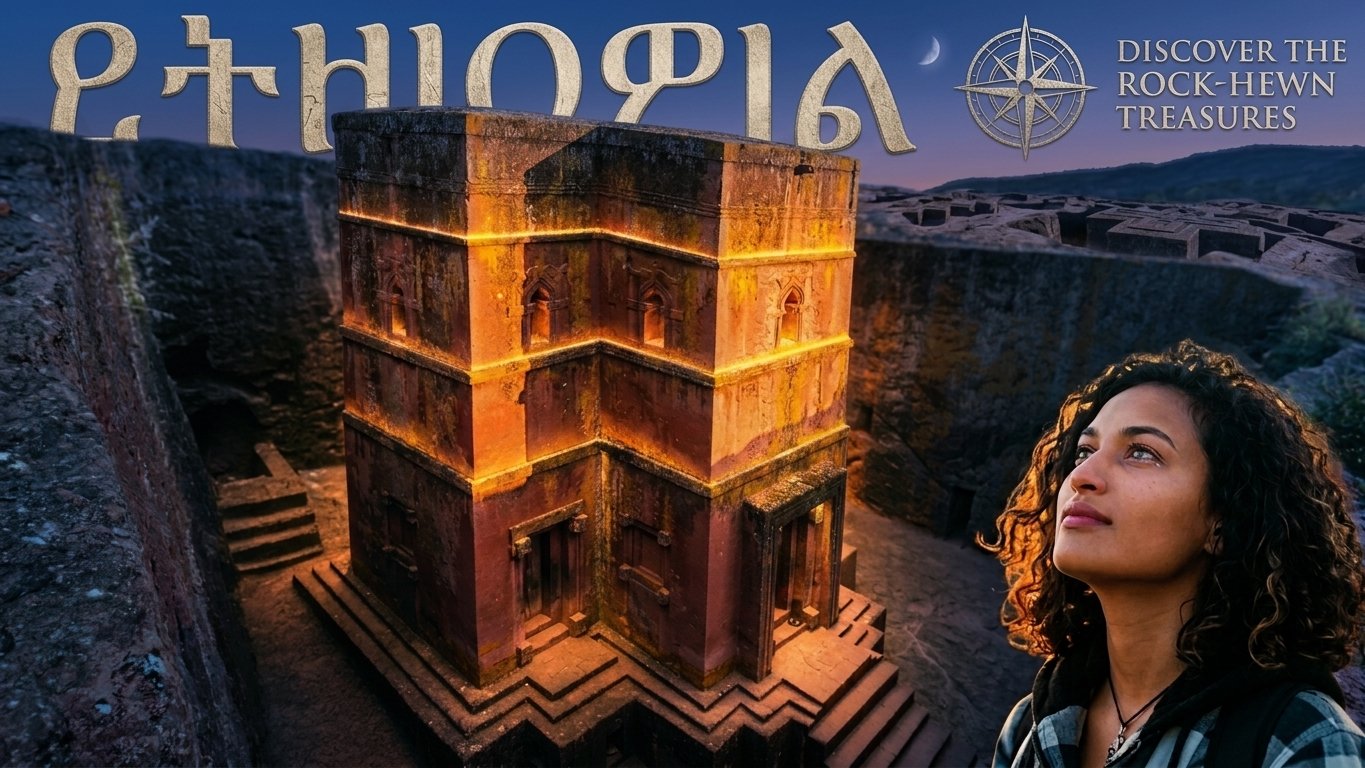
Situated in the mountainous Amhara region, Lalibela is home to 11 monolithic medieval churches carved entirely out of solid volcanic rock.
Commissioned in the 12th and 13th centuries by King Lalibela—who sought to create a “New Jerusalem” after Muslim conquests made travel to the Holy Land difficult for pilgrims—these structures were chiseled downward into the earth rather than built from the ground up.
-
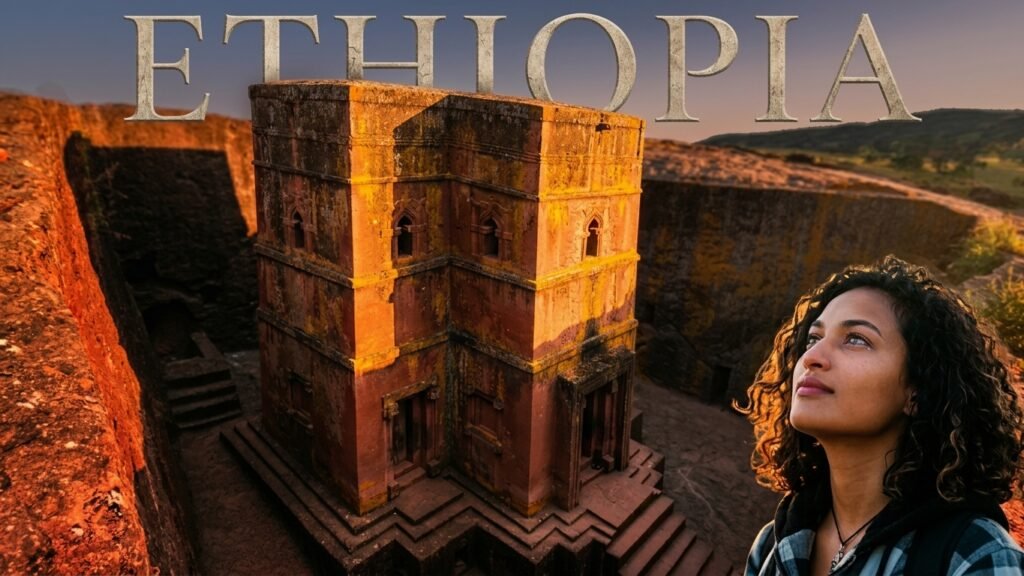
Biete Ghiyorgis (Church of St. George): The most famous of the 11 churches, carved in the precise shape of a Greek cross and standing in a deep, excavated pit.
-
Interconnected Tunnels: The churches are connected by an intricate subterranean system of drainage ditches, trenches, catacombs, and ceremonial passageways.
-
Living Worship: Lalibela is not merely a historical monument; it remains an active pilgrimage site for millions of Ethiopian Orthodox believers, especially during major holy days such as Genna (Christmas) and Timkat (Epiphany).
7. Modern Ethiopia: Balancing Legacy and Growth
Today, Ethiopia is organized as a Federal Democratic Republic. Its capital, Addis Ababa (“New Flower”), serves as the diplomatic heart of Africa—housing the headquarters of both the African Union (AU) and the United Nations Economic Commission for Africa (UNECA).
While navigating complex regional dynamics and modern economic challenges, the country continues to invest heavily in renewable energy, infrastructure, and the preservation of its irreplaceable cultural heritage. Ethiopia remains an unparalleled destination where deep antiquity, rich biodiversity, and living traditions meet.
FAQs
1. Why was Ethiopia never colonized by European powers?
Ethiopia successfully preserved its independence primarily due to a strong sense of national identity, mountainous natural defenses, strategic diplomacy, and a decisive victory over invading Italian forces at the Battle of Adwa in 1896 under Emperor Menelik II.
2. How were the churches of Lalibela built?
The 11 churches were not built with blocks or mortar; instead, medieval stonemasons carved them downward directly out of solid basaltic rock. They excavated deep trenches around giant blocks of stone and then hollowed out doors, windows, altars, and columns inside.
3. What is the primary language spoken in Ethiopia?
While Ethiopia has around 80 different local languages, Amharic and Afaan Oromo are among the most widely spoken. Amharic serves as the official working language of the federal government, written in the ancient Ge’ez script.
4. What rare wildlife lives in Ethiopia’s national parks?
Ethiopia’s high-altitude ecosystems are home to rare endemic species, including the Ethiopian wolf (the world’s most endangered canid), the Gelada baboon, and the Walia ibex (found in the Simien Mountains).