




When Ambition Outpaces Practicality: The World’s Most Infamous Infrastructure Failures
1. Introduction: The Risks of Misguided Mega Projects
When Grand Visions Fall Short
In the world of civil engineering and urban planning, history is filled with grand megaprojects that promised sweeping economic transformation but ultimately delivered little. From multi-billion-dollar highways that bypass major commercial centers to eerily empty ghost cities, these ventures frequently come with staggering financial price tags.
Lessons in Poor Planning and Forecasting
These infamous infrastructure failures highlight the dangerous gap between political ambition and practical feasibility. Characterized by severe underutilization, heavy public controversy, and astronomical cost overruns, these projects serve as permanent cautionary tales regarding the critical importance of rigorous preliminary studies, environmental accountability, and realistic demand forecasting.
2. Number 1: Interstate H3 (Hawaii, United States)
An Engineering Marvel with Astronomical Costs
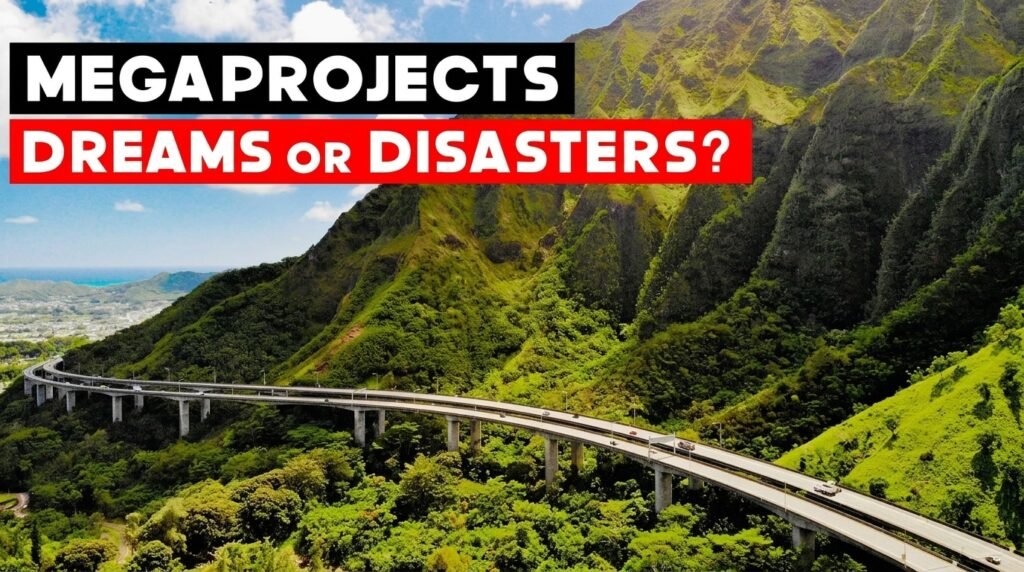
Spanning 26 kilometers across some of Hawaii’s most breathtaking natural scenery, the Interstate H3 was initially envisioned in the 1960s as a vital military necessity to connect the Pearl Harbor Naval Base with the Marine Corps Air Station. Despite intense environmental and cultural protests, Congress exempted the project from federal environmental laws in 1986, allowing construction to begin in 1989. Completed in 1997, the highway features high-tech tunnels and sprawling viaducts to minimize ecological damage.
The “Road to Nowhere” and Cultural Controversy
The project’s price tag spiraled out of control, ultimately reaching $1.3 billion—averaging an astronomical $50 million per kilometer and costing five times its original estimate due to routing changes and delays. Critics dubbed it the “Road to Nowhere” because it lacked direct access to downtown Honolulu and quickly outlived its initial military utility. For native Hawaiians, the H3 remains a painful symbol of cultural loss, as construction permanently damaged sacred sites, leaving a controversial legacy at the intersection of modern development and heritage preservation.
3. Number 2: Ciudad Real Central Airport (Spain)
Solving Madrid’s Aviation Congestion
Conceived to relieve growing capacity pressures on Madrid’s main international airport, the Ciudad Real Central Airport was built with a staggering $1.3 billion investment. The facility boasted one of Europe’s longest commercial runways and was designed to handle up to 2 million passengers annually initially, with future expansion plans targeting 10 million.
Isolation, Bankruptcy, and Repurposing
Located 200 kilometers away from Madrid, the airport’s remote site proved deeply inconvenient for airlines and travelers alike, suffocating passenger demand. The facility plunged into heavy financial losses and declared bankruptcy in 2012, having accumulated $350 million in debt. Subsequent auctions met with abysmal interest—including a derisory bid of just $12,000—before the airport found a modest second life during the COVID-19 pandemic as temporary storage for grounded aircraft.
4. Number 3: Naypyidaw (Myanmar)
A Brand-New Capital City in the Jungle
In 2005, Myanmar’s military junta announced the construction of a brand-new capital city, Naypyidaw, designed to replace Yangon. Officially launched as the administrative seat of government in 2006, the city cost over $4 billion to build and featured hyper-ambitious infrastructure, including a massive 20-lane highway, luxury hotels, championship golf courses, and a 99-meter replica of Yangon’s famous Shwedagon Pagoda.
Infrastructure Without Essential Services
Despite its grand scale and modern appearance, Naypyidaw suffered from a severe lack of essential civic life, including shortages in quality healthcare, higher education institutions, and sustainable local employment opportunities. Its signature 20-lane expressway is frequently devoid of vehicular traffic, epitomizing the city’s severe underutilization and its profound disconnect from the daily needs of the wider population.
5. Number 4: Forest City (Malaysia)
A Futuristic Eco-City on Reclaimed Islands
Projected as a multi-billion-dollar green metropolis, Forest City in Malaysia was built across four reclaimed artificial islands near the border of Singapore. Backed by massive Chinese real estate investments, the $100-billion development promised an eco-friendly urban ecosystem powered entirely by renewable energy, featuring vertical gardens, green rooftops, and multi-layered streets separating pedestrians from vehicles.
Foreign Reliance and Economic Stagnation
Even before completion, the project faced intense geopolitical and economic headwinds. By 2019, Chinese nationals owned 80 percent of the properties, sparking local backlash and accusations of exclusion. Subsequent shifts in Malaysian foreign ownership regulations, combined with international travel restrictions during the COVID-19 pandemic, crippled the project’s viability. Today, Forest City remains largely a ghost town, housing fewer than 500 residents within a space engineered for 700,000.

6. Number 5: Yucca Mountain Nuclear Waste Depository (Nevada, United States)
Addressing America’s Nuclear Storage Crisis
Conceived in the 1980s, the Yucca Mountain project in Nevada was designed to serve as the United States’ primary geological repository for spent nuclear fuel and radioactive waste. The engineering plan involved securing high-level waste within a complex network of tunnels bored 300 meters beneath the mountain surface.
Political Impasse and Legal Limbo
Despite significant federal expenditure, the Yucca Mountain depository remains trapped in political, legal, and environmental limbo. Fierce opposition from state stakeholders, local communities, and political leaders stalled its implementation indefinitely. The project stands as a textbook case study on the extreme complexities of managing hazardous environmental waste and the absolute necessity of early stakeholder consensus.
Frequently Asked Questions (FAQs)
1. Why is the Interstate H3 in Hawaii considered controversial?
Beyond costing an astronomical $1.3 billion ($50 million per kilometer), it destroyed sacred native Hawaiian cultural sites and lacks direct access to downtown Honolulu.
2. What caused the failure of Ciudad Real Central Airport in Spain?
Its remote location—situated 200 kilometers away from Madrid—made it highly inconvenient for travelers and airlines, leading to bankruptcy and massive debt.
3. Why was Naypyidaw built in Myanmar?
The military junta constructed the new capital city in 2005 to replace Yangon, equipping it with oversized infrastructure like a 20-lane highway that remains heavily underutilized.
4. What led to the stagnation of Forest City in Malaysia?
Forest City suffered from an over-reliance on foreign buyers, subsequent regulatory changes on foreign property ownership in Malaysia, and pandemic-related travel restrictions.
5. What is the current status of the Yucca Mountain nuclear repository?
The project remains permanently stalled due to intense political opposition, legal battles, and local stakeholder resistance in Nevada.
6. What common factor links most of these failed megaprojects?
A severe lack of realistic feasibility studies, poor demand forecasting, and an overreliance on grand political ambition rather than practical utility.
7. How did some of these failed projects find temporary utility?
For example, Ciudad Real Central Airport was temporarily repurposed during the COVID-19 pandemic to store grounded commercial aircraft.
Authoritative References
-
Federal Highway Administration (USA) – Interstate H3 Construction History and Cost Overrun Analysis
-
European Aviation Safety Agency (EASA) – Regional Airport Infrastructure Feasibility and Utilization Reports
-
United Nations Office for Disaster Risk Reduction (UNDRR) – Urban Planning and Mega-Project Risk Assessments