




Chongqing: The Architectural and Transit Marvels of the Mountain Megacity
Rising dramatically from the rugged terrain of Southwest China, Chongqing stands as a global megacity unlike any other. Known as the “Mountain City” (Shancheng), Chongqing is a province-level municipality that spans a vast 31,700 square miles (82,400 square kilometers)—an area roughly equivalent in size to the country of Austria.
With over 32 million residents within its municipal boundaries, the metropolis sits directly at the strategic confluence of the Yangtze and Jialing rivers. To conquer its mountain topography, extreme river valleys, and dense population, Chongqing’s civil engineers have crafted some of the most radical, futuristic infrastructure solutions on the planet.

Chongqing: The Architectural and Transit Marvels of the Mountain Megacity
Rising dramatically from the rugged terrain of Southwest China, Chongqing stands as a global megacity unlike any other. Known as the “Mountain City” (Shancheng), Chongqing is a province-level municipality that spans a vast 31,700 square miles (82,400 square kilometers)—an area roughly equivalent in size to the country of Austria.
With over 32 million residents within its municipal boundaries, the metropolis sits directly at the strategic confluence of the Yangtze and Jialing rivers. To conquer its mountain topography, extreme river valleys, and dense population, Chongqing’s civil engineers have crafted some of the most radical, futuristic infrastructure solutions on the planet.
1. Architectural Landmarks and Vertical Urbanism
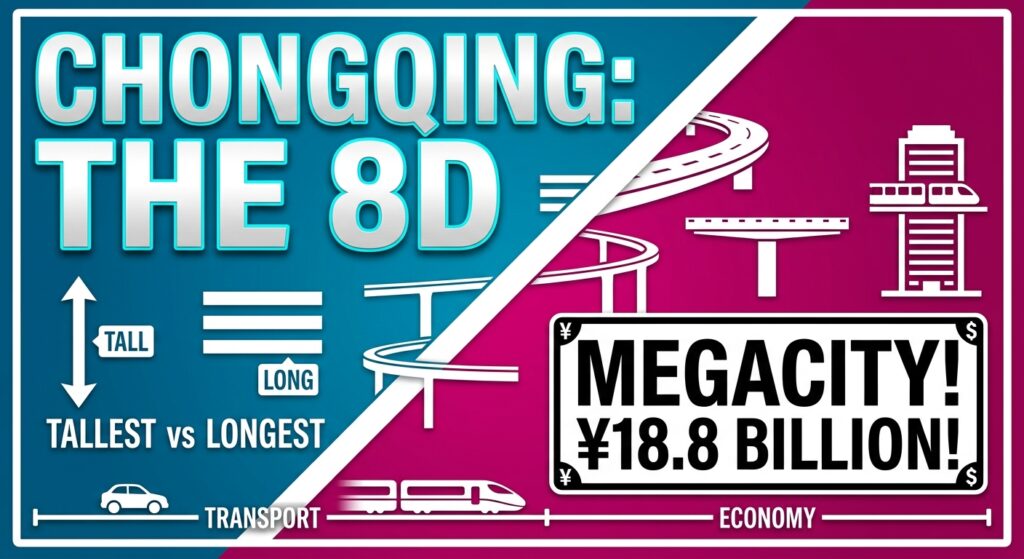
Chongqing’s extreme vertical terrain forces urban designers to build upwards, downwards, and sideways, creating a multi-layered cityscape where roads, rail lines, and buildings stack atop one another.
The Crystal at Raffles City Chongqing
Designed by renowned architect Moshe Safdie, Raffles City Chongqing sits directly at the confluence of the Yangtze and Jialing rivers. Its defining feature is The Crystal, a 300-meter-long curved “horizontal skyscraper” suspended 250 meters in the air across the tops of four 250-meter-tall towers. Housing an indoor botanical garden, observation deck, infinity pool, and dining suites, it represents a high-altitude engineering marvel.
Historical Preservation Meets Modernity
Alongside futuristic glass towers, Chongqing preserves its cultural heritage:
Jiefangbei (People’s Liberation Monument): Standing at the heart of Chongqing’s busiest commercial shopping district, this historic tower marks the city’s modern center.
Huguang Guild Hall: A restored 18th-century complex featuring traditional Qing Dynasty timber architecture, serving as a reminder of the city’s ancient trade roots.
Hongyadong: A multi-tiered traditional Diaojiaolou (stilt house) complex built against a steep cliff edge along the river, illuminated at night as a bustling culinary and cultural market.
2. Engineering the Mountain City: Innovative Transit Solutions
Building a mass transit system across steep rock faces and wide rivers required custom-engineered transit solutions tailored to steep grades and tight elevation shifts.
Straddled Monorail Technology
Traditional heavy steel-rail subway systems struggle with steep mountain inclines and sharp turn radii. Chongqing solved this by deploying an extensive straddled-type monorail system (notably CRT Lines 2 and 3).
Liziba Station: Globally famous for passing directly through the 6th to 8th floors of a 19-story residential apartment building, demonstrating high-density urban integration without noise disruption.
High-Grade Capability: Rubber-tired monorail cars climb steep mountain grades with ease, traversing high-elevation viaducts and river bridges smoothly.
World-Record Circular Rail Loop
Chongqing’s Metro Loop Line spans 50.88 kilometers, making it the world’s longest circular rail transit loop line operating through a mountainous terrain. Equipped with Advanced Communications-Based Train Control (CBTC) systems, the loop links major railway hubs, residential districts, and commercial centers across complex elevation changes.
3. Cultural Hubs, Green Spaces, and Culinary Heritage
Despite its rapid industrialization, Chongqing integrates lush green parks and iconic street food culture into daily life.
The World-Famous Hot Pot Capital
Chongqing is internationally recognized as the world capital of Sichuan-style Hot Pot. Built around a fiery broth heavily spiced with native Sichuan peppercorns (Huajiao) and red chili peppers, Hot Pot is a central social ritual for locals and tourists alike. Other famous regional dishes include Chongqing spicy small noodles (Xiaomian) and pickled vegetable stir-fries.
Urban Green Spaces and Botanical Reserves
To balance high-density urban growth, Chongqing maintains extensive natural reserves within municipal boundaries:
Nanshan (South Mountain) Botanical Garden: A massive highland reserve offering panoramic views of the city skyline and Yangtze River bends.
Eling Park: One of the city’s oldest urban parks, perched high on a ridge overlooking both the Jialing and Yangtze rivers.
Three Gorges Gateway: Chongqing serves as the primary western departure point for river cruises navigating the Three Gorges region along the Yangtze.
Frequently Asked Questions (FAQs)
1. Is Chongqing the largest city in the world?
In terms of total administrative municipal land area, Chongqing covers 31,700 square miles (82,400 sq km), making it one of the largest municipal territories on Earth. However, this area includes rural counties, farmland, and mountain ranges alongside the core urban megalopolis.
2. Why does Chongqing use monorails instead of traditional subway trains?
Chongqing’s extreme mountainous terrain features steep elevation changes and tight turns. Straddled monorail trains equipped with rubber tires handle high-incline tracks and tight turn radii significantly better than traditional steel-wheel subway trains.
3. What is “The Crystal” at Raffles City Chongqing?
The Crystal is a 300-meter-long “horizontal skyscraper” skybridge positioned 250 meters above the ground across four vertical skyscrapers. It holds observation decks, gardens, and amenities.
4. Why is Chongqing called the “Mountain City”?
The core metropolitan area is constructed directly on and around the rugged Daba, Wushan, Wuling, and Dalou mountain ranges, creating a 3D urban landscape where street levels vary by hundreds of meters across adjacent blocks.