




Why Scientists Spent 50 Years Building ITER: The Ultimate Quest for Nuclear Fusion
For decades, the dream of harnessing nuclear fusion—the very process that powers the sun—has been viewed as the holy grail of clean energy. Today, that dream is taking physical form through ITER (International Thermonuclear Experimental Reactor), a massive, multi-nation scientific endeavor under construction in Saint-Paul-lez-Durance, southern France.
Representing one of the most complex engineering challenges in human history, ITER is designed to prove that nuclear fusion can be scaled up to provide a virtually limitless, safe, and sustainable energy source for the future.

1. The Promise of Nuclear Fusion
Unlike nuclear fission (which splits heavy atoms like uranium), nuclear fusion forces light hydrogen atoms together to release massive amounts of energy.
Abundant Fuel: The process relies on two hydrogen isotopes—deuterium and tritium—which can be sourced directly from seawater.
Zero Greenhouse Gases: Fusion generates millions of times more energy than fossil fuels while producing zero carbon dioxide or harmful greenhouse emissions.
Minimal Waste: Unlike traditional nuclear reactors, fusion reactors do not generate long-lived radioactive waste; any waste produced has a half-life of roughly 300 years rather than millennia.
2. The Core Challenge: Replicating the Sun on Earth
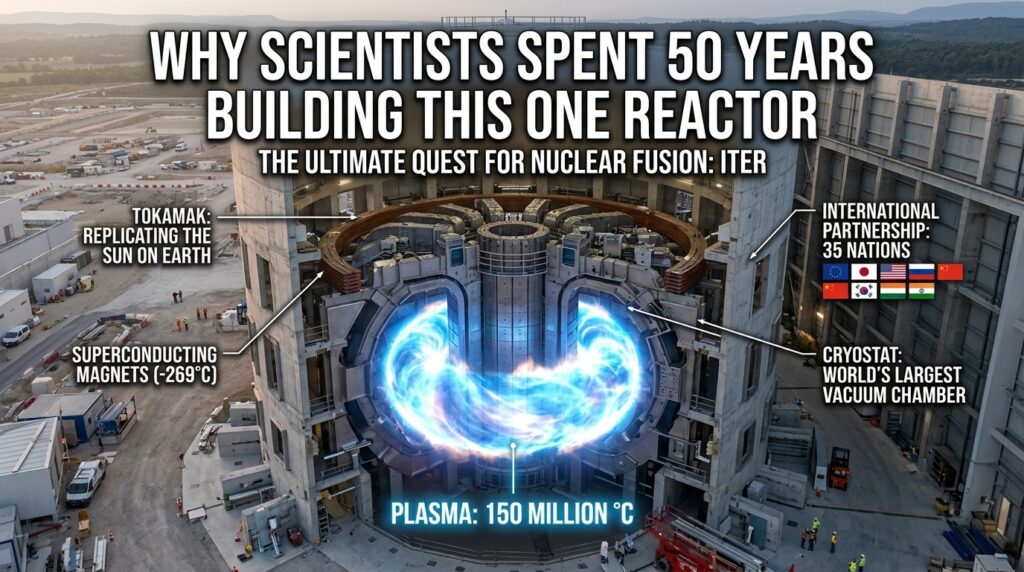
To force atoms to fuse, scientists must replicate the extreme conditions found in the core of the sun. This requires generating temperatures exceeding 150 million degrees Celsius, turning gas into a superheated state called plasma.
Keeping this scorching plasma stable and contained inside a vacuum is an immense engineering hurdle. At the heart of ITER is the Tokamak—a giant, doughnut-shaped magnetic chamber designed specifically to house and control this plasma using powerful magnetic fields and extreme heat.
3. Engineering Marvels and Massive Scale
The scale of the ITER construction site is staggering, spanning 180 hectares (nearly the size of Monaco) and housing 39 distinct buildings. Key components include:
The Tokamak Building: A seven-story structure rising 60 meters above ground and extending 13 meters below, built to support a machine weighing as much as three-and-a-half Eiffel Towers.
Seismic Foundations: The entire reactor rests on 500 seismic bearings designed to absorb shocks and maintain absolute alignment during operation.
The Cryostat: Constructed in India and weighing nearly 4,000 tons, this is the world’s largest stainless-steel vacuum chamber, built to insulate the reactor’s magnets.
Superconducting Magnets: The toroidal field coils, produced in Japan, weigh over 6,000 tons (a quarter of the project’s total mass) and must be kept at near absolute zero (-269°C) using liquid helium to maintain plasma stability.
4. International Collaboration and Current Timeline
ITER represents an unprecedented global partnership, uniting 35 nations, 5,000 companies, and over 15,000 workers from nearly 90 countries. Despite encountering logistical hurdles, engineering complexities, and scheduling delays, the project continues to push forward:
2035: Anticipated start for initial deuterium-deuterium plasma operations, focusing on machine testing and plasma control without major fusion power production.
2039: Planned commencement for deuterium-tritium plasma operations with significant fusion power generation.
While ITER is an experimental feasibility study rather than a commercial electricity generator, its success will lay the technical foundation for future fusion power plants, paving the way for a clean energy revolution.
Frequently Asked Questions (FAQs)
1. What does ITER stand for and what is its primary goal? ITER stands for the International Thermonuclear Experimental Reactor. Its primary goal is to demonstrate the scientific and technological feasibility of nuclear fusion power at scale.
2. Why is nuclear fusion considered safer than traditional fission reactors? Fusion reactors cannot melt down, use abundant fuel sources derived from seawater, and do not produce long-lived, highly radioactive waste like traditional uranium-based fission reactors.
3. What temperature is required to achieve nuclear fusion in a Tokamak? Temperatures exceeding 150 million degrees Celsius are required—hotter than the core of the sun—to create the plasma necessary for fusion.
4. What is the role of the Cryostat in the ITER reactor? The Cryostat is the world’s largest stainless-steel vacuum chamber. It maintains the extreme cold environment (-269°C) required to keep ITER’s massive superconducting magnets operational.
5. Will ITER produce commercial electricity for the power grid? No. ITER is fundamentally a large-scale scientific feasibility study designed to test and prove fusion technology, paving the way for future commercial fusion power plants.