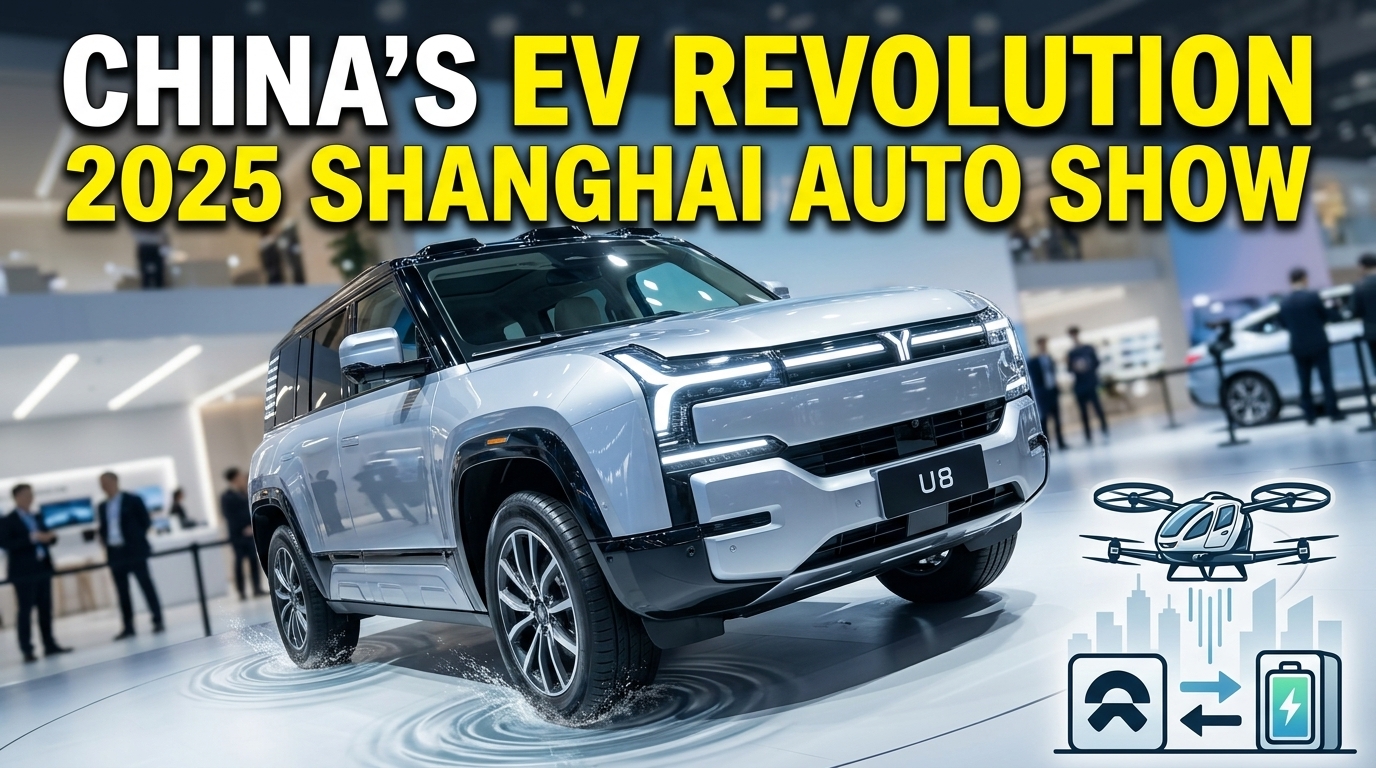
China’s Electric Vehicle Revolution at the 2025 Shanghai Auto Show
The 21st Shanghai International Automobile Industry Exhibition (Auto Shanghai 2025), held at the National Exhibition and Convention Center (NECC), served as a massive turning point for the global automotive market. Far from being a routine auto show, the event shattered long-standing assumptions about Western dominance in electric vehicles (EVs), with Chinese automakers taking center stage through groundbreaking innovations and near-term commercial tech

1. BYD: From Underdog to Global Titan
BYD has grown from a battery assembler into the world’s largest electric vehicle manufacturer by volume. At the exhibition, their showcase featured:
YangWang U8: A luxury electric off-roader featuring amphibious driving capabilities (allowing it to float and maneuver through floodwaters) and independent four-wheel torque control for 360-degree tank turns.
YangWang U9: A high-end hypercar equipped with an adaptive suspension system enabling it to literally jump, bounce, and dance to music.
BYD Seagull: A mass-market compact EV priced under $10,000 featuring over 300 km of range, smart infotainment, and standard safety technology.
2. XPeng: Flying Cars and AI Pilots
XPeng blurred the line between science fiction and reality with practical urban mobility solutions:
XPeng AeroHT: A functional flying car prototype featuring foldable rotors, a lightweight carbon-fiber frame, and true vertical takeoff and landing (VTOL) capabilities, backed by plans to launch low-altitude urban flight corridors.
X9 MPV: A spacious family vehicle featuring a full-width digital cockpit, modular furniture-like seating, and voice-activated AI controls.
3. NIO: The AI Experience and Battery Swapping Revolution
NIO shifted focus toward human emotion, comfort, and seamless interaction:
NIO ET9: A luxury electric sedan designed like a wellness retreat, complete with a panoramic smart glass roof and ergonomic massage seats.
Nomi: NIO’s emotionally intelligent AI co-pilot that recognizes facial expressions, understands tone of voice, adapts to emotional cues, and learns driver habits over time.
Automated Battery Swapping: NIO bypassed traditional charging waits with fully automated stations that replace depleted batteries with fully charged ones in under 3 minutes (having completed over 40 million swaps globally).
4. Luxury Redefined by Zeekr and Avatr
Zeekr 007: A sleek electric sedan featuring face recognition ignition, suicide doors, a full-windshield head-up display, and AI-assisted drive controls.
Avatr 12: Backed by Huawei and CATL, this digital sanctuary offered touch-sensitive surfaces with no physical buttons, AR windshield projections, biometric sensors, and aggressive pricing up to 30% cheaper than Western equivalents.
5. The Robo-Taxi Revolution
Live demonstrations from companies like Baidu (Apollo RT6), Pony.ai, and AutoX showcased fully autonomous, steering-wheel-free vehicles operating seamlessly in simulated urban environments with complex pedestrian and traffic conditions.
6. Tesla’s Conspicuous Absence
In stark contrast to the massive local turnout and energy, Tesla chose not to attend the influential exhibition—signifying a symbolic shift as Chinese consumers increasingly turn toward homegrown champions like BYD, NIO, XPeng, and Zeekr for superior performance, pricing, and innovation.
Frequently Asked Questions (FAQs)
1. What made Auto Shanghai 2025 a milestone for the automotive industry? It marked a seismic shift where Chinese automakers demonstrated global leadership through advanced EV tech—such as flying cars, amphibious SUVs, sub-$10,000 mass-market models, and automated battery swapping—while legacy pioneers like Tesla sat out the event.
2. How does the BYD YangWang U8 handle severe weather or obstacles? It features amphibious capabilities enabling it to float through floodwaters, along with independent four-wheel torque control that allows it to execute 360-degree tank turns in tight spaces.
3. Are XPeng’s flying cars operational? Yes. The XPeng AeroHT is a real flying car prototype with VTOL capabilities, successful flight tests, and impending plans for low-altitude urban flight corridors.
4. How does NIO’s battery swapping network work? Instead of plugging in to charge, drivers pull into an automated station where robots replace a depleted battery with a fully charged one in less than three minutes.
5. What makes NIO’s Nomi assistant unique? Unlike traditional utilitarian voice assistants, Nomi is an emotionally intelligent co-pilot that recognizes facial expressions, responds to emotional cues, and adapts to driver habits over time.