




China’s Exponential Leap: How Innovation is Rewriting Global Tech Leadership
For decades, the global consensus framed China as the world’s primary manufacturing hub—a powerhouse for producing footwear, textiles, and consumer electronics, but reliant on Western engineering for groundbreaking innovations. That paradigm has fundamentally shifted. Driven by massive state-directed investments, rapid industrial scaling, and aggressive technological development, China is setting the pace across key high-tech sectors.
From unprecedented civil engineering to fourth-generation nuclear power, green energy networks, and autonomous transportation, China’s modern infrastructure demonstrates how a knowledge-based economy can leapfrog traditional industrial phases.
The World’s Highest Suspension Bridge: Engineering Guizhou’s Terrain
Infrastructure investment in China has evolved beyond basic utility into a strategic driver for regional economic transformation.
The Huajiang Grand Canyon Bridge: Built over the Beipan River in Guizhou Province, this structure stands 625 meters (2,051 feet) above the canyon floor. Spanning 2,890 meters in total length with a main span of 1,420 meters, it holds the title of the world’s tallest suspension bridge.
Economic Integration: Designed to connect isolated mountainous regions, the bridge slashes local travel times from over two hours across the canyon down to just two minutes, drastically improving regional logistics, integration, and tourism opportunities.
Precision at Scale: Built despite severe canyon winds and complex karst geology, the project leveraged advanced satellite navigation (BeiDou), smart drone monitoring, and ultra-high-strength materials to achieve millimeter-level precision.
Mega-Scale EV Manufacturing: BYD’s Manufacturing Hubs
China’s transition from traditional manufacturing to advanced green mobility is exemplified by BYD. Originally founded as a battery manufacturer, BYD has grown into one of the world’s largest electric vehicle (EV) producers, competing directly with legacy international automakers.
To support this rapid expansion, BYD has built massive manufacturing facilities, including its sprawling production complexes in Shenzhen and surrounding regions. Spanning vast tracts of industrial land, these gigafactories are designed to produce millions of electric vehicles annually. Operating with extreme vertical integration—building everything from power batteries to semiconductors in-house—BYD’s scale allows it to lower production costs significantly while accelerating innovation cycles in the global EV market.
Commercializing Next-Generation Energy: The Thorium Nuclear Breakthrough
Energy security and decarbonization are central to China’s long-term technology strategy. A major milestone in this effort is the development of experimental fourth-generation nuclear power systems.
TMSR-LF1 (Wuwei, Gansu): China has successfully brought online an experimental Thorium Molten Salt Reactor (TMSR-LF1). Unlike traditional uranium-based light-water reactors, this system utilizes liquid fluoride salts as a coolant and thorium as a fuel source.
Inherent Safety: Thorium reactors operate at near-atmospheric pressures and cannot suffer classical high-pressure meltdowns. If power is lost, the liquid salt fuel passively drains into sub-critical storage tanks to cool safely.
Resource Abundance & Reduced Waste: Thorium is significantly more abundant than uranium. Furthermore, molten salt reactors generate a fraction of the long-lived actinide waste produced by conventional plants, reducing waste management lifespans from thousands of years down to centuries.
Industrial Automation and Autonomous Defense Platforms
The integration of artificial intelligence and mass manufacturing has transformed defense and autonomous logistics industries.
Reports detailing Chinese procurement orders point toward a massive expansion of autonomous aerial vehicles (UAVs). Leveraging its dominant commercial drone supply chain, domestic electronics industry, and advanced robotics manufacturing, China has established an unparalleled industrial capacity to produce military and dual-use drones at scale.
From micro-reconnaissance units to medium-altitude long-endurance (MALE) combat platforms like the Wing Loong series, China’s industrial base allows for rapid deployment, algorithm testing, and mass integration of swarm-based autonomous systems.
Urban Air Mobility: The Commercial Launch of Autonomous eVTOLs
Urban transportation is expanding into three-dimensional airspace through electric vertical takeoff and landing (eVTOL) aircraft.
[ Urban Air Corridor ] ──( Autonomous Flight )──> [ High-Speed Transit Nodes ]
                                                              │
[ Reduced Surface Traffic ] <──────( Low Noise / Zero Emissions )┘
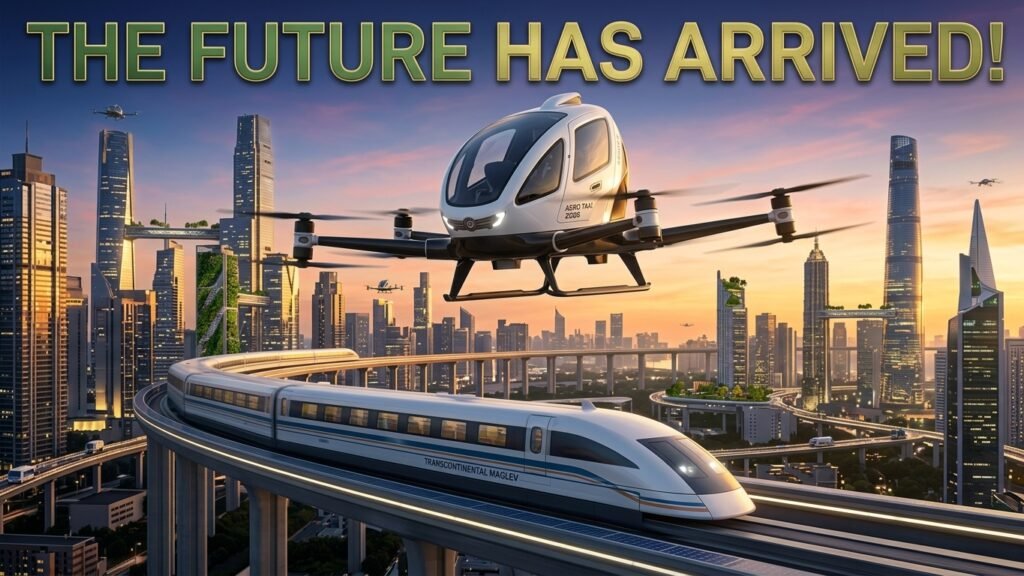
Guangzhou-based EHang made aviation history by securing the world’s first type certification, production certificate, and standard airworthiness certificate for a pilotless passenger-carrying eVTOL—the EHang EH216-S. Operating commercially across designated urban air corridors in cities like Shenzhen and Guangzhou, these two-passenger autonomous aircraft provide aerial sightseeing, airport transfers, and short urban commutes. This early regulatory and commercial clearance puts China at the forefront of the emerging multi-billion-dollar Urban Air Mobility (UAM) market.
National-Scale Infrastructure Comparisons
| Sector | Breakthrough Project | Scale & Capability | Primary Impact |
| Civil Engineering | Huajiang Grand Canyon Bridge | 625m vertical height, 1,420m main span | Reduces canyon crossing times to 2 minutes; links isolated economic zones. |
| Nuclear Energy | TMSR-LF1 Thorium Reactor | 2 MWt experimental liquid-salt reactor | Demonstrates passive-safety, low-waste generation-IV nuclear power. |
| Clean Grid Transit | West-to-East Green Energy Corridor | >400 GW total capacity via UHV lines | Transmits desert solar/wind power over 3,000 km directly to coastal industrial centers. |
| High-Speed Rail | 600 km/h Maglev Prototype | Frictionless magnetic levitation system | Bridges the speed gap between high-speed rail (350 km/h) and commercial air travel. |
| Aerospace | Commercial Launch Sector (Palace-1, etc.) | Reusable orbital boosters, Tiangong operations | Fosters a competitive private launch ecosystem alongside state space programs. |

The World’s Largest Green Energy Corridor
China has constructed a massive green energy corridor under its West-to-East Power Transmission initiative. Because China’s primary renewable resources (desert solar farms, high-altitude wind corridors, and mountainous hydro capacity) are thousands of kilometers away from its densely populated eastern industrial cities, traditional power grids were insufficient.
To solve this, China pioneered ultra-high-voltage (UHV) direct-current transmission lines. Operating at 800kV to 1,100kV, these UHV lines transmit power across 3,000-plus kilometers with minimal line loss. By aggregating over 400 gigawatts of clean energy capacity—more than the combined power capacity of several major European nations—China has proven that renewable energy can be scaled to support national-level heavy industry.
Next-Generation Rail: The 600 km/h Maglev System
China currently operates the world’s most extensive high-speed rail network, covering tens of thousands of kilometers. However, to shrink travel times between major economic mega-clusters—such as the Shanghai-Hangzhou corridor or the Chengdu-Chongqing economic circle—engineers have developed a high-speed Magnetic Levitation (Maglev) train capable of reaching speeds of 600 km/h (373 mph).
Developed by CRRC Qingdao Sifang, the train uses electromagnetic levitation to float above a dedicated guide track, eliminating mechanical friction. At operating speeds of 600 km/h, the system offers an efficient alternative to short-haul commercial flights, emitting zero direct emissions along its route while significantly reducing transit times between urban centers.
The Commercial Aerospace Ecosystem
While China’s state-run space agency continues to execute high-profile missions—including the continuous operation of the Tiangong Space Station and planned crewed lunar landings—a commercial space ecosystem is accelerating in parallel.
Private aerospace companies like Galactic Energy, iSpace, and Deep Blue Aerospace are actively developing cost-effective, reusable orbital rockets.
Reusable Launchers: Startups are testing grid fins, engine throttling, and vertical recovery systems similar to SpaceX’s Falcon 9, targeting low-cost payload deployment.
Satellite Constellations: Private firms are building low-Earth-orbit (LEO) broadband internet constellations, Earth observation networks, and orbital logistics services.
Synergistic Growth: By allowing private capital and commercial startups to innovate alongside state funding, China is rapidly scaling its aerospace manufacturing capacity and launch frequencies.
Conclusion: A Paradigm Shift in Global Technology
China’s rapid evolution across civil engineering, fourth-generation nuclear energy, autonomous mobility, and green power grids underscores a fundamental shift in the global order. Technological leadership is no longer concentrated solely in Western hubs. By coupling strategic long-term planning with rapid industrial scaling, China is redefining how modern infrastructure is designed, funded, and built.
FAQs
1. What makes the Huajiang Grand Canyon Bridge significant?
The Huajiang Grand Canyon Bridge in Guizhou Province is the world’s tallest suspension bridge, suspended 625 meters above the Beipan River. It cuts crossing times across the canyon from over two hours down to just two minutes.
2. How does a thorium nuclear reactor differ from a conventional nuclear reactor?
Thorium Molten Salt Reactors (TMSR) use liquid salt as a coolant instead of high-pressure water and run on thorium rather than uranium. They operate safely at atmospheric pressure, cannot undergo classic meltdowns, and generate waste that remains radioactive for hundreds of years rather than tens of thousands.
3. How does China transport renewable power from remote western deserts to eastern cities?
China uses ultra-high-voltage (UHV) transmission lines (DC currents operating up to 1,100kV). This technology allows vast amounts of solar, wind, and hydro power to travel over 3,000 kilometers across the country with minimal electricity loss.
4. What is the advantage of the 600 km/h Maglev train over traditional high-speed rail?
By floating on a magnetic cushion, Maglev trains eliminate physical track friction, allowing them to reach top speeds of 600 km/h compared to conventional high-speed rail limits (~350 km/h). This fills the travel time gap between high-speed trains and commercial airliners.
5. Has any company received commercial clearance for autonomous flying taxis?
Yes. Guangzhou-based EHang achieved airworthiness certification and production approval from China’s Civil Aviation Administration for its pilotless EH216-S eVTOL, allowing it to operate commercial passenger and sightseeing flights.
Sources and Further Reading
Guizhou Provincial Department of Transportation: Engineering data and height specifications for the Huajiang Grand Canyon Bridge.
Chinese Academy of Sciences (CAS): Technical updates on the TMSR-LF1 Thorium Molten Salt Reactor project in Wuwei, Gansu.
Civil Aviation Administration of China (CAAC): Type certification and commercial airworthiness approvals for autonomous eVTOL aircraft.
State Grid Corporation of China: Performance metrics and technical overviews of Ultra-High-Voltage (UHV) power transmission corridors.