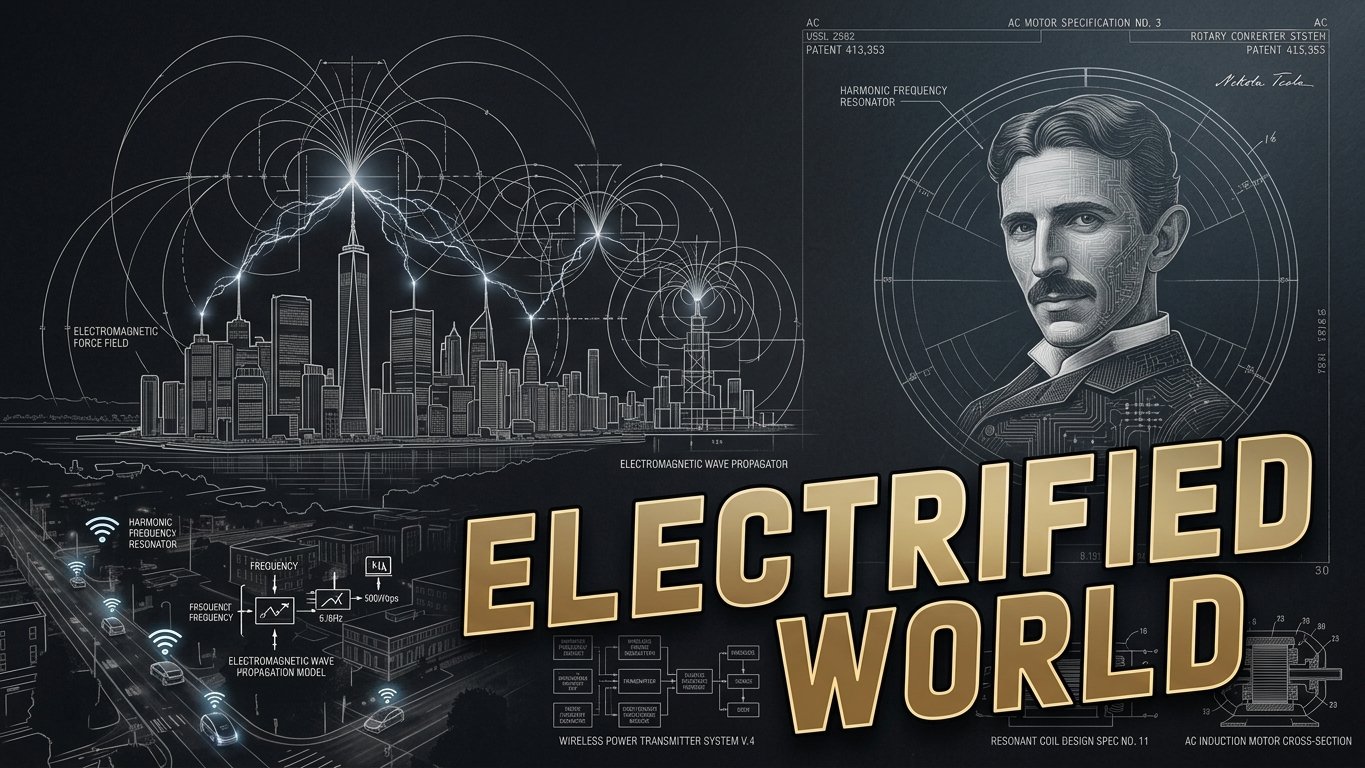
Electrifying the Future: The Genius, Rivalry, and Vision of Nikola Tesla
From the birth of the modern electrical grid to early concepts of global wireless communication, Nikola Tesla remains one of the most prolific and visionary figures in the history of science and technology. His work not only revolutionized how humanity harnesses energy but also laid the conceptual foundation for many 21st-century technologies.
1. Early Life, Mindset, and the Discovery of AC
Nikola Tesla was born in 1856 in Smiljan, within the Austrian Empire (modern-day Croatia). Raised by a priest father and an inventive mother, Tesla displayed extraordinary cognitive abilities from an early age.
+--------------------------------------------------------------------+
|                    TESLA'S INVENTIVE PROCESS                       |
+--------------------------------------------------------------------+
|  [ Eidetic/Photographic Memory ]                                   |
|                 │                                                  |
|                 ▼                                                  |
|  [ Mental 3D Visualization & Simulation ]                          |
|                 │                                                  |
|                 ▼                                                  |
|  [ Prototyping Without Physical Drafts/Models ]                     |
|                 │                                                  |
|                 ▼                                                  |
|  [ Direct Physical Construction & Implementation ]                |
+--------------------------------------------------------------------+
Key Formative Milestones
Eidetic Memory: Tesla possessed a vivid photographic memory, enabling him to visualize complex three-dimensional machinery, perform mental stress tests, and refine dimensions without physical drawings.
The Budapest Epiphany: While studying and working in Europe, Tesla conceived the principle of the rotating magnetic field—the fundamental physical concept behind the alternating current (AC) induction motor.
Arrival in America (1884): Tesla moved to New York City to work for Thomas Edison’s Edison Machine Works, bringing with him a passion to revolutionize electrical power distribution.
2. The War of the Currents: AC vs. DC
The late 19th century was defined by a fierce technological and commercial battle over how electrical power should be distributed across cities and nations: Direct Current (DC) versus Alternating Current (AC).
+-----------------------------------------------------------------------+
|                    DIRECT CURRENT (DC) LIMITATION                     |
|  Power Plant ───> [ High Energy Loss Over Distance ] ───> Short Range |
+-----------------------------------------------------------------------+

+-----------------------------------------------------------------------+
|                   ALTERNATING CURRENT (AC) ADVANTAGE                  |
|  Power Plant ───> [ Step-Up Transformer ] ───> Long-Distance Grid    |
|                                                     │                 |
|                                                     ▼                 |
|  End User    <─── [ Step-Down Transformer ] <───────┘                 |
+-----------------------------------------------------------------------+
Technical Comparison
| Feature / Metric | Direct Current (DC) | Alternating Current (AC) |
| Primary Champion | Thomas Edison (Edison Electric) | Nikola Tesla & George Westinghouse |
| Current Flow | Single direction | Alternating/reversing direction |
| Transmission Range | Short (~1 mile radius per plant) | Long (hundreds of miles via transformers) |
| Voltage Conversion | Extremely difficult in the 19th century | Efficient via Step-Up/Step-Down Transformers |
| Infrastructure Cost | High (required localized power plants) | Low (centralized power generation) |
Key Turning Points
The Westinghouse Partnership (1888): Industrialist George Westinghouse licensed Tesla’s AC patents, providing the financial backing needed to challenge Edison’s market dominance.
1893 Chicago World’s Fair: Westinghouse and Tesla won the contract to illuminate the World’s Columbian Exposition, proving to millions of visitors that AC was safe, reliable, and capable of large-scale illumination.
Niagara Falls Hydroelectric Power (1896): The completion of the Niagara Falls power station demonstrated that AC could harness massive natural kinetic energy and transmit high-voltage power over 20 miles to Buffalo, New York, effectively ending the War of the Currents.
3. Beyond AC: Major Innovations and Breakthroughs
While best known for alternating current, Tesla held over 300 patents worldwide spanning diverse fields of physics and mechanical engineering.
                    ┌─── Tesla Coil (High-Voltage Resonant Transformer)
                    ├─── AC Induction Motor & Polyphase Systems
TESLA'S INNOVATIONS ├─── Wireless Telegraphy & Radio Frequency Concepts
                    ├─── Bladeless Tesla Turbine
                    └─── Early Teleautomaton (Remote-Controlled Robotics)
Notable Inventions
The Tesla Coil (1891): A resonant transformer circuit capable of producing high-voltage, low-current, high-frequency alternating-current electricity. It became foundational for early radio technology and medical imaging research.
The Tesla Turbine: A uniquely efficient, bladeless turbine that operates on the principles of boundary layer fluid dynamics and adhesion.
Radio Control / Teleautomation (1898): Tesla demonstrated a radio-controlled boat at Madison Square Garden, introducing the world to wireless remote control and early concepts of robotics.
4. Wireless Energy & Wardenclyffe Tower
Following his high-voltage, high-frequency experiments in Colorado Springs (1899), Tesla became convinced that electrical energy could be transmitted wirelessly through the Earth’s upper atmosphere and crust.
The Wardenclyffe Vision
Supported by financier J.P. Morgan, Tesla began construction on the Wardenclyffe Tower facility in Shoreham, Long Island:
Physical Structure: A 187-foot wooden tower topped with a massive 55-ton steel-and-copper hemispherical dome.
Intended Capabilities: Simultaneous wireless transmission of voice, news, pictures, and global electrical power without physical cables.
Project Downfall: Mounting costs, technical delays, and the development of commercial transatlantic radio by Guglielmo Marconi led J.P. Morgan to withdraw funding in 1904. The tower was eventually dismantled in 1917.
Frequently Asked Questions
Why did Alternating Current (AC) defeat Direct Current (DC) in the 19th century?
AC won because it could be stepped up to extremely high voltages using transformers. High voltage allows electricity to travel over long distances through thin wires with minimal energy loss. Once it reaches a destination, transformers step the voltage back down to safe levels for consumer use. DC could not easily change voltages at the time, making long-distance transmission economically impractical.
How does the Tesla Coil work?
A Tesla Coil uses resonant inductive coupling to build up extreme voltages. It consists of two primary circuits: a primary circuit with a capacitor and primary coil, and a secondary circuit with a fine-wire coil and a top discharge terminal. When tuned to the same resonant frequency, energy transfers rapidly between the circuits, discharging dramatic high-voltage electrical arcs into the air.
What was the main cause of the failure of Wardenclyffe Tower?
Wardenclyffe failed primarily due to financial constraints and shifting investor priorities. When Guglielmo Marconi successfully sent a basic transatlantic radio signal using simpler, less capital-intensive equipment, financial backers lost interest in funding Tesla’s far more ambitious—and expensive—global wireless power and communications network.
References
Tesla, N. (1919): My Inventions: The Autobiography of Nikola Tesla. Electrical Experimenter Magazine.
Cheney, M. (2001): Tesla: Man Out of Time. Touchstone Publishing.
U.S. Patent Office Archives: Patents held by Nikola Tesla (US434300A – System of Alternating Current Motors, US613809A – Method of and Apparatus for Controlling Mechanism of Moving Vessels).