


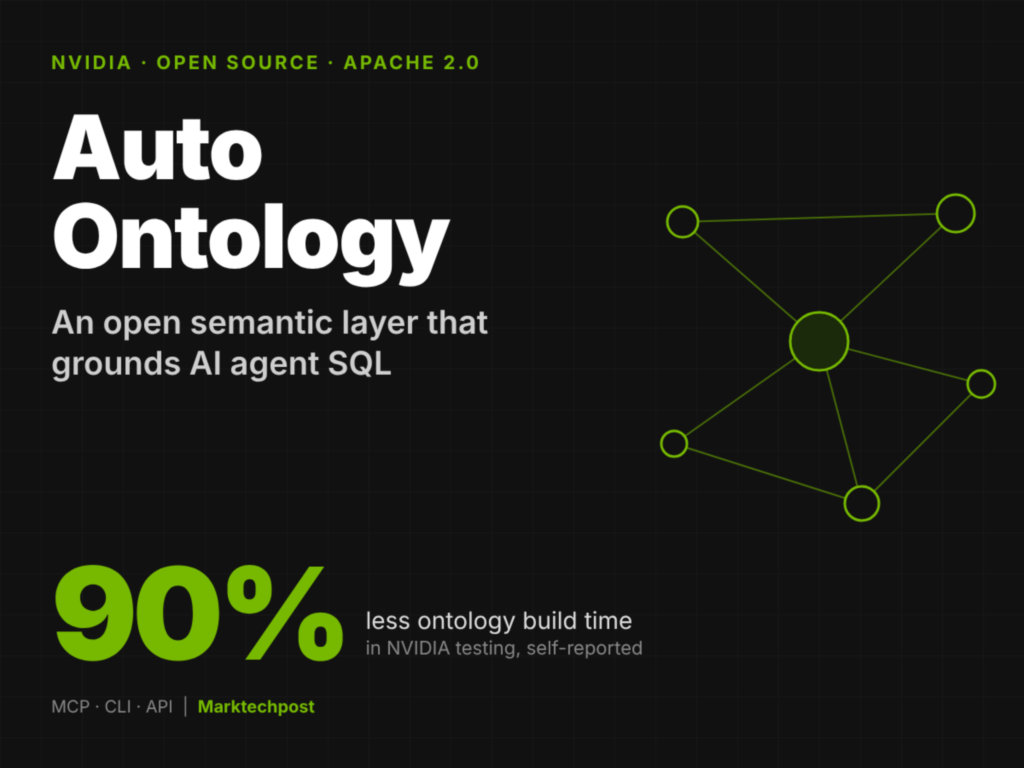
NVIDIA has released Auto Ontology, an open library under the Apache 2.0 license. NVIDIA Auto Ontology is a semantic layer framework that builds a context layer from enterprise metadata. Agents use that layer to write SQL against certified business definitions. The repository states the problem plainly: a fast revenue answer is worthless if the number is wrong.
TL;DR
- Library: Default LLM is
nvidia/nemotron-3-nano-30b-a3b, with Nemotron embedding and reranking models. - Runs on: Docker Compose for a local stack, or Kubernetes via Helm. Inference uses hosted NVIDIA NIM endpoints or self-hosted NIMs.
- Performance: Strong engineering, thin public evidence.
- Best: Ontology creation time cut by 90% in NVIDIA testing (self-reported).
- Worst: 0 published text-to-SQL accuracy scores. The eval repo ships a harness, not results.
- Bottom line: An open, MCP-ready context layer that any agent harness can query. But you must run the benchmarks yourself to trust it.
What is NVIDIA Auto Ontology?
It is a context layer that sits between an agent and the data warehouse. It tells the agent where data lives and what fields mean. It also says whether to use a field, how to use it, and where it came from.
Here are the five jobs:
- Discover: generate ontologies from metadata and connect existing semantic models.
- Ground: give agents trusted meaning for metrics, entities and relationships.
- Validate: check generated queries against certified definitions and lineage.
- Expose: serve context through MCP, CLI and API.
- Learn: fold certified corrections back into the ontology.
NVIDIA’s developer page frames the output as a starting ontology. Business experts still test, refine and certify it.
How does Auto Ontology work?
The stack has 4 core services. A Next.js 16 frontend handles the web UI and authentication on port 3000. A FastAPI backend with LangChain runs chat, NL-to-SQL and catalog APIs on port 3001. An ingestion worker writes embeddings on port 3002. Postgres with pgvector stores the catalog, the ontology and the vectors.
Source databases can be Databricks, Postgres, Snowflake or DuckDB. Models are set through environment “triplets” of endpoint, key and model. Separate roles exist for reasoning, non-reasoning, embedding and reranking. Any OpenAI-compatible endpoint works.