


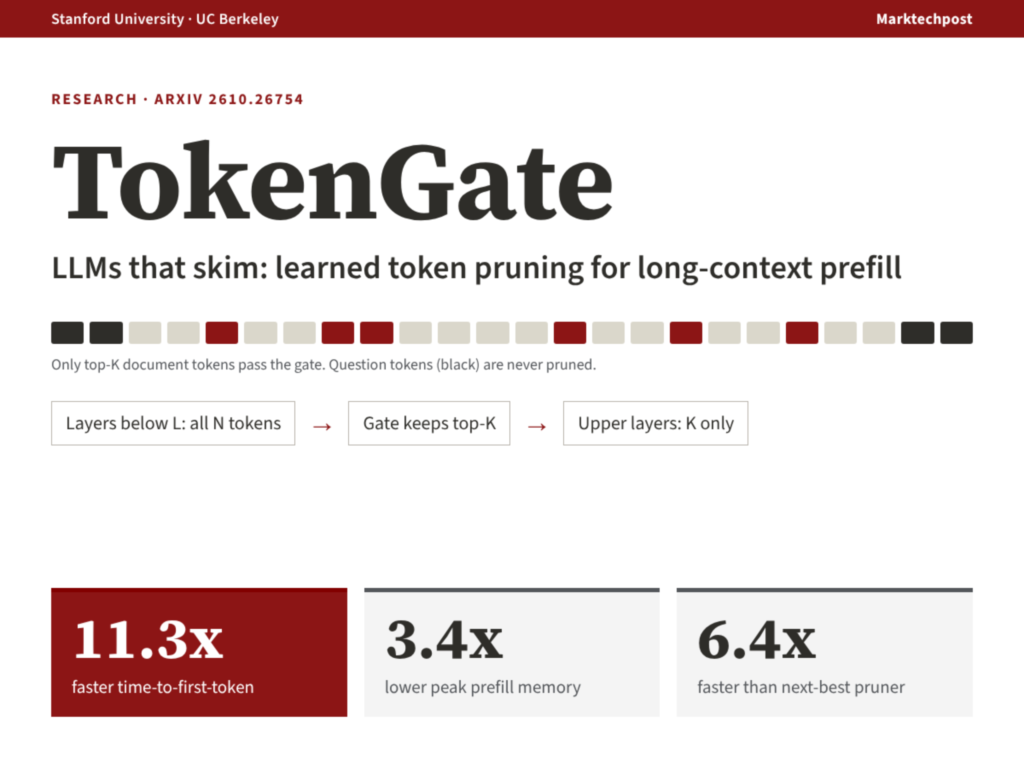
Stanford and UC Berkeley researchers released TokenGate, a module for long-context prefill. TokenGate learned token pruning lets an existing LLM skim its input. Only the tokens that matter get full processing. The research team reports 1.4x to 11.3x faster time-to-first-token (TTFT) with no accuracy loss. Peak prefill memory drops 1.5x to 3.4x. Code and checkpoints are on GitHub under Apache-2.0.
TL;DR
- MLP gate: A small MLP gate and LoRA (r=16) added to Qwen3-1.7B or Qwen3.5-2B. Tested on contexts up to 128k tokens.
- Runs on: Paper timings use 1 A100 at batch size 1. Training used 4 A100s.
- Performance: Pareto-optimal on 5 tasks against 6 baselines.
- Best: NIAH 16k at 11.3x faster TTFT and 3.42x lower memory. TTFT gain hits 13.0x at 128k.
- Worst: Speedup drops to 1.4x on some tasks.
What is TokenGate?
TokenGate is a drop-in component that adds trainable token pruning to pretrained LLMs. Transformers push every token through every layer. Attention cost grows quadratically with length. Training-free pruning is cheap but loses accuracy at high pruning rates. Architectural changes often need pre-training from scratch.
How does TokenGate learned token pruning work?
The forward pass splits into 3 phases:
- Standard forward: layers below gate layer L process all N tokens as usual.
- Gate module: an MLP scores each token from its post-attention residual at layer L. A top-K selector keeps the highest-scoring tokens.
- Pruned forward: layers above L process only those K tokens and never create KV entries for pruned ones.
Only the document part of the prompt is prunable. The question is never pruned.
What is token-gated attention?
Top-K selection is not differentiable, which blocks end-to-end training. TokenGate borrows the Mixture-of-Experts router trick. Each kept token’s score becomes a bias on attention logits above the gate. That bias gives gradients a path back to the scorer.
A learnable per-head gain and a learnable temperature refine this. The temperature corrects for each query seeing fewer keys. Training uses plain next-token loss. Each step averages a full-context loss and a random-budget loss. So 1 trained gate works across budgets.