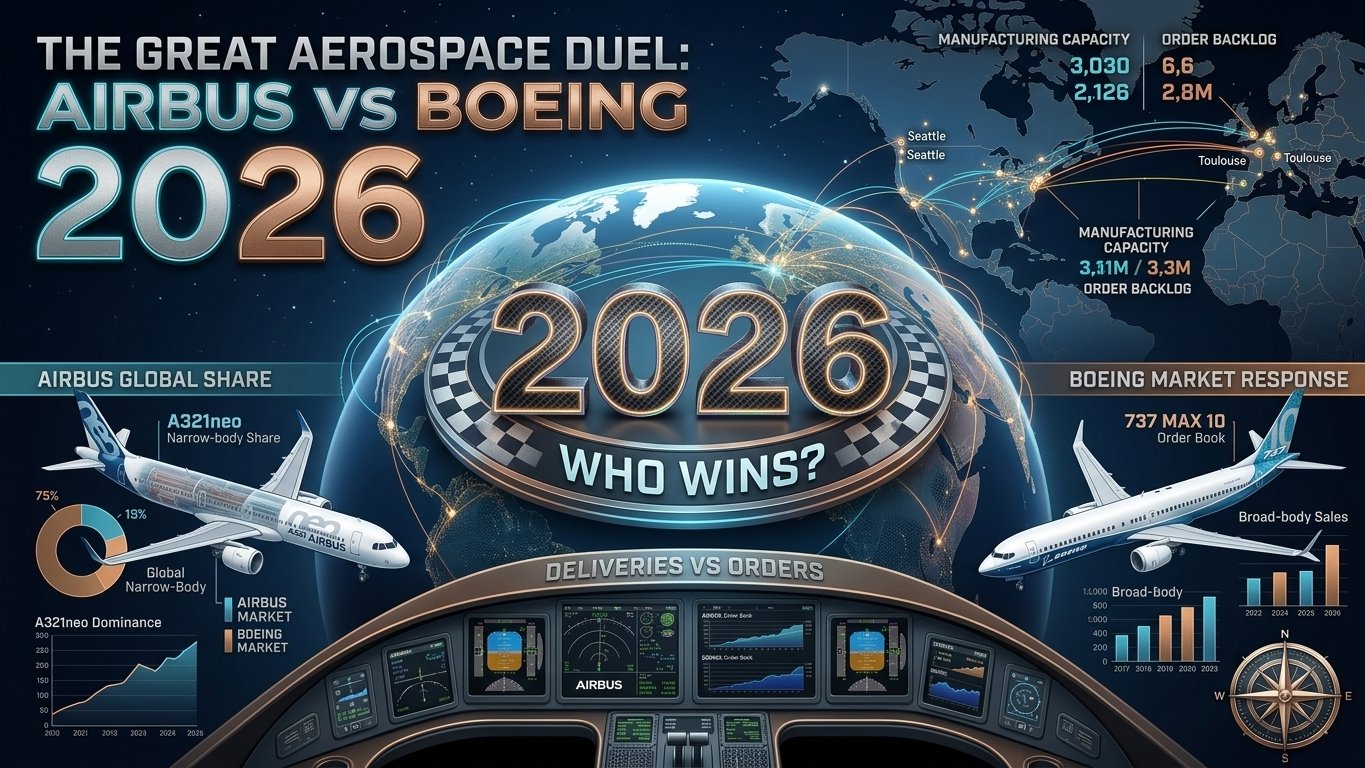
The Battle for the Skies: Airbus vs. Boeing and the Future of Aviation
When you board a commercial flight today, the odds are virtually absolute that you are stepping onto an aircraft built by one of just two aerospace giants: Airbus or Boeing.
This global duopoly shapes global trade, influences international diplomacy, and dictates how millions of passengers travel every day. Often compared to Coke versus Pepsi—albeit with billions of dollars and millions of lives on the line—the battle between Seattle-born Boeing and Europe’s multi-nationally backed Airbus is an ongoing saga of technological breakthroughs, fierce market rivalry, and corporate crises.
As the aviation industry moves through the mid-2020s, the contest has shifted from sheer market dominance to a high-stakes race toward supply chain execution, pilot philosophy, and the ultimate frontier: sustainable zero-emission flight.
The Birth of a Duopoly: How Two Titans Came to Rule the Sky
The global commercial aviation market was not always a two-player game. In the mid-20th century, the skies were shared by iconic American manufacturers like McDonnell Douglas, Lockheed, and Convair.
Boeing’s Early Dominance
Founded in 1916 in Seattle, Washington, Boeing established itself as the undisputed king of the Commercial Jet Age with the introduction of the 707 in the late 1950s, followed by the iconic 747 “Queen of the Skies.” Boeing’s engineering prowess defined modern passenger travel, creating a reputation for rugged reliability and American manufacturing muscle.
Europe Unites with Airbus
To challenge America’s near-monopoly on commercial aviation, European nations—primarily France, Germany, Spain, and the UK—pooled their industrial and engineering capabilities to form Airbus in 1970. Headquartered in Toulouse, France, Airbus released its first aircraft, the A300, which made history as the world’s first twin-engine widebody airliner.
Over the decades, as development costs soared and competition intensified, legendary rivals faded or were absorbed. The defining moment arrived in 1997 when Boeing merged with McDonnell Douglas, solidifying the global duopoly that remains today.
[1916: Boeing Founded] ───────┐
                              ├─> [1997: Boeing-McDonnell Douglas Merger] ──┐
[1920s-70s: McDonnell Douglas]┘                                            │
                                                                           ├─> [Global Duopoly]
[1970: Airbus Consortium Created (France, Germany, Spain, UK)] ───────────┘
Market Dynamics: Orders, Deliveries, and Backlogs
Success in the aerospace industry is measured in aircraft deliveries and long-term order backlogs. By mid-2025, Airbus maintained a firm lead in both metrics, largely due to supply chain stability and high demand for its single-aisle jets.
The Numbers Driving the Rivalry
| Metric | Airbus | Boeing |
| Annual Deliveries (2024 Actual) | ~770 Aircraft | ~530 Aircraft |
| Annual Delivery Target (2025) | ~800 Aircraft | Ramping up production |
| Total Order Backlog | Exceeds 8,000 aircraft | Approximately 6,000 aircraft |
| Primary Market Driver | A320neo / A321neo family | 737 MAX family / 787 Dreamliner |
| Core Strengths | European/Asian low-cost carriers, narrowbody dominance | Legacy US carriers, widebody long-haul, cargo freighter market |
While Airbus holds a significant overall lead in market share—driven primarily by the immense popularity of the A320neo family—Boeing retains a powerful foothold with major U.S. legacy airlines and continues to perform strongly in the long-haul widebody and commercial freighter markets.
The Narrowbody War: A320neo vs. Boeing 737 MAX
The single-aisle, narrowbody market represents the true workhorse of global aviation, driving short-to-medium-haul domestic and regional routes. This segment generates the vast majority of revenue for both plane makers.
                   SINGLE-AISLE WORKHORSE COMPARISON

       Airbus A320neo Family                 Boeing 737 MAX Family
 ┌───────────────────────────────┐     ┌───────────────────────────────┐
 │ • Introduced Digital FBW (1987)│     │ • First Flew in 1967          │
 │ • Wider Cabin Structure       │     │ • Deep Carrier Loyalty        │
 │ • Market Leader in Deliveries │     │ • Rushed Development Crisis   │
 └───────────────────────────────┘     └───────────────────────────────┘
The Legacy 737 vs. The Digital A320
Boeing’s 737 first flew in 1967, establishing a legendary reputation for mechanical durability and earning deep loyalty from low-cost operators like Southwest Airlines and Ryanair. When Airbus launched the A320 in the late 1980s, it introduced digital fly-by-wire flight controls and a slightly wider cabin, offering enhanced passenger comfort and operational efficiency.
The Neo Transition and the MAX Crisis
In the 2010s, Airbus introduced the A320neo (New Engine Option), delivering massive fuel savings that prompted airlines to place record-breaking orders. Under pressure to quickly offer a competing aircraft without requiring airlines to undergo lengthy pilot recertifications, Boeing rapidly developed the 737 MAX by fitting larger engines onto an aging 737 airframe.
This rushed redesign led to software vulnerabilities—specifically within the Maneuvering Characteristics Augmentation System (MCAS)—which played a central role in two tragic crashes in 2018 and 2019. The resulting global grounding of the 737 MAX damaged public confidence in Boeing and allowed Airbus to capture a commanding lead in narrowbody market share. Boeing has since overhauled its safety culture, updated its software, and retrained pilots, but overcoming that setback remains a central operational focus.
Widebody Flagships: A350 vs. Boeing 787 Dreamliner
In the widebody long-haul market—where aircraft cross oceans to connect continents—both manufacturers showcase their most prestigious engineering innovations.
                      WIDEBODY INNOVATION

    Boeing 787 Dreamliner                    Airbus A350 XWB
┌──────────────────────────────┐       ┌──────────────────────────────┐
│ • Pioneered Carbon Fuselage  │       │ • Over 50% Composite Material│
│ • Higher Cabin Humidity      │       │ • Extra-Wide, Quiet Cabin    │
│ • Revolutionary Fuel Efficiency│     │ • Preferred by Top Global Carriers│
└──────────────────────────────┘       └──────────────────────────────┘
The 787 Dreamliner Breakthrough
Boeing revolutionized long-haul flight when it launched the 787 Dreamliner. Featuring an airframe constructed primarily of composite materials (carbon fiber), the 787 lowered structural weight, dramatically reduced fuel burn, and allowed for higher cabin humidity and pressure levels, reducing passenger jet lag.
The A350 Response
Airbus responded with the A350 XWB (Extra Wide Body), constructed with over 50% composite materials. The A350 features a quiet cabin environment, advanced aerodynamics, and long range, securing key orders with major international carriers such as Singapore Airlines and Qatar Airways.
While the 787 had a head start in market adoption, the A350 has steadily closed the gap, turning the widebody market into a close, highly competitive race.
Cockpit Philosophies: Control Yoke vs. Side-Stick
Beyond aerodynamics and fuel burn, the clash between Airbus and Boeing represents a fundamental difference in flight deck engineering and pilot philosophy.
Boeing: The Traditionalist Approach
Physical Yoke: Boeing cockpits feature a prominent central control column (yoke) between the pilot’s legs, providing direct physical feedback.
Pilot Authority: Boeing’s design philosophy places final authority firmly with the human pilot. While flight computers assist, they generally do not override manual control inputs if a pilot chooses to push the aircraft to its limits.
Visual Cues: Boeing aircraft feature pointed nose profiles and iconic V-shaped cockpit windows.
Airbus: The Fly-by-Wire Pioneer
Side-Stick Control: Airbus replaced the traditional yoke with a side-stick controller located on the outboard console, opening up space for pull-out tables.
Flight Envelope Protection: Airbus aircraft utilize computer systems to enforce hard limits. The flight control system actively prevents a pilot from executing maneuvers that would exceed structural load limits or stall the aircraft.
Cockpit Commonality: Airbus prioritizes a standardized flight deck design across all models. A pilot qualified on an A320 can transition to an A330 or A350 with minimal additional simulator training, providing airlines with significant operational flexibility.
The Next Frontier: Hydrogen vs. Sustainable Aviation Fuels (SAF)
As the aviation industry works toward net-zero carbon emissions, Airbus and Boeing are pursuing distinctly different technological paths for the future.
                       SUSTAINABLE AVIATION STRATEGIES

         Airbus: ZEROe Concept                Boeing: SAF & Efficiency
┌─────────────────────────────────────┐  ┌─────────────────────────────────────┐
│ • Direct Hydrogen Combustion        │  │ • 100% Drop-In SAF Compatibility    │
│ • Zero CO2 Direct Flight Emissions  │  │ • Works with Existing Fleet & Pipes │
│ • Target Service Entry: 2035        │  │ • Focus on Immediate Scalability    │
└─────────────────────────────────────┘  └─────────────────────────────────────┘
Airbus’s Hydrogen Bet (ZEROe)
Airbus is betting heavily on hydrogen technology, aiming to launch the world’s first commercial zero-emission aircraft under its “ZEROe” initiative by 2035. Using hydrogen combustion and fuel cell technology, Airbus aims to eliminate direct carbon emissions during flight, though this will require rebuilding airport refueling infrastructure worldwide.
Boeing’s Focus on Sustainable Aviation Fuel (SAF)
Boeing is focusing its sustainability efforts on ensuring its entire fleet is certified to run on 100% Sustainable Aviation Fuels (SAF) by 2030. Because SAF can be used in existing jet engines without modifying aircraft or airport fueling infrastructure, Boeing considers drop-in SAF to be a more immediate, scalable solution for reducing global carbon footprints.
Beyond the Duopoly: Emerging Competitors and Future Horizons
While Airbus and Boeing remain dominant today, the future of aviation is being reshaped by technological shifts, new market entrants, and operational innovations.
Emerging Global Competitors: State-backed manufacturers like China’s COMAC (with its C919 narrowbody jet) are seeking to break the Western duopoly and capture market share in high-growth Asian markets.
Single-Pilot Operations & AI: Both manufacturers are researching advanced automation and AI assistance for flight decks. While single-pilot commercial operations face public perception hurdles, advanced automation aims to reduce pilot workload and improve safety monitoring.
Advanced Composites and Manufacturing: Next-generation aircraft will rely on lightweight composite structures, automated production lines, and real-time fleet health data to lower operating costs and minimize environmental impacts.
Conclusion: The Passenger Wins
The rivalry between Airbus and Boeing is far more than a simple corporate competition. It is a technological engine that has driven decades of progress in global transport.
By constantly pushing one another to build safer, faster, more comfortable, and more efficient aircraft, this duel has made world travel accessible to millions of people. Whether you fly on an Airbus A320neo or a Boeing 787 Dreamliner, this continuous push for innovation ensures that global aviation remains a vital, connected ecosystem.
FAQs
1. Which company currently leads in total aircraft orders and deliveries?
Airbus holds a lead over Boeing in both annual deliveries and total order backlog, primarily driven by the sales of its A320neo and A321neo narrowbody aircraft family.
2. What is the key difference between Airbus and Boeing cockpits?
Airbus uses a side-stick controller located on the side console along with hard-limit electronic envelope protection. Boeing uses a traditional central control yoke and gives the pilot manual authority to override computer systems if necessary.
3. What was the impact of the Boeing 737 MAX grounding?
The global grounding of the 737 MAX following crashes in 2018 and 2019 led to severe financial losses and reputational damage for Boeing, prompting major leadership changes, overhauled safety protocols, and a shift in narrowbody market share toward Airbus.
4. How do Airbus and Boeing differ in their sustainability strategies?
Airbus is investing in hydrogen-powered zero-emission aircraft targeting a 2035 entry into service. Boeing focuses on making current and future aircraft 100% compatible with Sustainable Aviation Fuels (SAF) using existing engine and fueling infrastructure.
5. What is “cockpit commonality” in Airbus planes?
Cockpit commonality refers to Airbus’s standardized cockpit design across different aircraft families. This enables airlines to retrain pilots from one model (like the single-aisle A320) to another (like the widebody A350) faster and more cost-effectively.
Sources and Further Reading
Airbus Commercial Aviation: Official fleet specifications, delivery reports, and details on the ZEROe hydrogen initiative.
Boeing Commercial Airplanes: Market outlooks, 787/737 program updates, and SAF implementation timelines.
International Air Transport Association (IATA): Global traffic statistics, airline fleet trends, and net-zero carbon roadmaps for commercial aviation.