




Undersea Cables: The Hidden $1.3 Million-Kilometer Lifeline of the Global Internet
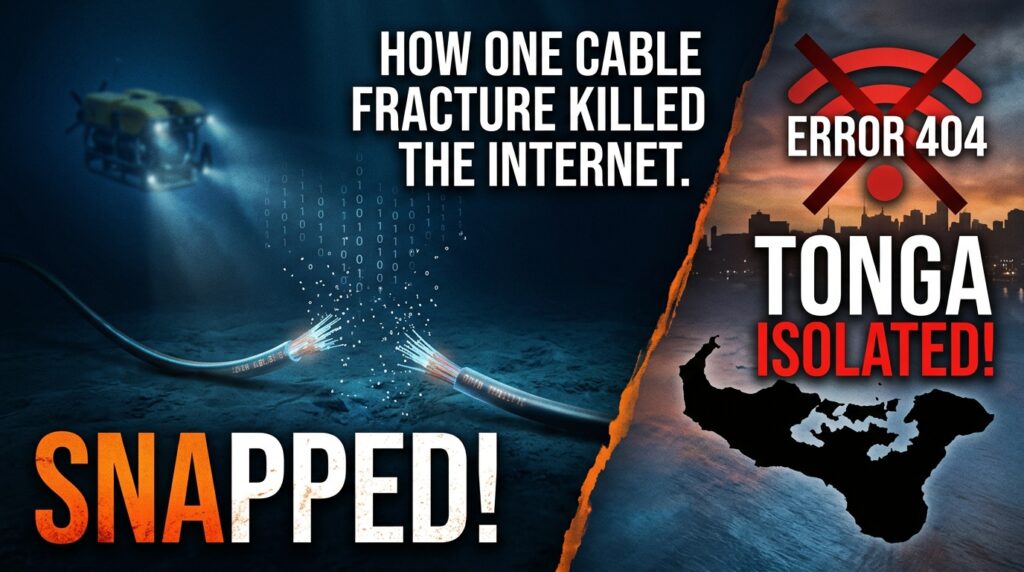
In January 2022, the Hunga Tonga-Hunga Ha’apai volcano erupted in the South Pacific, creating the largest atmospheric explosion recorded since Krakatoa in 1883. The blast sent shockwaves around the world and was heard as far away as Alaska. But for the 100,000 residents of Tonga, a secondary catastrophe unfolded silently beneath the waves: a single undersea cable snapped, plunging the entire island nation into five weeks of complete digital darkness.
The Tongan blackout exposed a fundamental reality about modern global communication. Despite widespread assumptions that data flows through satellites, cell towers, or the cloud, 95% of all international internet traffic—from daily emails and video calls to cross-border financial transactions—moves through physical fiber-optic wires resting on the ocean floor, sometimes as deep as 8,000 meters below sea level.

Undersea Cables: The Hidden $1.3 Million-Kilometer Lifeline of the Global Internet
In January 2022, the Hunga Tonga-Hunga Ha’apai volcano erupted in the South Pacific, producing the largest atmospheric explosion recorded since Krakatoa in 1883. The blast sent shockwaves across the globe and was heard as far away as Alaska. But for the 100,000 residents of Tonga, a secondary catastrophe unfolded silently beneath the waves: a single undersea cable snapped, plunging the entire island nation into five weeks of complete digital darkness.
The Tongan blackout exposed a fundamental reality about modern global communication. Despite widespread assumptions that data flows through satellites, cell towers, or the cloud, 95% of all international internet traffic—from daily emails and video calls to cross-border financial transactions—moves through physical fiber-optic wires resting on the ocean floor, sometimes as deep as 8,000 meters below sea level.
1. Anatomy and Physics of the Subsea Internet
The sheer scale of the global subsea network is astounding. There are approximately 400 active undersea cable systems spanning over 1.3 million kilometers across the globe—enough wire to circle the Earth 32 times.
Compact Footprint: Despite carrying massive bandwidth, most deep-sea cables are surprisingly thin—scarcely thicker than a standard garden hose.
Laser Transmission: Each cable houses multiple fiber strand pairs that transmit data using continuous pulses of laser light. A single fiber pair can process terabits per second, transferring enough data to move the entire U.S. Library of Congress in under a minute.
High-Voltage Repeaters: Because light signals degrade as they travel through solid glass, cables are built alongside copper conductors carrying up to 10,000 volts of electricity. This power feeds underwater optical repeaters placed every 50 to 150 kilometers to boost signal strength.
Extreme Velocity: A photon entering a cable in New York travels 6,600 kilometers through the dark ocean floor, passes through dozens of submerged repeaters, and reaches London just 60 milliseconds later.
2. The Big Tech Pivot: From Telecoms to Tech Monopolies
For over a century—from the first transatlantic telegraph cable in the 1850s to the telecom boom of the 1990s—undersea infrastructure was funded and built by telecommunications consortiums such as AT&T, British Telecom, and France Telecom.
Around 2012, a radical shift occurred. Tech giants realized that traditional telecom providers were charging them astronomical rates to carry their data—data that was expanding exponentially due to billions of daily search queries, streaming demands, and cloud infrastructure operations.
Google: Currently owns or co-owns over 33 subsea cable systems. This includes the 6,400-kilometer Dunant cable connecting Virginia to France, constructed for Google’s exclusive private use.
Meta: Backed 2Africa, a staggering 45,000-kilometer cable system circling the entire African continent and linking 33 countries. It stands as the longest subsea cable ever constructed.
Amazon & Microsoft: Both heavily invest in private and joint-venture cable builds to link their global data centers and cloud services directly, effectively bypassing public telecom networks.
3. Deep-Sea Repairs: Fixing the Global Grid
Undersea cables break on average more than 100 times every year. Causes range from commercial fishing trawlers and dragged ship anchors to underwater landslides, seismic events, and deliberate sabotage.
Despite 1.3 million kilometers of active line across the globe, there are only about 40 specialized cable repair ships worldwide. The repair process follows a precise sequence:
Fault Location: The repair ship uses acoustic positioning systems to locate the exact break on the seafloor.
ROV Deployment: Remote Operated Vehicles (ROVs) descend up to 5,000 meters into the ocean floor to locate and cut the damaged cable section.
Surface Hauling: Attached lift lines hoist the severed cable ends up to the specialized repair ship on the surface.
Fusion Splicing: On deck, specialized technicians use microscopic fusion splicers to re-join individual glass strands measuring just 9 microns in diameter—roughly one-eighth the thickness of a human hair.
Re-testing & Re-burial: The spliced cable is thoroughly re-tested, lowered back down to the seabed, and buried securely into the ocean floor.
4. The World’s Three Strategic Cable Chokepoints
The global internet grid relies heavily on three primary maritime corridors. Any localized physical or geopolitical disruption at these chokepoints presents a severe threat to international connectivity:
1. The Luzon Strait: Positioned between Taiwan and the Philippines, this corridor channels virtually all major trans-Pacific cables connecting East Asia to North America. It sits directly in a geologically active zone and a highly sensitive geopolitical region near TSMC’s semiconductor foundries.
2. The Suez-Red Sea Corridor: Serves as the primary overland and maritime pipeline connecting Europe to Asia. Red Sea disruptions force data rerouting along far longer paths around the African continent, causing latency spikes and network strain.
3. The Strait of Malacca & Singapore: Almost all trans-Pacific and Asia-to-Europe cables land in or pass through Singapore, giving the small island nation more cable landing stations per square kilometer than anywhere else on Earth.
Frequently Asked Questions (FAQs)
1. Does internet traffic travel through satellites or undersea cables? Over 95% of international internet traffic travels through undersea fiber-optic cables. Satellites handle a small fraction of global traffic, mostly serving remote land locations or maritime vessels where physical cables cannot land.
2. How do undersea cables stay powered across whole oceans? Cables contain a copper outer layer surrounding the optical fibers that carries up to 10,000 volts of direct current. This powers optical amplifiers (repeaters) spaced every 50 to 150 kilometers to boost signal strength over thousands of miles.
3. What happens when an undersea cable snaps? Network traffic is dynamically rerouted across alternative subsea cables. However, if an isolated area (like Tonga) relies on a single cable, or if multiple cables in a key chokepoint snap simultaneously, severe internet blackouts and latency spikes occur until specialized repair ships splice the broken fibers back together.
4. Why are tech companies like Google and Meta building their own cables? Hyper-scale technology companies generate unprecedented amounts of global traffic through cloud computing, streaming, and AI workloads. Owning private subsea cable infrastructure allows them to eliminate third-party telecom transit fees, optimize latency, and maintain complete control over data security.