




The Seismic Shift in the Electric Vehicle Landscape: Inside Auto Shanghai 2025
Forget everything you thought you knew about the global electric vehicle (EV) race. For over a decade, Western markets relied on a single narrative: Tesla was the undisputed king of EV innovation, while competitors scrambled to match its manufacturing efficiency, software integration, and battery technology.
That narrative is now unraveling.
The 21st Shanghai International Automobile Industry Exhibition (Auto Shanghai 2025), hosted at the National Exhibition and Convention Center (NECC) in Shanghai, China, served as a definitive turning point for the global automotive sector. Spanning massive pavilions and digital demonstration zones, the event was not merely a traditional trade show. It operated as a clear declaration that Chinese automakers have transitioned from rapid adopters to pace-setting innovators.
While Western original equipment manufacturers (OEMs) presented incremental iterations and polished concept designs, domestic Chinese brands introduced functional, production-ready technologies: amphibious luxury SUVs, urban flying cars, human-centric AI co-pilots, fully automated battery swapping networks, and driverless robo-taxis.
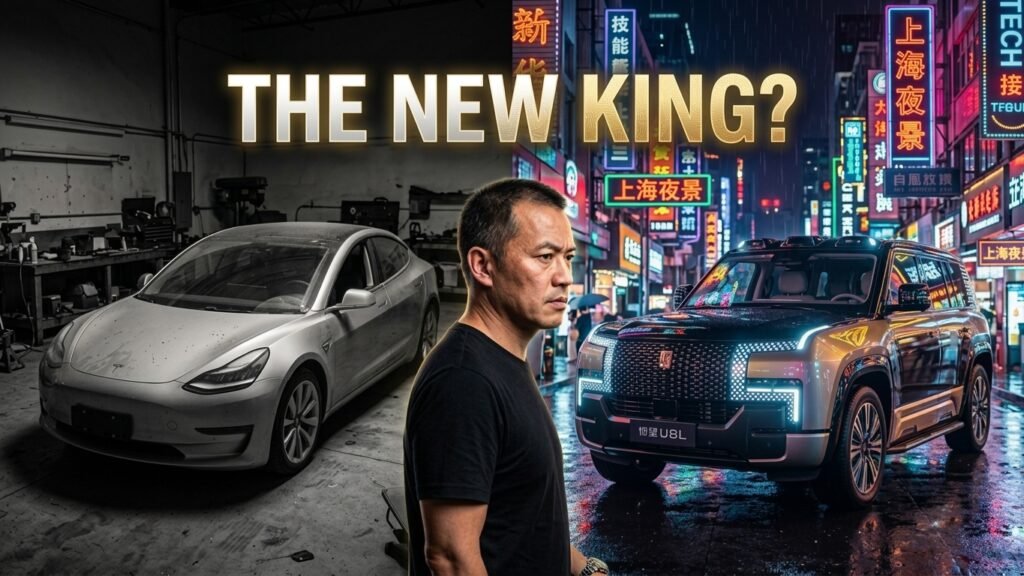
Perhaps most telling was the quiet landscape surrounding legacy leaders. Tesla, despite operating its highest-volume Gigafactory in Shanghai, had no official display or presence at the exhibition. The contrast highlighted a profound structural change: the center of gravity for EV innovation, market speed, and design philosophy has shifted eastward.
1. The Death of the Western EV Monopoly
For years, global automotive dynamics followed a predictable pattern: advanced powertrain technology and luxury features originated in Western markets—predominantly the United States, Germany, and Japan—and were subsequently adapted for foreign consumption. Chinese manufacturers were often viewed primarily as high-volume assemblers or domestic market specialists.
Auto Shanghai 2025 invalidated that paradigm. The exhibition demonstrated that Chinese automotive OEMs no longer require external validation or foreign technology transfers to dominate the market. Supported by vertically integrated supply chains, sovereign battery manufacturing ecosystems, and massive domestic engineering talent, brands like BYD, XPeng, NIO, Zeekr, and Avatr are advancing product lifecycles at speeds unprecedented in legacy manufacturing.
Traditional Western Automotive Cycle vs. Chinese EV Development Cycle

Legacy OEMs:     [ Strategy & Design (2 yrs) ] ➔ [ Engineering & Sourcing (2 yrs) ] ➔ [ Validation & Production (2 yrs) ] = 6 Years
Chinese EV OEMs: [ Concept & Rapid Prototyping (6 mos) ] ➔ [ Software Integration & Deployment (1 yr) ]      = 1.5–2 Years
While legacy manufacturers navigate multi-year retooling delays, platform revisions, and software integration hurdles, Chinese competitors iterate vehicle platforms with the agility of consumer electronics companies. Vehicle hardware is increasingly paired with over-the-air (OTA) software architecture, allowing feature sets to evolve post-purchase.
Consequently, European and American automotive leaders now find themselves competing against lower production costs combined with superior feature density, software execution, and manufacturing throughput.
2. BYD: From Battery Manufacturer to Global Automotive Titan
No individual entity illustrates this technological shift better than BYD (Build Your Dreams). Originating as a battery firm, BYD has grown into the world’s largest electric vehicle manufacturer by volume. At Auto Shanghai 2025, BYD demonstrated that its aspirations extend far beyond mass-market volume; it aims to define the technological envelope across every price segment.
The Yangwang U8: Redefining Utility and Survival Engineering
The highlight of BYD’s display was the Yangwang U8, a ultra-luxury off-road SUV engineered with extreme capabilities:
Amphibious Operation: The vehicle features an IP68-rated waterproof powertrain and body seal, allowing it to float on water, maintain buoyancy, and maneuver across flooded areas using wheel rotation for emergency propulsion.
Independent Four-Wheel Torque Control (e4 Platform): Powered by four independent electric motors, the vehicle continuously calculates traction requirements per wheel. This enables precise torque vectoring and allows the platform to perform $360^\circ$ tank turns on its own axis by rotating left and right wheels in opposing directions.
Integrated Terrain Intelligence: The platform features active suspension systems capable of adjusting body height and dampening dynamically across extreme topographies.
+-----------------------------------------------------------------------+
|                         BYD YANGWANG U8 TECH                          |
+--------------------------+--------------------------------------------+
| Powertrain Architecture  | Quad-Motor Independent Wheel Drive (e4)   |
| Emergency Capabilities   | Amphibious Floating & Water Maneuverability|
| Maneuverability          | 360-Degree Tank Turns                      |
| Suspension               | DiSus-P Intelligent Hydraulic Body Control |
+--------------------------+--------------------------------------------+
The Yangwang U9: Dynamic Active Suspension
Alongside the U8, BYD showcased the Yangwang U9 hypercar, capable of accelerating from $0 \text{ to } 100 \text{ km/h}$ in under 2 seconds. Beyond raw speed, the U9 demonstrated the capabilities of BYD’s DiSus-X Intelligent Body Control System. The active suspension manages kinetic force in real time, allowing the vehicle to balance chassis motion during aggressive cornering, launch forward without rear squat, and actively jump or bounce clear of ground obstacles.
The BYD Seagull: Demolishing the Cost Barrier
While hypercars captured attention, BYD’s most disruptive display was targeted at mass adoption: the BYD Seagull. Offered at an accessible price point, the compact EV provides over 300 kilometers of driving range, advanced standard safety features, and a fully integrated smart infotainment system.
Mass-Market Cost Architecture Comparison

Metric                   BYD Seagull                  Legacy Western EV Standard
---------------------------------------------------------------------------------
Entry Price Target       <$10,000 USD                 $30,000 - $35,000 USD
Battery Tech             LFP (Lithium Iron Phosphate) Nickel-Manganese-Cobalt (NMC)
Estimated Range          300+ km                      300 - 350 km
Standard Tech Features   Smart Display, OTA, ADAS     Basic Infotainment (Tiered)
While foreign automakers struggle to engineer sub-$30,000 electric platforms without sacrificing margins or feature sets, BYD’s vertical integration—controlling everything from raw lithium processing to semiconductor fabrication—enables profitable mass-market electrification.
3. XPeng: Elevating Mobility into the Skies and AI Cockpits
XPeng used Auto Shanghai 2025 to transition from a pure-play automotive company into an integrated multi-modal transportation developer, addressing both ground-level transit and low-altitude urban airspace.
Low-Altitude Urban Aviation: XPeng AeroHT
Front and center at XPeng’s exhibit was the XPeng AeroHT flying car prototype. Moving past speculative visual concepts, the AeroHT is built as a functional system featuring:
Dual-Mode Chassis Configuration: Operates as a road-legal electric vehicle with integrated, fold-away rotor arms.
Lightweight Carbon Fiber Airframe: Constructed with high-strength composite materials to minimize gross takeoff weight while meeting structural safety margins.
Vertical Takeoff and Landing (VTOL): Electric propulsion units allow the aircraft to lift, hover, and transition into directional flight without a runway.
XPeng confirmed successful flight testing phases alongside plans to launch low-altitude transport corridors in target metropolitan areas in China. This system aims to bypass road congestion by utilizing low-altitude airspace for point-to-point transit.
                         +------------------------+
                         |  XPeng AeroHT Mobility |
                         +-----------+------------+
                                     |
           +-------------------------+-------------------------+
           |                                                   |
           v                                                   v
+-----------------------+                           +-----------------------+
|  Ground Operations    |                           |  Airborne Operations  |
|  - Folded Rotors      |                           |  - Deployed Arms      |
|  - Standard EV Drive  |                           |  - Electric VTOL      |
|  - Public Road Specs  |                           |  - Low-Altitude Transit|
+-----------------------+                           +-----------------------+
The XPeng X9: Reimagining Family Transport
On the ground, XPeng introduced the X9 Multi-Purpose Vehicle (MPV), designed around an automated cabin environment. The interior incorporates modular seating tracks, voice-activated artificial intelligence that continuously monitors cabin ambient conditions, and an expansive digital cockpit array. The vehicle functions less as a traditional car and more as a mobile workspace and living hub.
4. NIO: Human-Centric AI and the Battery Swapping Blueprint
While competitors focused on horsepower metrics and high-speed flight concepts, NIO structured its showcase around human-centric design, cabin wellness, and energy replenishment ecosystems.
The ET9 and Nomi AI: The Emotional Sanctuary
NIO’s flagship sedan, the ET9, highlights minimalist design and noise-isolation engineering. Key features include:
Panoramic Smart Glass Infrastructure: Dynamic electrochromic glass panels that automatically adjust light transparency based on external sunlight conditions.
Ergonomic Active Cabin Elements: Multi-point massage seating, integrated ambient lighting, and active noise-cancellation systems built directly into the chassis framework.
                           +-------------------+
                           |  NIO Nomi AI Host |
                           +---------+---------+
                                     |
        +----------------------------+----------------------------+
        |                            |                            |
        v                            v                            v
+---------------+            +---------------+            +---------------+
| Facial & Voice|            | Contextual    |            | Predictive    |
| Biometrics    |            | Adaptation    |            | Route Optimization|
| Detects user  |            | Adjusts lights|            | Reroutes via  |
| stress/mood   |            | and audio     |            | traffic data  |
+---------------+            +---------------+            +---------------+
Central to the interior experience is Nomi, NIO’s onboard AI co-pilot. Powered by biometric sensors, facial detection, and tone recognition, Nomi actively senses driver fatigue or stress. Rather than functioning solely as an automated command parser, the system adapts interior lighting, adjusts climate configurations, queues soothing media playlists, and dynamically reroutes travel paths around high-traffic zones.
Battery Swapping vs. Static Fast Charging
NIO’s primary infrastructural advantage remains its proprietary battery swapping technology. While global automakers continue investing in high-kilowatt charging stations that still require drivers to dwell for 20 to 45 minutes, NIO bypasses charging friction entirely through automated battery replacement:
Energy Replenishment Timeline Comparison

Method                    Process Time      Driver Experience
---------------------------------------------------------------------------------
Traditional DC Fast-Charge  25 - 45 Mins      Vehicle parked; cable manually tethered
NIO Power Swap 4.0        < 3 Mins          Automated drive-in; full pack swap
Drivers enter a compact, automated swapping bay. Robotic systems unscrew the depleted battery pack from the underside of the vehicle frame, replace it with a fully charged unit, and run automated diagnostic checks. The entire cycle finishes in under three minutes. With tens of millions of completed swaps and thousands of operational stations worldwide, NIO has commercialized an alternative energy architecture that legacy manufacturers previously considered unfeasible.
5. Premium Redefined: Zeekr, Avatr, and the Western Price Disruption
Luxury automotive manufacturing was long defined by combustion engine heritage, bespoke leather interiors, and brand equity accumulated over decades. Brands like Zeekr and Avatr are redefining premium motoring around software architectures, integrated biometrics, and aggressive pricing.
+---------------------------------------------------------------------------+
|                          NEXT-GEN CHINA LUXURY SPECS                      |
+-------------------+-------------------------------------------------------+
| Zeekr 007         | • Facial recognition ignition & driver profiling      |
|                   | • Full-windshield Head-Up Display (AR-HUD)            |
|                   | • Frameless suicide doors with electronic actuation   |
|                   | • AI-driven dynamic driving controls                  |
+-------------------+-------------------------------------------------------+
| Avatr 12          | • Buttonless minimalist cabin layout                  |
| (Backed by Huawei | • Electrochromic self-tinting panoramic glass         |
|   & CATL)         | • Integrated biometric sensors & health monitoring    |
|                   | • Augmented Reality windshield navigation projections |
+-------------------+-------------------------------------------------------+
Advanced Tech at Lower Price Points
The critical competitive challenge for legacy luxury brands is not merely feature set availability—it is the price differential.
Both the Zeekr 007 and Avatr 12 enter the market priced significantly lower than comparable luxury EV offerings from Western brands. By combining tier-one component suppliers—such as battery giant CATL and tech developer Huawei—these brands deliver premium performance, extended range profiles, and advanced autonomous sensor suites at costs that challenge established European market margins.
6. Autonomous Operations: China’s Robo-Taxi Fleet Reality
Autonomous driving technology has moved past isolated test tracks in China. Autonomous mobility companies including Pony.ai, Baidu Apollo, and AutoX operated fully autonomous vehicles around Shanghai’s dense traffic areas during the exhibition.
                +-------------------------------------------+
                |         Baidu Apollo RT6 Robo-Taxi        |
                +---------------------+---------------------+
                                      |
       +------------------------------+------------------------------+
       |                                                             |
       v                                                             v
+-------------------------------+                   +-------------------------------+
| Purpose-Built Architecture    |                   | Modular Interior Capabilities |
| - Steering wheel-free design  |                   | - Passenger Transit Lounge    |
| - Redundant safety systems    |                   | - Mobile Retail Space         |
| - Integrated LIDAR & Cameras  |                   | - Automated Freight / Logistics|
+-------------------------------+                   +-------------------------------+
The Baidu Apollo RT6 demonstrates this progress. Designed specifically as a steering-wheel-free ride-hailing vehicle, the RT6 features redundant safety systems, integrated roof-mounted perception arrays, and flexible cabin spaces.
Comparative Regional Frameworks for Autonomous Deployment

Vector                     China                                Western Markets (US/EU)
-----------------------------------------------------------------------------------------
Regulatory Alignment       Integrated state-level framework     Fragmented state/country laws
Infrastructure Integration Smart-city V2X cloud integration     Isolated vehicle sensor reliance
Public Deployment Status   Active commercial robo-taxi fleets   Limited pilot market rollouts
China’s competitive edge in autonomous transport relies on systemic alignment:
Smart City Integration (V2X): Urban roads are increasingly outfitted with Vehicle-to-Everything infrastructure, streaming traffic signal data, hazard warnings, and pedestrian movements directly to onboard compute units.
Unified Regulatory Approval: Government entities coordinate with autonomous developers to establish testing zones, safety standards, and insurance structures.
Public Readiness: Higher urban density and rapid adoption of digital platforms foster strong consumer interest in driverless transit services.
7. Tesla’s Absence: A Symbolic Turning Point
Perhaps the most discussed aspect of Auto Shanghai 2025 was an empty space: Tesla was completely absent from the event floor.
Tesla operates Gigafactory Shanghai, a core manufacturing hub responsible for producing hundreds of thousands of vehicles annually for domestic delivery and global export markets. Choosing not to participate in China’s premier automobile event reflects a notable strategic gap.
                         +--------------------------+
                         | Tesla's Market Position  |
                         +------------+-------------+
                                      |
           +--------------------------+--------------------------+
           |                                                     |
           v                                                     v
+--------------------------+               +----------------------------------+
| Historical Dominance     |               | Emerging Reality                 |
| - Pioneer status         |               | - Stale product lineups          |
| - High brand prestige    |               | - Intensified price pressure     |
| - Fast-charging advantage|               | - Absence from key tech summits  |
+--------------------------+               +----------------------------------+
Historically, global markets viewed domestic Chinese vehicles as budget alternatives to Western models. Today, Chinese consumers increasingly prefer domestic brands that offer faster feature updates, localized software integrations, and lower ownership costs.
Tesla’s absence underscored a shifting dynamic: where Western manufacturers once led and foreign markets followed, domestic Chinese OEMs are now driving platform development, software innovation, and pricing models.
8. FAQs: Understanding the Global EV Shift
Is China really leading the global EV industry now?
Yes. China currently leads in manufacturing volume, battery supply chain control (processing over $70\%$ of global lithium and cobalt reserves), and hardware development speeds. Events like Auto Shanghai 2025 demonstrate that Chinese brands now set global standards for software integration, feature design, and pricing.
What makes BYD’s battery technology different from Tesla’s?
BYD utilizes its proprietary Blade Battery technology based on Lithium Iron Phosphate (LFP) chemistry. This construction offers high thermal stability, longer cycle life, and lower production costs compared to traditional Nickel-Manganese-Cobalt (NMC) cells. BYD’s vertical integration allows it to produce these battery packs entirely in-house at scale.
How does NIO’s battery swapping work, and why isn’t everyone doing it?
NIO vehicles are built on a modular chassis that allows automated battery swapping stations to unbolt a depleted pack and mount a fully charged pack in under three minutes. While Western manufacturers opted out due to high infrastructure costs and standardized pack design challenges, NIO committed early, creating a functional, proprietary network spanning thousands of stations.
Are flying cars like the XPeng AeroHT realistic for public roads?
XPeng’s AeroHT features a dual-mode system designed for both highway driving and low-altitude flight via vertical takeoff and landing (VTOL). The company is conducting real-world flight trials and partnering with Chinese municipalities to establish regulated low-altitude flight corridors. Initial commercial deployments are planned for target urban zones.
Why didn’t Tesla attend Auto Shanghai 2025?
Tesla has shifted away from traditional automotive trade shows to focus on proprietary launch events and direct digital communications. However, its absence at China’s premier auto exhibition—amid aggressive innovation and market share growth from domestic competitors—drew criticism from industry analysts.
Are Chinese luxury EVs coming to Western markets?
Yes. Chinese EV manufacturers are expanding exports to Europe, Southeast Asia, Latin America, and the Middle East. While trade tariffs present regulatory challenges in North America, many Chinese OEMs are establishing regional assembly plants globally to support long-term international expansion.
The New World Order of Automotive Engineering
Auto Shanghai 2025 demonstrated a clear realignment of the automotive industry. The technological focus has shifted from internal combustion engine displacement and legacy mechanical heritage to software architecture, sensor density, battery chemistry, and automated mobility networks.
Summary of the Global Automotive Transition

Era 1: Mechanical Dominance (20th Century)
Engine Performance ➔ German / US / Japanese Engineering ➔ Global Export

Era 2: Early Electrification (2010–2020)
Tesla Dominance ➔ Silicon Valley Software Focus ➔ Global Market Adoption

Era 3: Integrated Smart Mobility (2025+)
Chinese Ecosystem Dominance ➔ Vertical Supply Chains ➔ Autonomous & Multi-Modal Mobility
The primary developments showcased in Shanghai—from amphibious utility vehicles and battery swapping networks to low-altitude flying cars—confirm that future transport solutions are being actively deployed at scale. As global automotive manufacturers adapt to these changes, one reality is clear: the future of electric mobility is no longer a distant concept—it is accelerating out of Shanghai, Guangzhou, and Shenzhen today.