Suspended Above the Clouds: How China Built the World’s Most Record-Shattering Mega-Bridges
Over the past three decades, China has executed an infrastructure revolution unparalleled in human history. Among its most visually stunning and technically daunting achievements is its masterclass in bridge engineering. Traversing geological faults, treacherous deep-sea channels, dense urban river basins, and sheer mountain canyons, Chinese engineers have rewritten the rules of modern civil construction.
By pushing the limits of suspension, cable-stayed, and steel-arch engineering, China has constructed world-record-holding spans that conquer previously impassable landscapes. These mega-structures serve a dual purpose: they are critical economic engines that drastically reduce transit times across vast territories, and they are architectural wonders that draw tourists, engineering enthusiasts, and thrill-seekers from across the globe.
This comprehensive guide explores eight of China’s most iconic and record-breaking bridge projects, breaking down their structural engineering, geographical challenges, economic impacts, and world-record accomplishments.

1. High-Altitude Wonders: Conquering the Mountain Canyons
Southwestern China—particularly provinces like Guizhou, Yunnan, and Hunan—features some of the world’s most rugged karst topography. Deep river gorges, vertical cliff faces, and treacherous weather conditions historically isolated entire communities. To cross these chasms, engineers turned to high-altitude suspension and cable-stayed designs.
The Duge Beipanjiang Bridge (Guizhou & Yunnan)
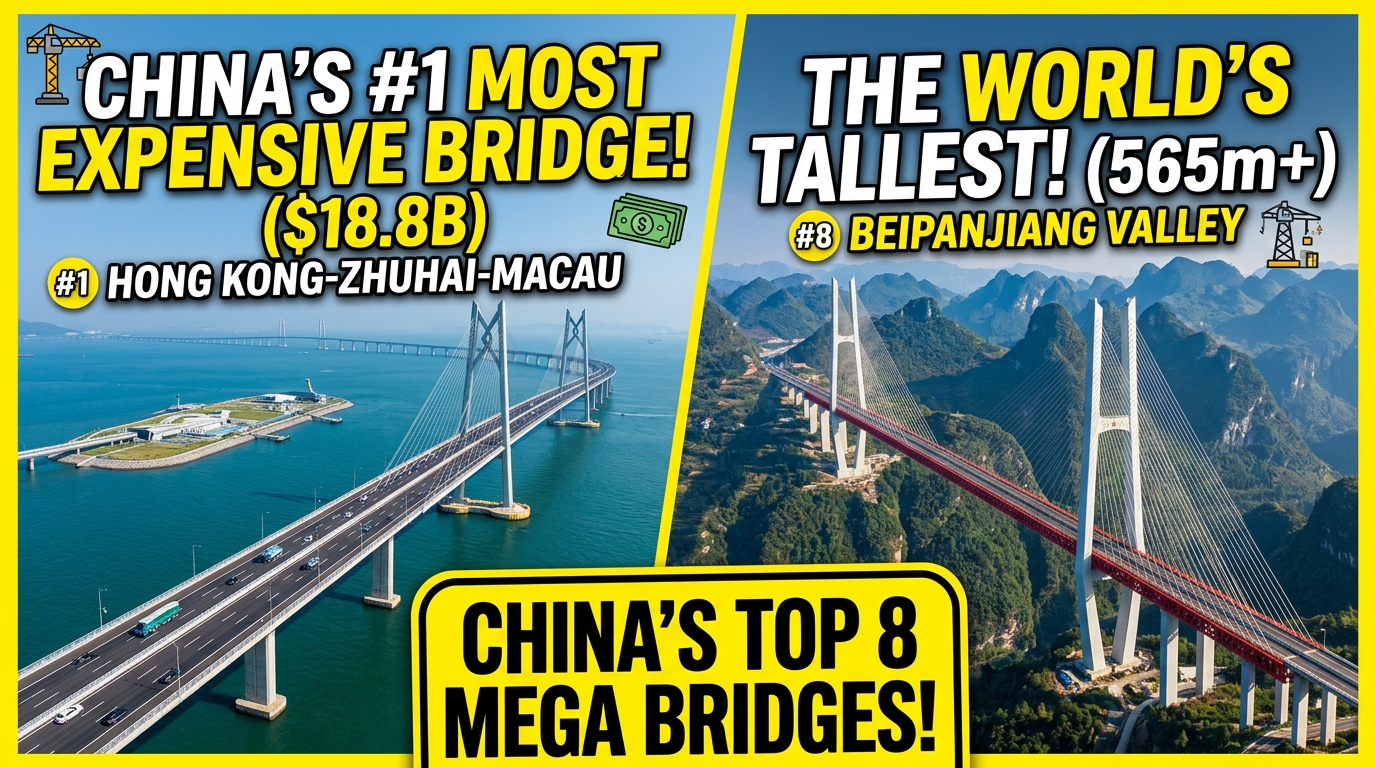
Standing as a monumental testament to modern structural engineering, the Duge Beipanjiang Bridge holds the official world record as the highest bridge on Earth.
Jaw-Dropping Deck Elevation: Suspended a staggering 565 meters (1,854 feet) above the floor of the Beipan River Canyon, the road deck hangs higher than the height of a 180-story skyscraper.
Engineering Precision Across Provinces: Spanning 1,341 meters in total length with a main span of 720 meters, the cable-stayed structure connects the mountainous border between Guizhou and Yunnan provinces.
Extreme Wind Mitigation: Due to high-velocity mountain wind gusts within the narrow gorge, aerodynamic testing was required to design a steel truss deck that dissipates wind shear without structural oscillation.
Economic Transformation: Prior to the bridge’s completion in late 2016, travelers navigating between Xuanwei in Yunnan and Shuicheng in Guizhou had to wind down steep mountain roads for over five hours. The Beipanjiang Bridge slashed that journey to under an hour.
The Aizhai Bridge (Hunan Province)
Located near Jishou in Hunan Province, the Aizhai Bridge is celebrated worldwide as both an engineering masterwork and an aesthetic triumph.
World-Class Proportions: Suspended 355 meters (1,165 feet) above the Dehang Canyon, the bridge features a main suspension span of 1,176 meters and a total length of 1,776 meters. It stands as one of the world’s highest and longest canyon-crossing highway suspension bridges.
Subterranean Tunnel Anchorages: The bridge’s mountain-to-mountain design presented unique anchoring challenges. Engineers had to bore anchorage tunnels directly into the sheer karst limestone cliffs on either side of the valley to secure the massive steel main cables.
Integrated Tourist Infrastructure: The bridge was designed with a dedicated glass-bottomed pedestrian walkway positioned beneath the main highway deck, allowing visitors to view the scenic Dehang Canyon directly through the floor of the structure.
2. Open-Sea Titans: Maritime Megaprojects
While high-altitude bridges conquer mountain chasms, China’s maritime mega-bridges tackle open-ocean currents, typhoons, and deep seabed foundations.
The Hong Kong-Zhuhai-Macau Bridge (HKZMB)
Representing the most expensive bridge project in China’s history at an estimated $18.8 billion, the Hong Kong-Zhuhai-Macau Bridge is the world’s longest fixed sea-crossing system.
55-Kilometer Structural Network: The HKZMB spans 55 kilometers across the Lingdingyang channel in the Pearl River Delta, integrating three cable-stayed bridges, long viaducts, artificial islands, and a deep-water sub-sea tunnel.
The Immersed Tube Tunnel: To allow high-tonnage cargo ships to pass into the Pearl River estuary without height restrictions, engineers constructed a 6.7-kilometer undersea tunnel. The tunnel connects to two custom-built artificial islands using 80,000-ton concrete immersed tube segments sunk into the seafloor.
Typhoon and Earthquake Resistance: Designed for a 120-year service life, the steel and concrete infrastructure is built to withstand magnitude 8.0 earthquakes, super-typhoons with winds exceeding 200 km/h, and accidental strikes by major commercial vessels.
Greater Bay Area Integration: By connecting Hong Kong, Zhuhai, and Macau directly, drive times across the delta were reduced from over four hours to just 45 minutes, forging an integrated economic megalopolis.
The Jiaozhou Bay Bridge (Shandong Province)
Spanning the ocean waters of Qingdao in Shandong Province, the Jiaozhou Bay Bridge represents one of the longest over-water bridge structures in the world.
42.5-Kilometer Length: The massive structure crosses the entire mouth of Jiaozhou Bay, connecting downtown Qingdao directly to the Huangdao District and the Qingdao West Coast New Area.
Multi-Bridge Structural Configuration: The 42.5-kilometer route is not a single simple causeway; it combines a self-anchored suspension section, cable-stayed channels, and concrete viaducts resting on over 5,000 concrete piers embedded into the marine seabed.
Corrosion Resistance: To combat the aggressive saltwater environment of the Yellow Sea, engineers developed specialized self-compacting high-performance concrete combined with cathodic protection systems to guard internal steel rebar against marine corrosion.
3. Metropolitan Architectural Icons
In China’s bustling megacities, bridges are built not only to manage immense vehicle volumes but also to serve as architectural symbols of urban modernization.
The Lupu Bridge (Shanghai)
Spanning the Huangpu River in central Shanghai, the Lupu Bridge holds a legendary status in modern steel-arch engineering.
World’s Longest Highway Steel Arch: Measuring 3,900 meters in total length with a central arch span of 550 meters, the Lupu Bridge stands as one of the world’s longest steel arch bridges.
Tied-Arch Structural Mechanics: The arch structure acts as a massive tied-arch system where the horizontal thrust of the arch is absorbed by high-tensile steel tie-cables beneath the deck, relieving pressure on the soft riverbank soil foundations of Shanghai.
Climbing Tourism Destination: Beyond serving as a major multi-lane highway artery, the bridge features built-in observation decks along the top curve of its massive steel arch, where tourists can climb 280 steps along the arch frame to enjoy panoramic views of the Shanghai skyline and Expo park grounds.
The Chaotianmen Bridge (Chongqing)
Built across the Yangtze River in the mountain metropolis of Chongqing, the Chaotianmen Bridge holds the world record for the longest main span of any arch bridge.
552-Meter Main Arch Span: The central continuous steel truss arch spans 552 meters, surpassing the famous Sydney Harbour Bridge and Shanghai’s Lupu Bridge.
Double-Deck Transit Capabilities: To maximize urban transit efficiency, the bridge features a double-deck layout:
Upper Deck: Houses a six-lane highway (expandable to eight lanes) with pedestrian sidewalks.
Lower Deck: Accommodates two heavy rail lines for Chongqing’s metro system alongside two additional vehicular traffic lanes.
Complex Topographic Anchorage: Because Chongqing is built on steep, hilly rock formations, the bridge anchors directly into massive natural sandstone rock beds on both sides of the Yangtze River.
4. Engineering Technological Breakthroughs
These record-shattering achievements are the direct result of rapid innovation in material science, computer modeling, and heavy construction equipment.
Structural Engineering and Material Science
Ultra-High-Strength Steel Cables: Modern spans like the Duge Beipanjiang and Aizhai bridges utilize parallel wire cables rated for tensile strengths exceeding 1,860 megapascals, allowing light, thin cable bundles to hold thousands of tons of dynamic load.
Self-Compacting High-Performance Concrete: Marine bridges use customized concrete mixes containing fly ash and silica fume to create dense, impermeable barriers against chloride penetration from seawater.
Advanced Construction Technology
Robotic Cable-Spinning: Main suspension cables are woven in mid-air using automated cable-spinning technology that pulls thousands of individual high-tensile wires across mountain gorges with mechanical precision.
Modular Pre-Fabrication: Heavy components—such as steel deck trusses and concrete pier blocks—are pre-fabricated off-site in industrial facilities and transported via specialized barges or heavy haulers before being hoisted into place by super-heavy cranes like the XGC88000 crawler crane.
Summary of Iconic Chinese Bridge Megaprojects
Duge Beipanjiang Bridge: Located in Guizhou and Yunnan provinces; features a 565-meter deck height above the river; holds the official record as the World’s Highest Bridge.
Hong Kong-Zhuhai-Macau Bridge: Spans 55 kilometers across the Pearl River Delta; holds the record as the World’s Longest Sea-Crossing Bridge and fixed link system.
Aizhai Bridge: Located in Hunan Province; features a 355-meter height and 1,176-meter span; famous for its mountain-tunnel anchorages and glass-bottom tourist walkway.
Jiaozhou Bay Bridge: Located in Shandong Province; spans 42.5 kilometers over open marine water; built using corrosion-resistant self-compacting marine concrete.
Chaotianmen Bridge: Located in Chongqing; features a 552-meter steel arch span; holds the record for the World’s Longest Steel Arch Bridge Span.
Lupu Bridge: Located in Shanghai; spans the Huangpu River with a 550-meter arch span; renowned for its tied-arch urban design and accessible deck climbing tours.
Tsing Ma Bridge: Located in Hong Kong; features a 1,377-meter main span; celebrated as one of the longest dual-use rail and highway suspension bridges in existence.
Frequently Asked Questions (FAQs)
1. Which bridge currently holds the record for the highest bridge deck in the world? The Duge Beipanjiang Bridge, located on the border of Guizhou and Yunnan provinces in China, holds the official world record with a road deck suspended 565 meters (1,854 feet) above the Beipan River canyon.
2. How does the Hong Kong-Zhuhai-Macau Bridge handle marine ship traffic? To allow large container ships and oil tankers to navigate the busy Pearl River Delta shipping lanes without colliding with bridge piers, the 55-kilometer system dips underwater into a 6.7-kilometer immersed tube tunnel connected by two artificial islands.
3. What is the difference between a suspension bridge and a cable-stayed bridge? In a suspension bridge (like the Aizhai Bridge), the road deck is suspended from vertical cables attached to thick main cables stretched between towers and anchored into the earth. In a cable-stayed bridge (like the Duge Beipanjiang Bridge), the road deck is supported directly by diagonal cables extending straight from the central towers down to the deck.
4. Why are so many world-record bridges concentrated in Guizhou Province? Guizhou features extreme karst topography filled with deep, steep valleys and limestone canyons. Building traditional ground-level expressways or railways through the region was geographically impossible, forcing civil engineers to span across deep canyons at record-breaking heights.