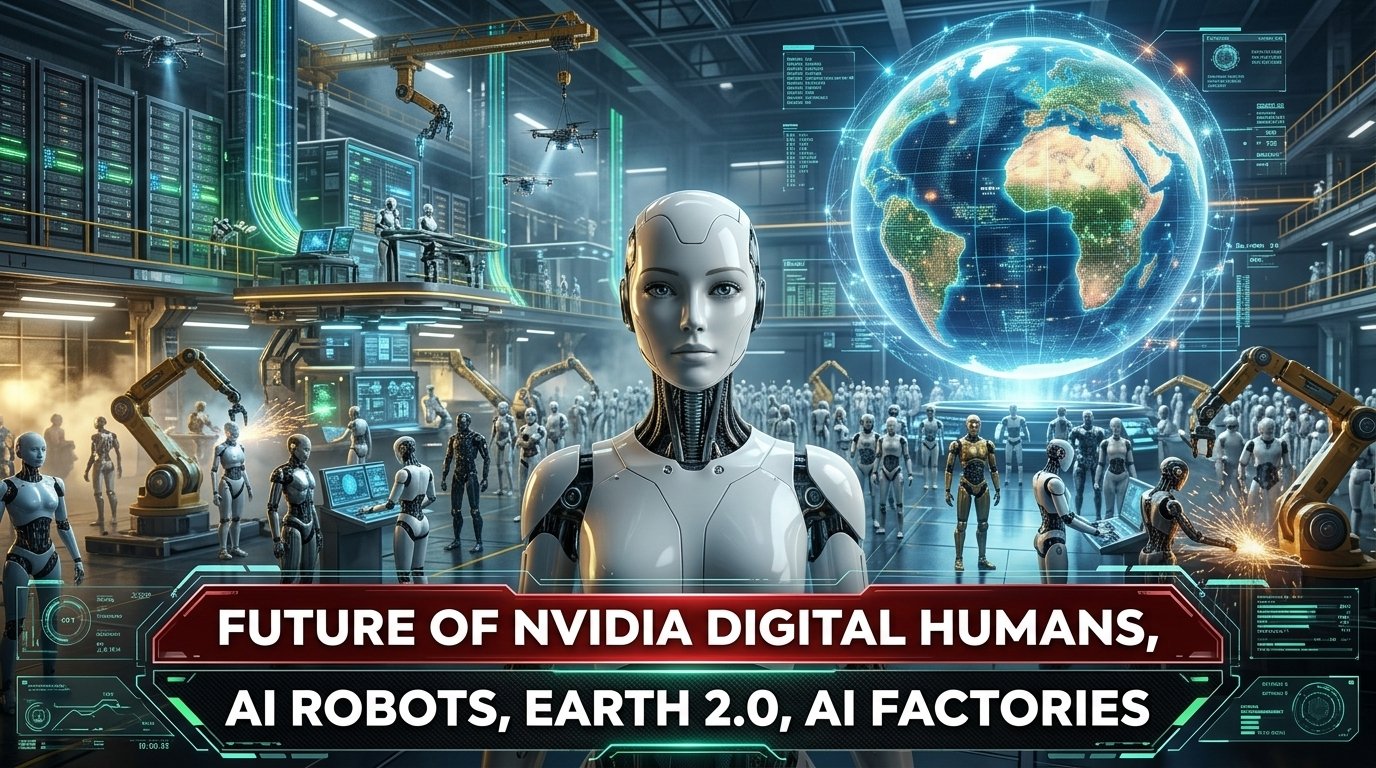
Jensen Huang and NVIDIA’s Vision: The AI Revolution, Digital Humans, and Earth 2.0
Artificial intelligence is no longer just a futuristic concept whispered about in science fiction laboratories—it is actively reshaping our world. At the forefront of this seismic shift is Jensen Huang, the visionary CEO of NVIDIA. Known for his iconic keynotes and bold pronouncements, Huang has steered NVIDIA from a 1993 startup focused on immersive video game graphics into the powerhouse driving the global AI revolution.
Today, NVIDIA’s specialized hardware and software ecosystems are fueling everything from advanced autonomous vehicles and robotic systems to life-saving medical breakthroughs. Let’s break down the major technological pillars Huang and NVIDIA are championing to define the future.
1. The GPU Revolution: From Pixels to Parallel Processing
To understand NVIDIA’s current dominance, we have to look back at its foundational bet on the graphics processing unit (GPU).
In 1993, Huang and his co-founders recognized that gpus possessed a unique advantage over traditional central processing units (CPUs): parallel processing. While CPUs tackle complex tasks sequentially, GPUs can process thousands of calculations simultaneously.
What started as a tool to render smooth video game pixels quickly became recognized as the ideal computational workhorse for heavy data lifting. When deep learning and massive data sets emerged, requiring unprecedented computing power, NVIDIA’s GPUs were already positioned to handle the load, providing the hardware foundation for the modern AI boom.
2. NVIDIA NIMs and the Rise of Digital Humans
One of Jensen Huang’s most striking recent unveilings is NVIDIA NIM (NVIDIA Inference Microservice), a platform designed to create hyper-realistic, lifelike digital humans.
Using NVIDIA’s powerful GPUs and advanced AI algorithms, NIMs generate interactive, photorealistic digital representatives capable of understanding context, reacting dynamically, and communicating naturally. This technology is fundamentally transforming human-computer interaction across multiple sectors:
-
Customer Service: Friendly, intelligent digital avatars deployed globally to assist customers and handle transactions in real-time.
-
Healthcare Support: Virtual assistants helping medical staff manage massive administrative workloads and offering preliminary patient guidance.
-
Enterprise Efficiency: Digital supervisors and operational guides optimizing complex workflows and production lines.
3. Redefining Robotics: AI Machines as Collaborators
Gone are the days when industrial robots were limited to clunky, repetitive factory tasks. NVIDIA’s computing architecture is empowering a new generation of smart, adaptable robots capable of navigating dynamic environments.
Rather than viewing automation as a threat to human labor, Huang champions a human-robot partnership. While AI-powered robots handle dangerous, heavy, or data-intensive processes, human workers are freed up to focus on higher-level problem-solving, emotional intelligence, and creative design.
-
In Manufacturing & Logistics: Autonomous mobile robots transform warehouses into self-optimizing hives, picking and packing orders with pinpoint precision.
-
In Healthcare: Specialized robotics assist surgeons in performing minimally invasive procedures with sub-millimeter accuracy, reducing patient recovery times and infection risks.
4. Earth 2.0: Simulating Our Planet for a Sustainable Future
Perhaps one of NVIDIA’s most awe-inspiring initiatives is Earth 2.0, a real-time digital twin of our entire planet. Powered by massive supercomputing infrastructure and advanced AI simulation algorithms, Earth 2.0 acts like “Google Earth on steroids.”
Real-World Impact of Planetary Simulation
-
Climate & Disaster Management: Scientists can model complex climate shifts and predict natural disasters before they strike, enabling proactive emergency responses.
-
Urban Planning: City developers can test traffic flows, building layouts, and green infrastructure solutions virtually before laying a single brick in the physical world.
-
Global Supply Chains: Logistics networks can simulate trade routes, predict bottlenecks, and dynamically route goods to maximize efficiency and minimize carbon footprints.
5. The AI Factory: The Next Industrial Revolution
Jensen Huang has also introduced a vision for the AI Factory—a complete reimagining of industrial production where physical and digital manufacturing ecosystems merge.
Just as Earth 2.0 creates a digital twin of the planet, an AI Factory creates a virtual replica of the production floor. Every machine, material flow, and process is continuously mapped and optimized via real-time data analysis.
-
Self-Optimizing Production: Factories can automatically adjust lines to match fluctuating market demand and predict equipment failures before they happen.
-
Localized On-Demand Manufacturing: Minimizing waste, cutting transportation emissions, and creating highly resilient, agile supply chains.
FAQs
1. What role do GPUs play in the AI revolution?
GPUs excel at parallel processing, meaning they can perform thousands of calculations simultaneously. This massive computational bandwidth is required to train and run the deep learning models and complex neural networks that power modern artificial intelligence.
2. What are NVIDIA NIMs?
NIMs (NVIDIA Inference Microservices) are a software platform used to create photorealistic, interactive digital humans powered by AI, revolutionizing customer service, healthcare assistance, and virtual collaboration.
3. How does the AI Factory differ from traditional manufacturing?
Traditional factories rely on rigid, pre-programmed automation or manual labor. AI Factories use a digital twin ecosystem where real-time data and AI algorithms dynamically optimize machinery, supply chains, and resource consumption autonomously.
4. What is the primary purpose of NVIDIA’s Earth 2.0 project?
Earth 2.0 is a hyper-realistic digital twin of our planet designed to model climate change, predict severe weather, optimize global supply chains, and assist urban planners in building sustainable cities through large-scale simulation.
5. Will AI-powered robotics replace human workers entirely?
No. Leaders like Jensen Huang emphasize that the future is built on partnership. AI and robotics take over repetitive, dangerous, and data-heavy tasks, empowering human workers to focus on creativity, critical thinking, and complex problem-solving.
Sources and Further References
-
NVIDIA Developer & Keynote Archives: Technical documentation regarding GPU evolution, Cuda architecture, and enterprise AI infrastructure.
-
NVIDIA Omniverse & Earth 2.0 Documentation: Frameworks surrounding digital twins, climate modeling, and industrial simulation technologies.